


In the 80s I frequently heard claims about frequency space being scarce. Mobile phone providers were growing and they wanted more spectrum. They were having to decrease the size of their cells so that they could reuse the spectrum they had. The more spectrum they had, the less reuse was needed. Other services, such as public safety and even amateur radio operators, said their bands were packed. 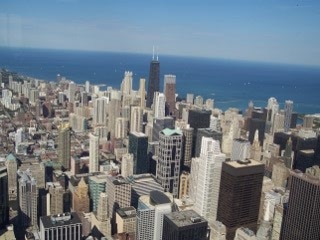
I recall repeating this claim to a friend around 1990. He said, “I keep reading that, but I don’t see it when I tune down any band above 30MHz. It’s mostly unused.” It struck me because I had observed the same thing but never thought about it as evidence against spectral scarcity. A year later when my family was on vacation, they took me to Sears tower. When we arrived at the observation deck, I tuned along the 460MHz public safety band. Every 25kHz, and in some cases 12.5kHz, I heard a station. When that station stopped transmitting, there were weaker stations behind it. I surveyed every band my handheld could receive for the rest of the time we were there, without taking notice of the exhibits and without it ever occurring to me what a nerd I was.
It etched in my mind that at a high elevation in an dense urban area, the spectrum was indeed crowded. Trunking systems, in which say 50 users whose usage duty cycle is well under 20% can share 10 frequencies, were being introduced at the time. A decade later Wi-Fi became common. The 2.4GHz band is about 80MHz wide, big enough to fit three non-overlapping 22MHz channels. Three channels sounds like way too few, but 802.11’s channel access scheme does an excellent job of sharing a channel among many uncoordinated users. Several office networks and a coffee shop can all use the same channel without users typically noticing a degradation in throughput. The collision avoidance scheme allows them to share the bandwidth fairly.

When I first observed this I thought it was a clear example of a libertarian approach providing vastly better results than a government approach. Wi-Fi equipment typically has a country setting so that the device can obey the laws of the country where it’s deployed. I used to joke there should be a “Somali country code” that would let the device do whatever it wanted. Somalia at the time had no functioning government yet had some of the best mobile phone service in Africa, partly because it didn’t have government corruption impeding deployment of wireless technology. My first post for element14 argued for that self-interested devices would have an incentive to share the channel nicely in exchange for reciprocity from other devices.
I recently watched an IEEE tutorial on dynamic spectrum markets, though, and learned the pure libertarian model is simplistic. The presentation breaks down channel access into three types: exclusive use (e.g. TV and radio stations), commons (e.g. Wi-Fi), or hierarchical (e.g. DFS Wi-Fi channels that devices must abandon if they detect another service using the channel). The common model only works well if spectrum isn’t too scarce. For short range communication at >3GHz, spectrum is not scarce, so this model works well. The model does not work as well for services that cover a larger area.
The IEEE presentation argues for the creation of some system that allows users to rent the use of a frequency range for a short time in a very limited area, such as for a few minutes within range of a single access point.
For the next few decades, I believe bandwidth for short-range use will remain plentiful. The 5-6GHz (a) band of Wi-Fi is still underutilized is most places. Higher frequency bands can be made available if it becomes crowded. Techniques like MIMO and CDMA can increase the amount of data sharing the channel.
In rural regions, there will be plenty of bandwidth even for services covering a broad area. Urban regions, will follow the pattern of renting commercial or residential space in a dense urban area with prices shockingly high to people from less densely-populated. As with many issues, rural people will want a more laissez-faire approach and urbanites will want a strong Leviathan to maintain a framework for people to live together in close proximity in peace.
When making spectrum use policy, we should avoid a one-size-fits-all approach for entire countries. We need a way to allow a device to hog all the spectrum in a rural field but negotiate a rental price when the same device is located in a place like the Sears Tower.

