


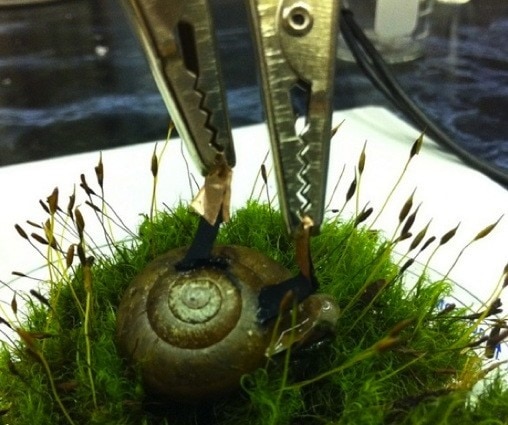
Clips connected to the implanted eletrodes, measuring the generation within the snail.
(Via L. Halámková, J. Halámek, V. Bocharova, A. Szczupak, L. Alfonta, E. Katz, Implanted biofuel cell operating in living snail. J. Am. Chem. Soc. 2012, in press (DOI: 10.1021/ja211714w) | Copyright 2012 American Chemical Society)
A research team from Clarkson University in Postdam N.Y., led by chemistry professor Evgeny Katz, has developed the very first fuel cell comprised of a live snail. This “battery” makes much less electricity than a AAA battery, but Katz and his collaborators from the Ben-Gurion University are working to increase the power produced.
Biocatalytic electrodes made of Buckypaper, or thin sheets of carbon nano-tubes, were implanted in the snail. These electrodes combined with certain enzymes consume glucose and also use the oxygen circulating in the snail’s hemolymph (blood) to produce the current. After proper feeding and relaxing, the snail was able to regenerate the glucose needed for this biochemical electrical reaction by the biocatalytic electrodes. The snail was fitted with its own portable cell, which allowed it to move about freely while producing electricity. (Brings a new meaning to the saying “by perseverance the snail reached the ark [arc- Charles Spurgeon]”.)
The question then becomes, how can the minute amounts of electricity be used? The masters of exploit at the U.S. Military and the Homeland Security Department have already thought of uses. They propose using these snail batteries as sensors for gases etc. and wireless transmitters for minute microphones, video cameras and other espionage gear.
Katz elaborated, "In this [direction] the biofuel cells are expected to operate in small creatures (snails, worms, insects, etc) providing sustainable electrical power for various sensors and wireless transmitters... In the future setup, the implanted bioelectrodes will be connected to a microelectronic device (sensing and wireless transmitting) fixed at the snail body, and the snail will be released to move as much as it wants."
Take a look at some other insects used for surveillance and generating alternative energy.
Cabe
