



NREL facility (Via NREL)
Slowly, but surely, leaps and developments are being made that are making renewable energies competitive with fossil fuels. On December 16, 2011 an article was published in Science magazine by researchers at the National Renewable Energy Lab (NREL) that describes a new application of quantum mechanics in a solar cell, which improves the external quantum-mechanical efficiency of the solar cell to 114%.
The NREL solar cell takes advantage of a quantum-mechanical effect called multiple excitation generation (MEG) by means of quantum dots (QD’s). The crystalline tiny semiconductor QDs, 1-20 nm, will exhibit many extreme effects of quantum physics; large band gap as size decreases, electron-hole excitation, "enhanced coupling" of electrons and positive holes.
The MEG effect is observed when a photon, from the high-energy spectrum of the sun, is absorbed by a semiconductor material inside the photocell. The result of the energy absorbed from one of these high-energy photons is the excitation of multiple electrons in the semiconductor atoms. As the electrons are excited by this photon, they move from the valence shell of the atom to the conductive shell where they are free to flow leaving behind electron-hole pairs in the atoms they used to occupy. The electron-hole pairs can be envisioned as voids that are theoretically left in the atom when the electron leaves the atom’s electron cloud. These electron-hole pairs, also called excitons, attract other excited electrons and this repetitive process can be used to create a current.
This solar cell has reached an external quantum efficiency of over 100%, which means that there are more electrons flowing in a circuit outside the solar cell than are photons of a specific solar spectrum flowing into the cell. Up to 130% efficiency was achieved by factoring in the reflection of photons and absorption of photons by the material.
This effect is significantly enhanced when it occurs in a quantum dot. Quantum dots are minute pieces of semiconductor that range from 1 to 20 nanometers. Due of their size they exhibit peculiar quantum mechanical properties that improve the efficiency of the MEG solar cell. One advantage is that the smaller they are, the higher the energy they release when an electron is excited from the valence band to the conducting band (higher bandgap) but in turn, this excitation must be done by higher energy photons. QD’s also allow for the formation of electron-hole pairs (excitations) at room temperature bringing a stronger attraction between electrons and electron holes.
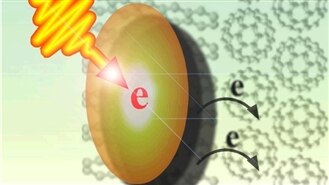
Giving off 2 electrons for every photon. (Via Science/AAAs)
By keeping these electrons within their minute volumes, quantum dots are able to capture higher energy photons that would normally be turned to heat and lost. The application of the multiple excitation generation, enhanced by the use of quantum dots, has allowed scientists to reach the point where there are more electrons flowing out of the solar cell then there are photons (of the adequate energy level) exciting them out of a quantum dot. Remember, this means that the whole solar spectrum is not used, just the photons that have enough energy but another advantage to the use of QD’s is their cheap cost and relatively easy manufacturing process.
Initially, electrons had a difficult time jumping from one quantum dot to the next to create a current. NREL scientists found the solution to this in a chemical coating of hydrazine and ethanedithiol that connects the dots with short organic chains and improves their conductivity. These quantum dots cover a layer of nano-structured zinc oxide, a transparent conductor proven to make MEG effective. They covered the top electrode of the solar cell in gold and covered the entire panel with anti-reflection glass. Due to this type of solar cell, which only uses the high-energy end of the solar spectrum, the over all efficiency of converting light to electricity was only 5%. However, Bruce Parkinson, a chemist from the University of Wyoming, Laramie, who confirmed the concept of an MEG solar cell, expressed this achievement “shows promise for the next generation [solar cell] designs.”
These third generation solar cells currently require 2.5 to 3 times the energy needed to excite electrons out if their valence shell to the conducting shell. Parkinson and NREL scientists agree that if they can lower this energy needed by creating more efficient quantum dots, they will see vast improvements in the efficiency of the MEG solar cell. Taking into account their cheap cost, MEG solar cells will make solar energy competitive with fossil fuels. NREL scientists had predicted that using MEG could increase the total thermodynamic energy conversion efficiency to around 55% compared to today’s standard solar cell efficiency of about 20%. While this peak has not yet been reached, their quantum dot solar cell confirmed previous MEG experimental results and promises a lot of room for improvement.
Eavesdropper