


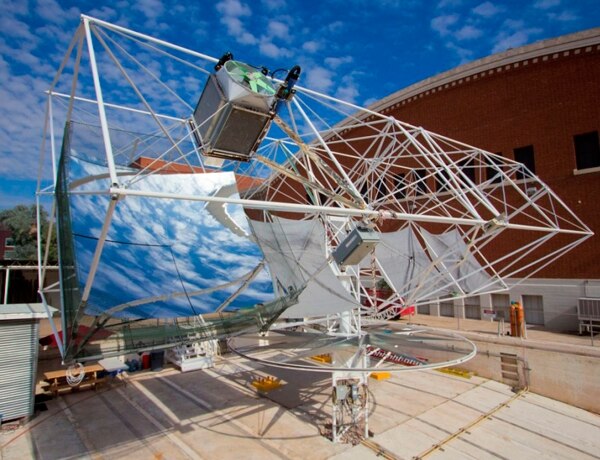
Roger Angel's solar collector (via University of Arizona)
The field of solar power in-home to countless ideas, methods, and devices for capturing the Earth's sliver of the Sun's energy. Another possible solution is brought to the world by the company REhnu out of Arizona, USA. Founded by terrestrial telescope mirror designer Roger Angel, the effort brings solar panel and mirror combinations that are poised to produce an affordable $1 dollar per watt by 2020.
Angel’s field of expertise is not in designing photovoltaic cells; actually, he has designed some of the biggest mirrors used in giant telescopes. His first was a 6.5-meter in diameter honeycomb mirror structure. A 8.2-meter version of that mirror is still being used in a telescope in Chile.
To collect solar power cost-effectively, large areas of land need to be set aside and covered with cheaper single layered solar-cells. These cells only collect a finite set of light-energy spectrum. Alternatively, costly multi-layer solar cells can be used to gather a larger band of the energy. Either way, the cost per watt exceeds viability versus traditional energy production.
With use if REhnu gigantic mirrors, the solar concentration system can focus intense beams of sunlight up to 1,200 times. This intense beam, which contains a wide energy range of photons, is focused onto the more expensive multi-layered ultra-high-efficiency photovoltaic cells. The multi-layered cells have hit efficiencies of 40% compared to the 15-20% efficiency produced by the single layered cells.
REhnu is able to bring down prices by using cheap float glass, used to make windows, to manufacture their mirrors. They have already completed a prototype comprised of a 3.1-meter wide mirror that focuses a ray of sunlight into a spherical receiver, which then spreads it into an array of 8 ultra-high-efficiency three-layer cells.
Now, REhnu is designing a 20kW lightweight prototype in a 5-acre area called The Solar Zone in the desert of Arizona. The company hopes to place 42 systems in the space to output 840 kW. REhnu estimates it will take 15 square kilometers to achieve their goal of $1/watt and to produce one gigawatt of electricity.
Eavesdropper
