


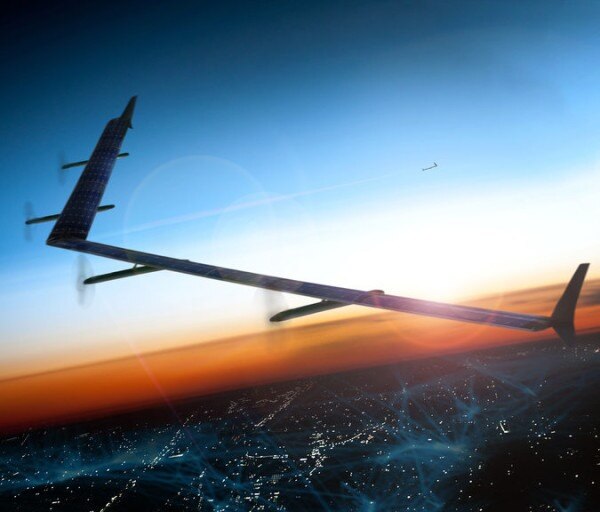
Facebook plans to go aloft to beam Internet access down from a fleet of solar-powered drones. Aquila is the code name for the social media giant’s V-shaped unmanned vehicles, one of which which recently completed its first test flight in the U.K., a fact announced last week by Facebook CEO Mark Zuckerberg on—where else—his Facebook page. Last year Facebook acquired the UK- based drone maker Ascenta, which created early versions of the Qinetiq Zephyr, the world’s longest flying solar-powered unmanned aircraft. In 2010, the Zephyr 7 set a world endurance record of 336 hr., 22 min., reaching an altitude of 70,740 ft.
The Ascenta team, working with Facebook's Connectivity Lab now has come up with a design for a solar-powered craft that can soar at 60,000 feet for up to three months at a time, and use a laser to beam high-speed data to the remotest regions of the world. The fleet of Aquila drones is part of an Internet.org project that aims to bring Internet access to the 5 billion people that don't have it yet. Internet.org is a Facebook-led initiative in partnership with leading technology companies such as Samsung, Qualcomm, and Microsoft, whose goal is to make affordable basic internet services available to everyone in the world.
"Aircraft like these will help connect the whole world because they can affordably serve the 10% of the world's population that live in remote communities without existing Internet infrastructure," said Facebook’s Zuckerberg.
At Facebook’s developer conference in San Francisco last month Chief Technology Officer Mike Schroepfer said the final design of the solar-powered UAV “will have a wingspan greater than a 737 (about 120 ft.) but will weigh less than a small car”.
Aquila is Latin for “eagle” and, like the constellation of the same name, represents the bird who carried Zeus/Jupiter's thunderbolts in Greco-Roman mythology. Google has a similar project to Aquila in the works; its Project Loon will employ flying balloons to beam down WiFi to areas without Internet service.