


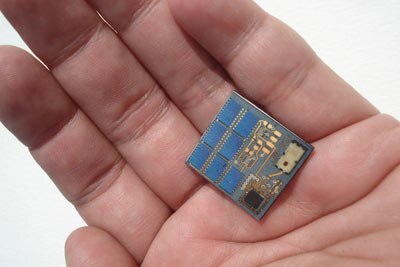
When Space Shuttle Endeavour launches for its final mission, a experimental type of satellite will be parts of its cargo. Three prototype 1-inch square satellites, each dubbed "Sprite," will be part of the Materials International Space Station Experiment (MISSE-8). Attached to the space station, they will sit in space for an undetermined number of years, to see how they stand up to the harsh environment. These micro-satellites were designed over the course of 3 years at Cornell University. Exact dates were not specified by the team. However, the prototypes were built by three students, Ryan Zhou, Zac Manchester, and Justin Atchison, when they were undergraduates. The latter two are now working on their doctorates. These "chip satellites" may have been made over 4 years ago.
Project leader, Mason Peck, talks about their potential, "[The] small size allows them to travel like space dust," said Peck. "Blown by solar winds (protons & electrons traveling at 600km/s, 370miles/s), they can 'sail' to distant locations without fuel. ... We're actually trying to create a new capability and build it from the ground up. ... We want to learn what's the bare minimum we can design for communication from space."
Peck's Sprites will be the first chip satellites launched into space. The goal now is to see how the communication system will work out, power, and overall tolerance to conditions. Then, Peck wants to launch a large number of Sprites and "sort out which is which."
Eavesdropper

