element14 Community
element14 Community
    Register Log In
  • Site
  • Search
  • Log In Register
  • Community Hub
    Community Hub
    • What's New on element14
    • Feedback and Support
    • Benefits of Membership
    • Personal Blogs
    • Members Area
    • Achievement Levels
  • Learn
    Learn
    • Ask an Expert
    • eBooks
    • element14 presents
    • Learning Center
    • Tech Spotlight
    • STEM Academy
    • Webinars, Training and Events
    • Learning Groups
  • Technologies
    Technologies
    • 3D Printing
    • FPGA
    • Industrial Automation
    • Internet of Things
    • Power & Energy
    • Sensors
    • Technology Groups
  • Challenges & Projects
    Challenges & Projects
    • Design Challenges
    • element14 presents Projects
    • Project14
    • Arduino Projects
    • Raspberry Pi Projects
    • Project Groups
  • Products
    Products
    • Arduino
    • Avnet & Tria Boards Community
    • Dev Tools
    • Manufacturers
    • Multicomp Pro
    • Product Groups
    • Raspberry Pi
    • RoadTests & Reviews
  • About Us
    About the element14 Community
  • Store
    Store
    • Visit Your Store
    • Choose another store...
      • Europe
      •  Austria (German)
      •  Belgium (Dutch, French)
      •  Bulgaria (Bulgarian)
      •  Czech Republic (Czech)
      •  Denmark (Danish)
      •  Estonia (Estonian)
      •  Finland (Finnish)
      •  France (French)
      •  Germany (German)
      •  Hungary (Hungarian)
      •  Ireland
      •  Israel
      •  Italy (Italian)
      •  Latvia (Latvian)
      •  
      •  Lithuania (Lithuanian)
      •  Netherlands (Dutch)
      •  Norway (Norwegian)
      •  Poland (Polish)
      •  Portugal (Portuguese)
      •  Romania (Romanian)
      •  Russia (Russian)
      •  Slovakia (Slovak)
      •  Slovenia (Slovenian)
      •  Spain (Spanish)
      •  Sweden (Swedish)
      •  Switzerland(German, French)
      •  Turkey (Turkish)
      •  United Kingdom
      • Asia Pacific
      •  Australia
      •  China
      •  Hong Kong
      •  India
      •  Japan
      •  Korea (Korean)
      •  Malaysia
      •  New Zealand
      •  Philippines
      •  Singapore
      •  Taiwan
      •  Thailand (Thai)
      •  Vietnam
      • Americas
      •  Brazil (Portuguese)
      •  Canada
      •  Mexico (Spanish)
      •  United States
      Can't find the country/region you're looking for? Visit our export site or find a local distributor.
  • Translate
  • Profile
  • Settings
Publications
  • Learn
  • More
Publications
Blog Stanford scientists develop polymer skin that self-heals and is sensitive to touch
  • Blog
  • Documents
  • Events
  • Files
  • Members
  • Mentions
  • Sub-Groups
  • Tags
  • More
  • Cancel
  • New
Join Publications to participate - click to join for free!
  • Share
  • More
  • Cancel
Group Actions
  • Group RSS
  • More
  • Cancel
Engagement
  • Author Author: Catwell
  • Date Created: 16 Nov 2012 7:22 AM Date Created
  • Views 411 views
  • Likes 0 likes
  • Comments 0 comments
  • research
  • hmi
  • material
  • Design
  • plastic
  • cabeatwell
  • prototyping
  • material_science
  • innovation
Related
Recommended

Stanford scientists develop polymer skin that self-heals and is sensitive to touch

Catwell
Catwell
16 Nov 2012

image

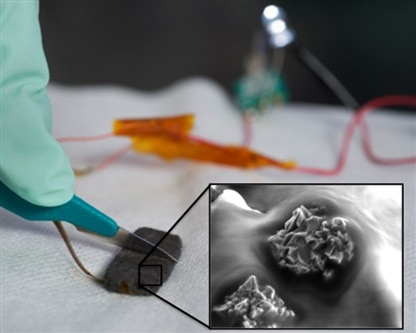
Self repairs its mechanical and electrical properties in 15 seconds (via Benjamin Tee and Chao Wang)


Human skin is a remarkable organ. It protects our internal organs from debris, pathogens and other hazards while being sensitive enough to detect heat and pressure. It’s also extremely sufficient at repairing itself after receiving damage. Those are some of the relative qualities that Stanford scientists incorporated into their newly developed polymer facsimile. The scientists, led by Professor Zhenan Bao, were successful in creating a synthetic polymer material that closely approximates that of its human-celled counterpart which can sense subtle pressure and repair itself when damaged. The team detailed their development in a recent paper entitled ‘An electrically and mechanically self-healing composite with pressure and flexion sensitive properties for electronic skin applications,’ which describes the process. The team combined two elements to achieve their goal with one being a polymer (plastic) that contains ‘long-chains’ of molecules that are held together by hydrogen bonds and the other consisting of the metal nickel that provides electric conductivity and mechanical strength. The hydrogen bonds are what allows the plastic to ‘self-heal’ as the weak attractions between the positive and negatively charged atoms, while are easy to break apart, are able to ‘recognize’ one another and reconnect/restore the original bond after being damaged. The scientists then added miniscule particles of nickel to not only increase the materials strength but also electrically conductive due to the rough nano-scale surface of the material (this turns the plastic from an electrical insulator to a conductor).


To test the materials resiliency, conductivity and sensitivity the team took a strip of material and cut it widthwise and then gently pressed it together for a few seconds and found it to retain 75% of its electrical conductivity which increased to almost 100% after resting for 30 minutes (in room temperature). They also found they could achieve the same percentage of conductivity after cutting, bending and stretching the same sample 50 times over. The scientists then concluded that the material could be used as a sensor that could measure pressure sensitivity and tension by measuring the changes in electrical current through manipulating (bending and stretching) the polymer which is calculated through the nickel particles relation/distance from each other. According to the scientists the hybrid polymer/nickel materials is sensitive enough to detect the pressure of a handshake. The team is also looking for ways to adapt the material to prosthetics that would possibly enable an amputee to regain some amount of feeling in the future. Of course, there are other possibilities the material could be applied to such as self-repairing electrical wiring that can regain its electrical current after being damaged or even regenerative mobile devices that have been damaged (screen repair or water damage?). The possibilities are endless.


Cabe

http://twitter.com/Cabe_e14

  • Sign in to reply
element14 Community

element14 is the first online community specifically for engineers. Connect with your peers and get expert answers to your questions.

  • Members
  • Learn
  • Technologies
  • Challenges & Projects
  • Products
  • Store
  • About Us
  • Feedback & Support
  • FAQs
  • Terms of Use
  • Privacy Policy
  • Legal and Copyright Notices
  • Sitemap
  • Cookies

An Avnet Company © 2026 Premier Farnell Limited. All Rights Reserved.

Premier Farnell Ltd, registered in England and Wales (no 00876412), registered office: Farnell House, Forge Lane, Leeds LS12 2NE.

ICP 备案号 10220084.

Follow element14

  • X
  • Facebook
  • linkedin
  • YouTube