


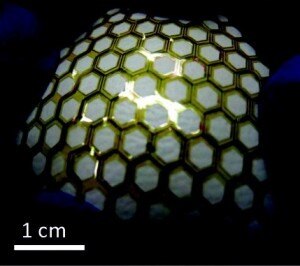
A baseball covered in the DOE Berkely stretchable thin film transistor array material (via DOE Berkely)
Many researchers are part of a race to creating stretchable/bendable electronics. Seamlessly integrated wearable electronics is now an inevitability. The U.S. Department of Energy (DOE) is no slouch in this area either with their latest development, large-area carbon-nanotube thin film transistor networks.
The material was developed at the Lawrence Berkely National Laboratory. The high charge mobility outstrips the capabilities of its organic counterparts. The team's first application was to take transistor network, they dubbed "e-skin," and use it as a touch interface.
A major issue the team tackled in this project was the carbon nanotube's low band-gap ratio (the on/off ratio, as the team called it). To defeat the low on/off ratio of the material the team had to make the purest solution of single-wall carbon nanotubes (SWNT) as possible. They make a solution that was 99% semiconductor SWNT. Applying this solution to a polymide substrate created the base material. To make it flexible, a hexagonal (honeycomb) shape was laser-cut into the sheets at a pitch of 3.3mm and a hole-side lenth between 1 - 1.85mm.
The paper's co-author Toshitake Takahashi explained the purpose on the holes, "The degree to which the substrate could be stretched increased from 0 to 60-percent as the side length of the hexagonal holes increased to 1.85 mm... In the future, the degrees of stretchability and directionality should be tunable by either changing the hole size or optimizing the mesh design.”
The final prototype was a 24 square centimeter "sensor pixel" array. The image below shows the pressure indication map of an "L" shaped object on top of the material. Max pressure of 15 kilo Pascals was sensed.

(via DOE Berkely)
Takahashi stated that using this array could make for a good touch input backplane for flexible displays in the near future. A common mantra spoken by many in the industry.
Cabe
More projects in the flextronics industry:
Transparent graphene transistor material stretches beyond all others
Molybdenite to replace silicon, and the 3-atom thick transistor
Cotton transistor and wearable electronics
Flexible memory breaks through flex limitations
Coiled nanowires could help with stretchable electronics
Stretchable silicon to make ‘smarter’ sports apparel
Molybdenite to replace silicon, and the 3-atom thick transistor
Cotton transistor and wearable electronics
Flexible memory breaks through flex limitations
Coiled nanowires could help with stretchable electronics
Stretchable silicon to make ‘smarter’ sports apparel