element14 Community
element14 Community
    Register Log In
  • Site
  • Search
  • Log In Register
  • Community Hub
    Community Hub
    • What's New on element14
    • Feedback and Support
    • Benefits of Membership
    • Personal Blogs
    • Members Area
    • Achievement Levels
  • Learn
    Learn
    • Ask an Expert
    • eBooks
    • element14 presents
    • Learning Center
    • Tech Spotlight
    • STEM Academy
    • Webinars, Training and Events
    • Learning Groups
  • Technologies
    Technologies
    • 3D Printing
    • FPGA
    • Industrial Automation
    • Internet of Things
    • Power & Energy
    • Sensors
    • Technology Groups
  • Challenges & Projects
    Challenges & Projects
    • Design Challenges
    • element14 presents Projects
    • Project14
    • Arduino Projects
    • Raspberry Pi Projects
    • Project Groups
  • Products
    Products
    • Arduino
    • Avnet & Tria Boards Community
    • Dev Tools
    • Manufacturers
    • Multicomp Pro
    • Product Groups
    • Raspberry Pi
    • RoadTests & Reviews
  • About Us
  • Store
    Store
    • Visit Your Store
    • Choose another store...
      • Europe
      •  Austria (German)
      •  Belgium (Dutch, French)
      •  Bulgaria (Bulgarian)
      •  Czech Republic (Czech)
      •  Denmark (Danish)
      •  Estonia (Estonian)
      •  Finland (Finnish)
      •  France (French)
      •  Germany (German)
      •  Hungary (Hungarian)
      •  Ireland
      •  Israel
      •  Italy (Italian)
      •  Latvia (Latvian)
      •  
      •  Lithuania (Lithuanian)
      •  Netherlands (Dutch)
      •  Norway (Norwegian)
      •  Poland (Polish)
      •  Portugal (Portuguese)
      •  Romania (Romanian)
      •  Russia (Russian)
      •  Slovakia (Slovak)
      •  Slovenia (Slovenian)
      •  Spain (Spanish)
      •  Sweden (Swedish)
      •  Switzerland(German, French)
      •  Turkey (Turkish)
      •  United Kingdom
      • Asia Pacific
      •  Australia
      •  China
      •  Hong Kong
      •  India
      •  Korea (Korean)
      •  Malaysia
      •  New Zealand
      •  Philippines
      •  Singapore
      •  Taiwan
      •  Thailand (Thai)
      • Americas
      •  Brazil (Portuguese)
      •  Canada
      •  Mexico (Spanish)
      •  United States
      Can't find the country/region you're looking for? Visit our export site or find a local distributor.
  • Translate
  • Profile
  • Settings
Publications
  • Learn
  • More
Publications
Blog Superconducting Chip Brings Us One Step Closer to Quantum Computing
  • Blog
  • Documents
  • Events
  • Files
  • Members
  • Mentions
  • Sub-Groups
  • Tags
  • More
  • Cancel
  • New
Join Publications to participate - click to join for free!
  • Share
  • More
  • Cancel
Group Actions
  • Group RSS
  • More
  • Cancel
Engagement
  • Author Author: Catwell
  • Date Created: 8 Mar 2013 7:16 PM Date Created
  • Views 464 views
  • Likes 1 like
  • Comments 0 comments
  • quantum
  • research
  • test
  • industry
  • hmi
  • quantum_computing
  • on_campus
  • light_computing
  • cabeatwell
  • prototyping
  • university
  • communication
Related
Recommended

Superconducting Chip Brings Us One Step Closer to Quantum Computing

Catwell
Catwell
8 Mar 2013

image

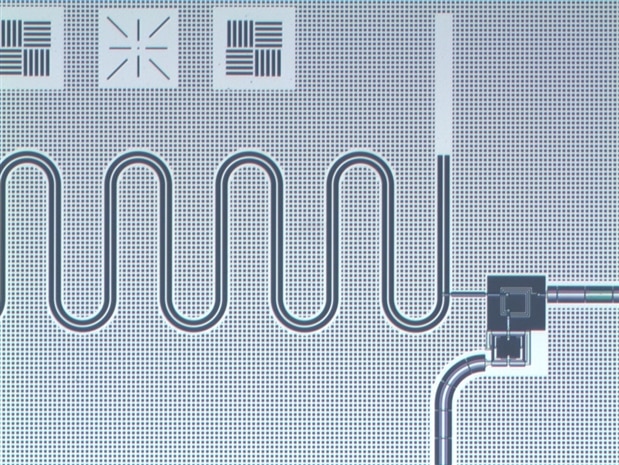
Cureved lines indicate the superconducting cavity. Bottom-right is the switch. (via UCSB & Physical Review Letters)


As we continue to pave our way to a computer-optimized world, the quest for more processing speed and computing capacity is bundled right alongside the ultimate goal. Current computing components are beginning to reach the beginning stages of their physical limits, though Moore’s Law suggests that in a few years our computers will be operating on processors sized at the atomic level. Quantum computing coincides with this theory - a form of computing that will harness atoms and molecules to perform processing operations at speeds that trump silicon-based computation. Most work on quantum computing is still on the theoretical level, signaling that the technology is still years away. However, recent work by researchers at the University of California Santa Barbara that involves the manipulation of photons on a superconducting chip brings quantum-computing one-step closer to reality.


Quantum computers work by exploiting quantum mechanics through the adoption of qubits to transfer information over the traditional bit system. The quantum theory of superposition explains that a system existing in a single state can be considered to partly exist in two or more other states all at once. When the system is observed, a single “weighted-average” of the states is seen. What this means for computation is that qubits can store information in a 1 or a 0 state while existing in every other possible state at the same time. Thus, rather than reading and performing one process at a time, a quantum computer would be able to perform many calculations all at once.


One way of transferring quantum information through qubits would be performed through manipulation of photons. Physicists Yu Chen, Yi Yin, and Jim Wenner developed a superconducting chip that incorporates a superconducting cavity and switch that controls that movement of a photon. Yin first used classical electronics to drive photons into the -273.12 degree Celsius resonator area of the superconducting cavity. The switch was then used to quickly open and close a shutter that allowed the photons to move down the cavity toward an area where the photons can transmit. The flexibility of the shutter allowed the researchers to have complete control over the released waveforms of the photons. This finding is significant, as it would allow perfect transmission of information via qubit along a superconducting cavity.


The next step in the research is to work on transferring photons between distant cavities. Wenner hopes the work will provide safe and accurate transmission of quantum information over long distance - for example, remote quantum communication between satellites and devices on Earth.


Cabe

http://twitter.com/Cabe_e14

  • Sign in to reply
element14 Community

element14 is the first online community specifically for engineers. Connect with your peers and get expert answers to your questions.

  • Members
  • Learn
  • Technologies
  • Challenges & Projects
  • Products
  • Store
  • About Us
  • Feedback & Support
  • FAQs
  • Terms of Use
  • Privacy Policy
  • Legal and Copyright Notices
  • Sitemap
  • Cookies

An Avnet Company © 2025 Premier Farnell Limited. All Rights Reserved.

Premier Farnell Ltd, registered in England and Wales (no 00876412), registered office: Farnell House, Forge Lane, Leeds LS12 2NE.

ICP 备案号 10220084.

Follow element14

  • X
  • Facebook
  • linkedin
  • YouTube