


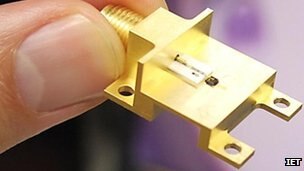
T-ray antenna (via Tokyo Institute of Technology)
It may seem sometimes that we have exploited the vast reaches of the electromagnetic spectrum, but technologies like WiGig, are showing this notion is not correct at all. T-rays, or electromagnetic waves found in the terahertz band, have traditionally been used for imaging research like X-rays, but now researchers from the Tokyo Institute of Technology are developing a system to apply this technology to ultra fast data transmission.
The terahertz band actually makes use of the 300 GHz to 3 THz frequencies a range currently unregulated by telecommunication authorities. Using a frequency of 542 GHz the team achieved data transfers of 3 Gb/s using a device called a resonant tunneling diode (RTD). These results are higher than anything achieved so far in the terahertz band.
This device is revolutionary in the terahertz data transmission because of its small size of only 1 mm-squared and low power necessities. RTDs are unusual in that the voltage across them can be decreased as the current increases. The RTDs generate waves in the terahertz band by making the diode inside them resonate.
Due to the energy usage, the Tokyo researchers hope to some day implement them in hand held devices for short-range data transfers. It is likely that terahertz Internet would work only in short distances of up to 10 m (33 ft), and this short range is something the researchers are trying to improve by making their devices resonate at higher frequencies, but this will also require more power.
It will take a long time before these devices are put in any device consumers can hold, but the future hopes for speeds of up to 100Gb/s, which blows current transfer rates out of the water at 15 greater than 802.11ac Wi-Fi.
Eavesdropper
