


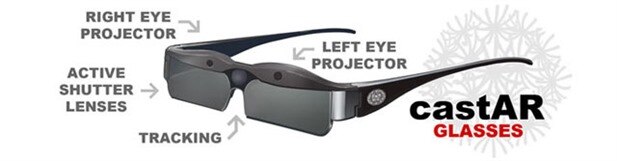
Artist concept of the finished castAR glasses (via castAR kickstarter page)
Augmented and virtual reality headwear has risen in popularity ever since Google Glass and the Oculus Rift hit the market. Those glasses and head-mounted displays either overlay interactive applications on the direct or indirect environment being viewed or create a computer-generated environment putting its user in that simulated world. Those two perspectives are usually separate from each other and integrated into a single design rather than both being on the same device. This is usually do to the fact there is too much hardware involved to be packed into a small space, however one company has seemingly managed to incorporate both AR and VR applications into a simple pair of glasses. Just 20 hours after posting their proposition on Kickstarter, Technical Illusions reached their funding goal of $400,000 for their castAR AR & VR system.
Ex Valve employees, Jeri Ellsworth and Rick Johnson, designed the glasses (first developed for Valve’s castAR project) so that users are able to see 3D holographic projections situated right in front of them. This is done using two micro-projectors housed on both sides of the glasses frames, with each projecting a portion of the image on a flat surface. The users eyes are able to focus naturally on the integrated images thereby eliminating the dizziness and nausea experienced using other headsets while gaming (Oculus is notorious for this). The system uses active shutter glasses that have a 120Hz refresh rate, which is necessary to view 3D video and images (higher would be better however). The glasses work by projecting the images (@ 720p resolution) onto their specialized retro-reflective RFID tracking surface that uses IR markers, which are then projected back to the systems glasses with the images/video piped to the lenses through an HDMI connection. A camera (connected via USB) housed in the center of the glasses frames scans the surface for IR LEDs (built into the surface mat) that tracks the users head, which specialized software then adjusts the image depending on the viewed angle. A simple clip-on attachment allows users to convert the glasses from projected AR into true augmented reality (used without the mat) or full virtual reality similar to the Oculus Rift.
Another interesting add-on for the castAR system includes the use of their ‘Magic Wand’ controller, which has an IR marker situated on its tip that allows users to use the device as either a gaming joystick of sorts or a 3D input device. It is also outfitted with several buttons, an analog joystick as well as a trigger that allows for additional options with multiple applications. Gaming with the castAR system isn’t limited to just video games, as the RFID mat can be used for board games as well. Users can affix RFID bases to game tokens or miniatures, like those from Dungeons and Dragons or MechWarrior, which can show vital or crucial information about the player on the virtual board. The board can also be created and configured using the company’s castAR software suite, which allows for online gaming as well, so friends can play against one another over an internet connection. Those looking to get their hands on one of the castAR systems can do so through a pledge of $189 and up, which nets you a pair of castAR glasses and a 1-meter X one-meter surface pad. $285 gets users the whole package including glasses, mat, AR & VR clip-on and Magic Wand.
C
See more news at:


