


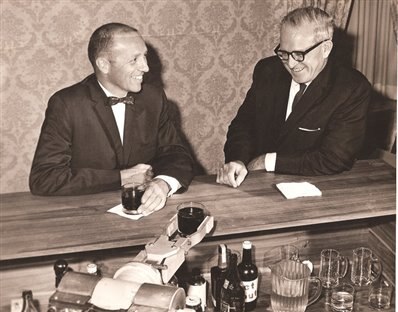
George C. Devol (right) and Joseph F. Engelberger (left) served by a Unimate robotic arm (lower center) (via the estate of George C. Devol)
George C. Devol (pron. de-VAHL), the creator of the groundbreaking original industrial robot, the Unimate mechanical arm, died on August 11th, 2011 at the age of 99.
In the 1950's Devol came up with the concept of a mechanical arm that could perform repeatable task with precision. He applied for a patent for the design in 1954. During a cocktail party where science fiction was discussed, Devol explained his idea to Joseph F. Engelberger. After the talk, Engelberger was sold on the idea. Together, the pair founded Unimation Inc. Short for Devol's naming of the concept Universial Automation.
Their goal was to replace factory workers with robotic machinery, but it soon turned into a device used in places that are hazardous to human life. Upon receiving the patent in 1961, a early version of the robot, named "Unimate" was delivered to General Motors in Trenton. The arm was used to lift and stack die-cast metal parts from hot molds and perform spot welding. A few years later, Ford , Chrysler, and Fiat also used Unimate robots for welding, spray-painting, applying adhesives, and other places where poisonous exhaust and loss of limb was possible.
The Unimate is controlled a large vacuum tube laden control-box with Drum memory data storage. The early form of computer memory used paper tape or punched cards to set the drum's data. (Drums were so commonly used for the main working memory that these computers were often referred to as drum machines.)
After $5 million dollars to produce the first Unimate, the final production version could be had for $20,000 at that time. In a demonstration of the Unimate on the Tonight show, Engelberger said renting a Unimate was an option. Only $2.50 an hour.
George C. Devol lived a long life and made an enormous impact on the world. If only we all could do the same.
Good work Mr. Devol
- Cabe Atwell
Unimate fun fact: Unimate name was coined to define the product or type of machine. Much like Kodak was to film at the time, or how Xerox refers to copying a page or Kleenex to tissue
Where are we in robotics today? Go to the element14 robotics section and find out.