


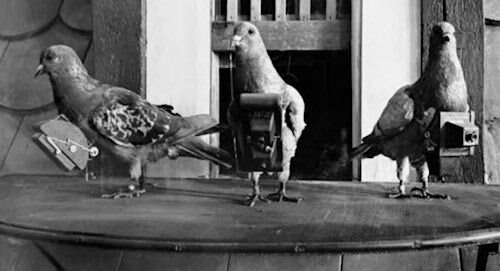
Pigeons fitted with Neubronner's various camera system (via archive photography)
The world is infatuated with flying robots with cameras. Take the latest toy helicopters, camera connectivity is an essential selling point. Companies announce their technological breakthrough, but they are unaware that the technology is already 104 years old (as of 2012). Pigeons outfitted with cameras took the world by storm in 1908, the product of one person, Julius Neubronner.
Julius Neubronner was a German apothecary in the at the start of the 1900s. His family consisted of a long line of early medical professionals, dealing with all things medicine, from chemical creations to surgery. Neubronner took over his father's practice in 1886. During the early days of the new pharmacy (1902), Neubronner expanded the capabilities by taking up using "pigeon post" for the delivery and receiving of urgent chemicals. A pigeon's maximum carrying weight was 75 grams (~2.6 oz).
Julius Neubronner was a German apothecary in the at the start of the 1900s. His family consisted of a long line of early medical professionals, dealing with all things medicine, from chemical creations to surgery. Neubronner took over his father's practice in 1886. During the early days of the new pharmacy (1902), Neubronner expanded the capabilities by taking up using "pigeon post" for the delivery and receiving of urgent chemicals. A pigeon's maximum carrying weight was 75 grams (~2.6 oz).
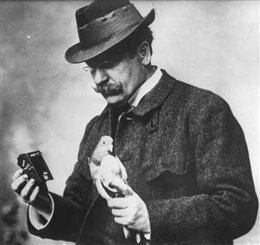
Julius Neubronner 1914 (via archive photography)
Pigeon post was used in high volume during the 19th and early 20th century for private and military correspondence. During the Franco-Prussian War of 1870, over 50,000 microfilm telegrams were sent via pigeon post to Paris, during the "pigeon post of Paris." During that era, pigeons were a tried and true vehicle; an autonomous flying device, capable of long-distance travel, hazard avoidance, and reusability. (not to mention easily reproducible.)
In 1903, some of Julius Neubronner's pigeons were lost in heavy fog, Eventually they found their way home; they were as healthy, and fat, as ever. This inspired Neubronner to attach a camera to the pigeons and record where it has been, tracing its path to destinations. At the time, Neubronner was an amateur photography and film maker, so it was by no long-shot that he would attempt the feat. (Side note: The lost pigeons were in the custody of a restaurant chef in Wiesbaden, hence their healthy condition upon return.)
After experimenting with a Ticka watch camera, a small film camera at the time, Neubronner set out to create a light-weight system for pigeons to carry. He developed a wooden camera model weighing between 30-75 grams that would attach to the pigeon via a harness and aluminum cuirass (chest plate). The camera worked on a time-delay system via pneumatic control. He found the pigeons would return home as fast as possible to have the camera removed, the same method behind carrier pigeon delivery. It was a success. (Neubronner built his dovecote, pigeon house, with an elastic landing board and spacious entry to accommodate the burdened pigeons. He was good to the birds.)
In 1907, he applied for a patent at the German patent office, to only to have the application rejected as being "impossible." In 1908, he produced some photographs taken with the pigeon cameras, and he was granted the patent. "Method of and Means for Taking Photographs of Landscapes from Above" was awarded in December of 1908.
The word spread after the 1909 International Aviation Exhibition in Frankfurt. During the show, people could watch pigeons returning. The pigeon's photographs were then turned into postcards for the audience. Neubronner also won prizes at the 1910 and 1911 Paris Air Show. The final camera system weighed 40 grams and could take 12 exposures.
The most famous photograph was one where the pigeon's wings are seen on either side of the image. See upper left of the image below:
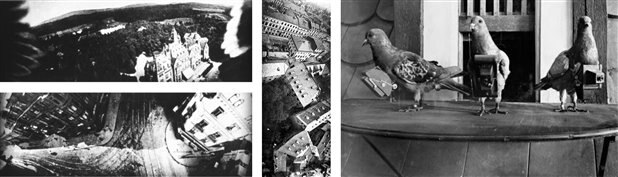
Aerial photographs of Schlosshotel Kronberg (top left) and Frankfurt (bottom left and center); pigeons fitted with cameras (right). (via Wiki)
Neubronner released a book describing 5 different models of camera on the pigeon platform:
- A double camera with lenses pointing in opposite directions.
- Stereoscopic setup with two lenses pointing in the same direction.
- One model that could transport film and take several pictures in a row.
- A bellows camera that would take a picture and retract the bellows.
- A panoramic camera based on the Doppel-sport panoramic camera. A lens would rotate 180 degrees to take a large exposure. This was never made.

Pigeon fitted with a German camera circa WWI or WWII
Pigeon camera systems were tested for use in the first world war. Neubronner did have military use in mind when he designed it originally. Tests were conducted by the Prussian War Ministry to satisfactory results, but pigeons were never put into use for surveillance. Neubronner did make a mobile dovecote and darkroom from battlefield use. Even after training pigeons for mobility, the system was never used.
The German army did take the pigeon camera system into the field during World War II. The difference was they trained dogs to carry a set of pigeons to locations for release and recovery. Each pigeon camera was capable of 200 exposures per flight. The goal was to release these behind enemy lines. Whether these were used or not is left to speculation. However, a German nursery toy soldier was produced in the act of using the system. In 1942, the Russian army found a truck containing pigeon cameras that took pictures at five-minute intervals.
The German army did take the pigeon camera system into the field during World War II. The difference was they trained dogs to carry a set of pigeons to locations for release and recovery. Each pigeon camera was capable of 200 exposures per flight. The goal was to release these behind enemy lines. Whether these were used or not is left to speculation. However, a German nursery toy soldier was produced in the act of using the system. In 1942, the Russian army found a truck containing pigeon cameras that took pictures at five-minute intervals.


(Left) German toy soldier with pigeon releasing. (Right) Neubronner's mobile dovecote
Despite the rise to fame and possible military use, the pigeon camera was not a profitable endeavor for Neubronner. He continued his medical practice, and it stayed in operation for two more generations. Neubronner's youngest son, Carl Neubronner, managed the company for 70 years before selling it 1995. Later, Carl Neubronner founded the Carl and Erika Neubronner Foundation to help disabled or needy people and to promote cultural non-profit organizations in Kronberg.
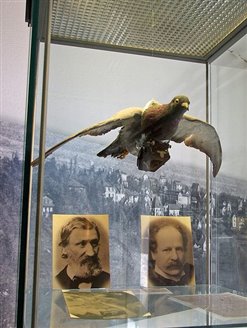
Neubronner pigeon exhibit (via Stadtmuseum Kronberg)
Next camera system you see on a flying toy or UAV, remember, it all started with Julius Neubronner's pigeon camera.
Cabe