element14 Community
element14 Community
    Register Log In
  • Site
  • Search
  • Log In Register
  • Community Hub
    Community Hub
    • What's New on element14
    • Feedback and Support
    • Benefits of Membership
    • Personal Blogs
    • Members Area
    • Achievement Levels
  • Learn
    Learn
    • Ask an Expert
    • eBooks
    • element14 presents
    • Learning Center
    • Tech Spotlight
    • STEM Academy
    • Webinars, Training and Events
    • Learning Groups
  • Technologies
    Technologies
    • 3D Printing
    • FPGA
    • Industrial Automation
    • Internet of Things
    • Power & Energy
    • Sensors
    • Technology Groups
  • Challenges & Projects
    Challenges & Projects
    • Design Challenges
    • element14 presents Projects
    • Project14
    • Arduino Projects
    • Raspberry Pi Projects
    • Project Groups
  • Products
    Products
    • Arduino
    • Avnet & Tria Boards Community
    • Dev Tools
    • Manufacturers
    • Multicomp Pro
    • Product Groups
    • Raspberry Pi
    • RoadTests & Reviews
  • About Us
  • Store
    Store
    • Visit Your Store
    • Choose another store...
      • Europe
      •  Austria (German)
      •  Belgium (Dutch, French)
      •  Bulgaria (Bulgarian)
      •  Czech Republic (Czech)
      •  Denmark (Danish)
      •  Estonia (Estonian)
      •  Finland (Finnish)
      •  France (French)
      •  Germany (German)
      •  Hungary (Hungarian)
      •  Ireland
      •  Israel
      •  Italy (Italian)
      •  Latvia (Latvian)
      •  
      •  Lithuania (Lithuanian)
      •  Netherlands (Dutch)
      •  Norway (Norwegian)
      •  Poland (Polish)
      •  Portugal (Portuguese)
      •  Romania (Romanian)
      •  Russia (Russian)
      •  Slovakia (Slovak)
      •  Slovenia (Slovenian)
      •  Spain (Spanish)
      •  Sweden (Swedish)
      •  Switzerland(German, French)
      •  Turkey (Turkish)
      •  United Kingdom
      • Asia Pacific
      •  Australia
      •  China
      •  Hong Kong
      •  India
      •  Korea (Korean)
      •  Malaysia
      •  New Zealand
      •  Philippines
      •  Singapore
      •  Taiwan
      •  Thailand (Thai)
      • Americas
      •  Brazil (Portuguese)
      •  Canada
      •  Mexico (Spanish)
      •  United States
      Can't find the country/region you're looking for? Visit our export site or find a local distributor.
  • Translate
  • Profile
  • Settings
Publications
  • Learn
  • More
Publications
Blog The Hybrid Memory Cube Consortium gang and the future of memory
  • Blog
  • Documents
  • Events
  • Files
  • Members
  • Mentions
  • Sub-Groups
  • Tags
  • More
  • Cancel
  • New
Join Publications to participate - click to join for free!
  • Share
  • More
  • Cancel
Group Actions
  • Group RSS
  • More
  • Cancel
Engagement
  • Author Author: Catwell
  • Date Created: 14 May 2012 5:49 PM Date Created
  • Views 568 views
  • Likes 1 like
  • Comments 3 comments
  • research
  • test
  • samsung
  • microsoft
  • hmc
  • industry
  • hmi
  • hybridmemorycube
  • hmcc
  • memory
  • cabeatwell
  • prototyping
  • measurement
  • ibm
  • innovation
  • communication
Related
Recommended

The Hybrid Memory Cube Consortium gang and the future of memory

Catwell
Catwell
14 May 2012

You don't have permission to edit metadata of this video.
Edit media
x
image
Upload Preview
image


The Hybrid Memory Cube Consortium (HMCC) has recently announced that Microsoft has joined the conglomerate in an effort to integrate HMC technology into next generation systems. The HMCC are a group of electronic equipment manufacturers that include industry giants such as Samsung, IBM and Micron that are looking to develop and implement  advancement in DRAM memory technology called Hybrid Memory Cube (HMC).


The HMC features 15x the performance of DDR3 memory by utilizing a memory die that’s stacked using Through-silicon-VIA (Vertical Interconnect Access used to create 3D circuits- hence the ‘cube’). HMC technology has increased density that enables more memory to be packed into a space that’s 90% less over today’s DDR3 modules while utilizing 70% less energy per-bit.


The connections between the efficient stacked chips are shorter, which is why it takes up less of a foot-print over traditional DDR modules and is also significantly faster. This means that memory bandwidth and clock speeds can remain constant with each new iteration of CPU’s and GPU’s which isn’t limited to networks and PC’s but will also provide a performance boost for mobile devices such as smartphones and tablets as well. Microsoft has recently join the Consortium, hoping its resources will get the technology developed quicker. If the Consortium is successful in their developments, the future will indeed be ‘cubed’!
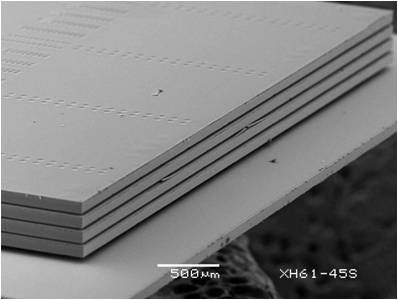
 

image

Actual image of a HMC (via HMCC)


Cabe

http://twitter.com/Cabe_e14

  • Sign in to reply
  • DAB
    DAB over 13 years ago in reply to Eavesdropper

    Hi E,


    Sorry, but I built that circuit 40 years ago in tech school.  It was a free running astable oscillator using two triodes that triggered a third triode to turn on a light.


    PS: I anyone who does not know what a triode is, think about a transister with emitter, base, and collector.  The triode had a cathode, gate, and anode.  From there, you wire them with resisters and capaciters just like you would with semiconductors.  Except the voltages are much higher, like about 290 volts verses 5 volts.


    Now if you are interested, I do have a ferrite core memory board that I framed.  It has 8K of 16 bit memory.  Probably costs about 16, 000 USD when new.  I think it makes a cool piece of technoart.


    Thanks,

    DAB

    • Cancel
    • Vote Up 0 Vote Down
    • Sign in to reply
    • More
    • Cancel
  • Eavesdropper
    Eavesdropper over 13 years ago in reply to DAB

    Moore's Law holds up every time.


    DAB,


    It would be interesting to see your first circuit. Could you dig it up and post on element14 somewhere?


    E

    • Cancel
    • Vote Up 0 Vote Down
    • Sign in to reply
    • More
    • Cancel
  • DAB
    DAB over 13 years ago

    It's amazing.  When I started in computers, we used ferrite donuts with six wires to get one bit.  Now you can put megabytes inside the donut hole.  Some of you would be overwhelmed if you saw the first logic circuit I built using tubes.  One bit used enough power to run a smart phone today.  From what I see in the research papers, its only going to get smaller and more useful.


    Wow.


    DAB

    • Cancel
    • Vote Up 0 Vote Down
    • Sign in to reply
    • More
    • Cancel
element14 Community

element14 is the first online community specifically for engineers. Connect with your peers and get expert answers to your questions.

  • Members
  • Learn
  • Technologies
  • Challenges & Projects
  • Products
  • Store
  • About Us
  • Feedback & Support
  • FAQs
  • Terms of Use
  • Privacy Policy
  • Legal and Copyright Notices
  • Sitemap
  • Cookies

An Avnet Company © 2025 Premier Farnell Limited. All Rights Reserved.

Premier Farnell Ltd, registered in England and Wales (no 00876412), registered office: Farnell House, Forge Lane, Leeds LS12 2NE.

ICP 备案号 10220084.

Follow element14

  • X
  • Facebook
  • linkedin
  • YouTube