


The O-Bow prototype in use. Sensor visible in the right image. (via zenprobe)
Ever hear a piece of music, which sampled orchestral instruments that didn’t sound quite right? Nowadays, the electrification of instruments is leading to a greater number of keyboard sampled musical instruments that don’t match up to the complex expression one can achieve on an actual violin rather than a Casio keyboard violin patch. This prompted Dylan Menzies from the De Montfort University in Leicester, UK to develop an electronic instrument called the O-Bow that uses a bow, keyboard, and an optical sensor to mimic the dynamic sounds of a violin bowing action.
String instruments generally provide musicians with such a wide range of possible expression. Take, for instance, a blues guitarist’s quick and subtle bends, taps, and vibrato holds all the while accompanied by rhythmically dynamic strumming and picking patterns. The case for the violin is much the same with bow velocity, bow position, vibrato, finger positioning, and down force, are all major contributors to the instruments sound.
This particular electronic instrument consists of a copper cylinder body with a groove that holds the optical sensor while also ensuring the bow does not slide off too easily. The sensor can measure bow speed and its horizontal angle for a number of bow types, which is then fed to additional software. An accompanying keyboard, or any other similar controller, is then used to control the instrument’s pitch. Of course, because the instrument is still electronic, there is greater flexibility in the instrument’s outputted sound.
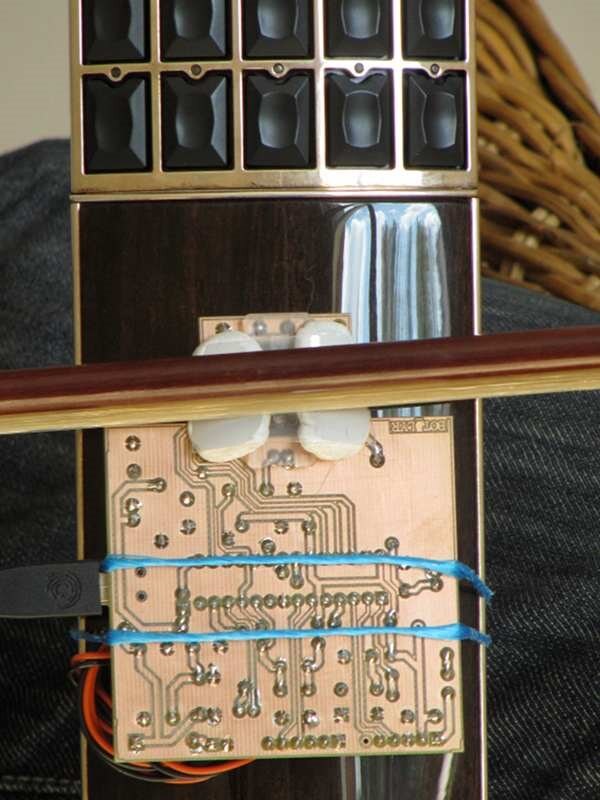
Inside the O-Bow concept prototype from a year ago. (via zenprobe)
Dylan still makes it a point that his O-bow device is not meant to be a replacement for a violin, but a much more forgiving way of creating the instrument’s dynamic expression electronically:
“From a broader perspective, bowing is a very natural, ancient mode of expression. It deserves to be integrated better into the modern world of electronic sound.” Take a look at the development page for long recordings of the device in operation. The audio clips are examples of the natural usage of a bow and the sensor.
After almost 3 years in the making, the O-bow is now patent pending (AKA “L-Bow,” Light bow, Optical bow). Future iterations may include bow down-force sensing.
C
See more news at: