element14 Community
element14 Community
    Register Log In
  • Site
  • Search
  • Log In Register
  • Community Hub
    Community Hub
    • What's New on element14
    • Feedback and Support
    • Benefits of Membership
    • Personal Blogs
    • Members Area
    • Achievement Levels
  • Learn
    Learn
    • Ask an Expert
    • eBooks
    • element14 presents
    • Learning Center
    • Tech Spotlight
    • STEM Academy
    • Webinars, Training and Events
    • Learning Groups
  • Technologies
    Technologies
    • 3D Printing
    • FPGA
    • Industrial Automation
    • Internet of Things
    • Power & Energy
    • Sensors
    • Technology Groups
  • Challenges & Projects
    Challenges & Projects
    • Design Challenges
    • element14 presents Projects
    • Project14
    • Arduino Projects
    • Raspberry Pi Projects
    • Project Groups
  • Products
    Products
    • Arduino
    • Avnet & Tria Boards Community
    • Dev Tools
    • Manufacturers
    • Multicomp Pro
    • Product Groups
    • Raspberry Pi
    • RoadTests & Reviews
  • About Us
  • Store
    Store
    • Visit Your Store
    • Choose another store...
      • Europe
      •  Austria (German)
      •  Belgium (Dutch, French)
      •  Bulgaria (Bulgarian)
      •  Czech Republic (Czech)
      •  Denmark (Danish)
      •  Estonia (Estonian)
      •  Finland (Finnish)
      •  France (French)
      •  Germany (German)
      •  Hungary (Hungarian)
      •  Ireland
      •  Israel
      •  Italy (Italian)
      •  Latvia (Latvian)
      •  
      •  Lithuania (Lithuanian)
      •  Netherlands (Dutch)
      •  Norway (Norwegian)
      •  Poland (Polish)
      •  Portugal (Portuguese)
      •  Romania (Romanian)
      •  Russia (Russian)
      •  Slovakia (Slovak)
      •  Slovenia (Slovenian)
      •  Spain (Spanish)
      •  Sweden (Swedish)
      •  Switzerland(German, French)
      •  Turkey (Turkish)
      •  United Kingdom
      • Asia Pacific
      •  Australia
      •  China
      •  Hong Kong
      •  India
      • Japan
      •  Korea (Korean)
      •  Malaysia
      •  New Zealand
      •  Philippines
      •  Singapore
      •  Taiwan
      •  Thailand (Thai)
      • Vietnam
      • Americas
      •  Brazil (Portuguese)
      •  Canada
      •  Mexico (Spanish)
      •  United States
      Can't find the country/region you're looking for? Visit our export site or find a local distributor.
  • Translate
  • Profile
  • Settings
Publications
  • Learn
  • More
Publications
Blog The Single Atom Transistor and the Technological Singularity
  • Blog
  • Documents
  • Events
  • Files
  • Members
  • Mentions
  • Sub-Groups
  • Tags
  • More
  • Cancel
  • New
Join Publications to participate - click to join for free!
  • Share
  • More
  • Cancel
Group Actions
  • Group RSS
  • More
  • Cancel
Engagement
  • Author Author: Catwell
  • Date Created: 21 Feb 2012 8:29 PM Date Created
  • Views 486 views
  • Likes 1 like
  • Comments 1 comment
  • research
  • transistor
  • industry
  • hmi
  • quantum_computing
  • on_campus
  • Design
  • cabeatwell
  • prototyping
  • university
  • innovation
  • technological_signularity
Related
Recommended

The Single Atom Transistor and the Technological Singularity

Catwell
Catwell
21 Feb 2012
You don't have permission to edit metadata of this video.
Edit media
x
image
Upload Preview
image


Moore's Law states that the number of transistors that can be placed inexpensively into an integrated circuit will double every two years or become half their original size. In reality, it turns out that the doubling/shrinking happens every 18 months. Based on prediction, the law will hold true until somewhere between 2015 and 2020. At which point, a single transistor will be the size of one atom.


Can single atom transistors exist? The answer is shocking; yes,  they already do.
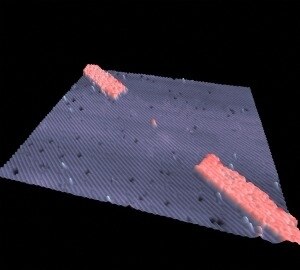
 

image

3D model constructed by a scanning tunnelling microscope of the single atom Phosphorus transistor (via UNSW)


Researchers at the University of New South Wales (UNSW), Australia, have precisely placed a single phosphorus atom between atomic-scale electrodes and control gates. UNSW Professor Michelle Simmons, leader of the project at the ARC Centre for Quantum Computation and Communication Technology, explained, "...this device is perfect... This is the first time anyone has shown control of a single atom in a substrate with this level of precise accuracy. Our group has proved that it is really possible to position one phosphorus atom in a silicon environment - exactly as we need it - with near-atomic precision, and at the same time register gates."


Inside a high-vacuum chamber, the team used a scanning tunnelling microscope (STM) to see/manipulate the atom on the crystalline substrate. A lithographic process was used to pattern the phosphorus atom into a usable transistor. A non-reactive layer of hydrogen was applied to the atomic circuit. The STM then removed selected hydrogen atoms, etching the surface.  A chemical reaction placed the phosphorus atoms in the center. Then everything is encapsulated in silicon. Connections through the silicon allow for control on the individual atoms. The results were theoretical agreement with what a single phosphorus atom transistor could do.


Although the team stated that they beat Moore's Law, they now have to manufacture inexpensive devices using the technology to solidify an actual law-break. They have only 3 years to do it. I am hoping they do so. Keep in mind, controlling individual atom is at the core of quantum computing, and this might just bring about the technological singularity much faster. (When innovation can happen in an instant, every instant.)


Cabe

http://twitter.com/Cabe_e14


See Engineering On Friday's take on this development.

  • Sign in to reply
  • DAB
    DAB over 13 years ago

    I could see this technology leading to molecular, atomic and subatomic transisters.

    All we need to do is learn how to use the basic laws of physics with improved technology and control.

    In a controlled environment, we should be able to establish a high degree of control using electomagnetic fields and photonics.


    DAB

    • Cancel
    • Vote Up 0 Vote Down
    • Sign in to reply
    • More
    • Cancel
element14 Community

element14 is the first online community specifically for engineers. Connect with your peers and get expert answers to your questions.

  • Members
  • Learn
  • Technologies
  • Challenges & Projects
  • Products
  • Store
  • About Us
  • Feedback & Support
  • FAQs
  • Terms of Use
  • Privacy Policy
  • Legal and Copyright Notices
  • Sitemap
  • Cookies

An Avnet Company © 2025 Premier Farnell Limited. All Rights Reserved.

Premier Farnell Ltd, registered in England and Wales (no 00876412), registered office: Farnell House, Forge Lane, Leeds LS12 2NE.

ICP 备案号 10220084.

Follow element14

  • X
  • Facebook
  • linkedin
  • YouTube