


ZigBee Smart Energy V2 available 2013 (via ZigBee Alliance)
The Internet of Things phenomena might have just become more fortified with the announcement of the brand new, publicly available ZigBee IP Specification. The network spec will bring the world’s first open standard for IPv6-based mesh networking to industries and consumers alike while also beefing up security measures. Specifically designed for Smart Grid applications, the ZigBee IP aims to provide reliable and automated energy management solutions with a looming potential to create diverse, IoT ecosystems thanks to its advanced networking and communications technology.
The ZigBee communication specification has found most use in personal area mesh networks, for instance, wireless home security, using the IEEE 802 standard. With no centralized control unit, ZigBee networks transmit data over long distances by passing information through each device along a designated path, creating an infinitely scalable mesh network. The specification is generally used for low-power devices with an accompanying low data-transfer rates (250 kb/s) intended for periodic communication - but with the expansion of such IoT networks, even less power consumption with higher data rates may be in store.
IPv6 was brought on as the successor to the previous IPv4 communications protocol. The eventual switch over to an IPv6 network is part of a response to the dwindling number of IP addresses available, implementing 128-bit IPs over the old 32-bit method. The new standard will surely meet the growing number of internet-ready devices’ needs by allowing 7.9×1028 times more devices to get connected.
The newly announce ZigBee IP spec provides the best of both worlds with an immensely expandable IPv6 ready mesh network. Internet protocols such as 6LoWPAN, IPv6, PANA, RPL, TCP, TLS and UDP are ready for use with upgraded security using the TLS1.2 protocol, link layer frame security, and support for public key infrastructure. ZigBee IP will operate under the standard 2.4GHz band, with 868/915/920 MHz frequencies available in certain countries.
Early adopters are likely to be Smart Grid based applications as the specification was originally designed to meet the Smart Energy Profile 2 requirements that will be released later this year. Companies such as Texas Instruments and Silicon Labs have already provided devices that will be used to test future ZigBee IP compliant products. Furthermore, the ZigBee Alliance will host a free webinar on April 3rd to clue-in interested technologists on more of the specifications capabilities. Make sure to check that out if you’re interested to learn about future Internet of Things based applications, and read below for more info on the ZigBee IP spec.
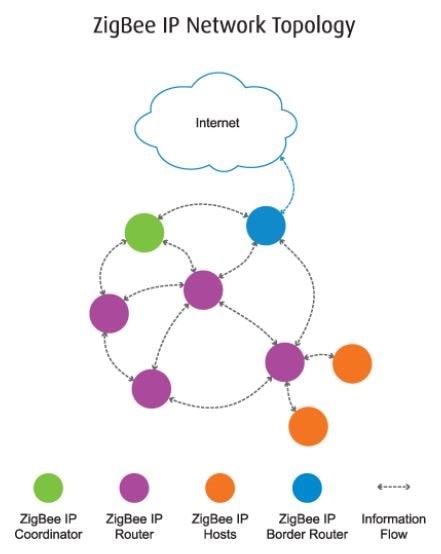
Characteristics of ZigBee IP include:
- Global operation in the 2.4GHz frequency band according to IEEE 802.15.4
- Regional operation in the 915Mhz (Americas), 868Mhz (Europe) and 920 MHz (Japan)
- Incorporates power saving mechanisms for all device classes
- Supports development of discovery mechanisms with full application confirmation
- Supports development of pairing mechanisms with full application confirmation
- Multiple star topology and inter-personal area network (PAN) communication
- Unicast and multi-cast transmission options
- Security key update mechanism
- Utilizes the industry standard AES-128-CCM security scheme
- Supports Alliance standards or manufacturer specific innovations
C
See more news at: