


Materials Engineering is a particularly important field in electronics, but often overlooked by the media. It is always about the next big product, the software update, peripherals. A paralleled amount of engineering work went into what makes up a product. Material Engineers are an integral part of our design lives. Today's focus is on a new thermoelectric material.
Thermal electric materials are made from alternating p-type and n-type semiconductors. When together, heat can be absorbed by the material and turned into electric current. Also known as the Seebeck effect. In another case, a similar material can be used to convert electric current to heat or a sold surface as in the Peltier effect. A common p-type thermoelectric material is based on Lead Telluride (PbTe). Efficiency of these materials is expressed as ZT, or the "thermoelectric figure of merit." To harvest energy from common sources, such as a car engine, a calculated ZT of 1.5 is needed. The common PbTe materials have an efficiency of 0.8. This type is often used on satellites or factories with high heat generating processes. Micro-heat loss would not produce enough worthwhile energy with a 0.8 ZT.
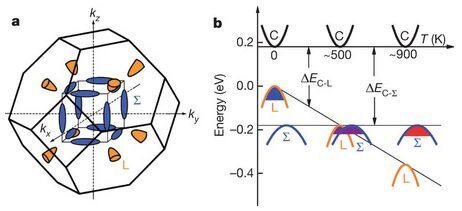
Physicists at the California Institute of Technology with the Chinese Academy of Sciences have worked together to produce a high ZT material. By adjusting the amount of tellurium (Te) in the PbTe material they were able to get a ZT of 1.8. Similarly, they produced a ZT of 1.5 by doping PbTe with thallium, and 1.4 with sodium. additionally, by adding selenium to the mix the team increased the material's conductivity, at the same time increasing the number of "degenerate valleys" in the band structure with boosts ZT.
Dr. Jeffrey Snyder, lead author of the study, said that these results were the "highest ever produced in independent laboratories." Dr. Snyder goes on to say that the team's next effort will be to create an n-type material with similar improvements, and take the p-type to even high ZT values at higher temperatures.
According to the Lawrence Livermore National Laboratory, almost 55% of all energy generated in 2009 in the USA was rejected. The majority of which was lost via waste heat. What Dr. Snyder's team is doing will regain a major portion of the lost energy, not only in the U.S. but globally. The ramifications could least to extending our natural resources twice as long as forecasted. I hope what the team creates is done quickly. The world needs it.

Cabe
