


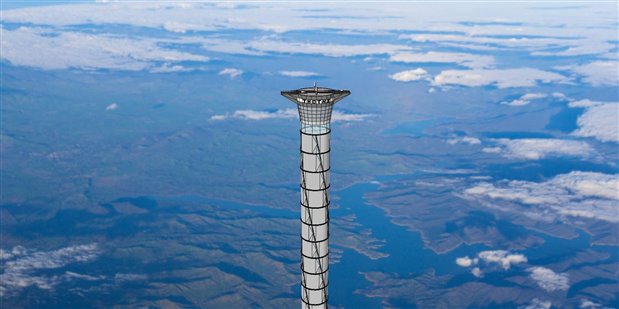
The notion of a “space elevator”, a giant structure rising from the ground and enabling payloads to be placed into orbit without having to use rockets, is a long-time staple of science fiction. In fact, in his 1979 novel “The Fountains of Paradise,” Arthur C. Clarke described an “orbital tower” 36,000 km (about 22,300 miles) in height linked with a satellite in geostationary orbit.
Clarke would have been amused to learn that about a week ago a Canadian company, Thoth Technology, Inc., was granted a United States patent for a tall space elevator. The freestanding 20km tall (65.6k ft.), 300-meter (990 ft.) diameter cylindrical space tower would incorporate wall cells that would be pneumatically pressurized and would use active guidance to steer the head of the tower over a point on its base to counteract wind forces. Using this method the lightweight structure would not require guy wires for stabilization. At 20 km above the planet, it would stand more than 20 times the height of the current tallest structures in the world and could also be used for wind-energy generation, communications and tourism.
Commenting on the development its inventor, Dr. Brendan Quine, said astronauts would ascend to 20 km by electrical elevator and space planes could be launched in a single stage to orbit from the top of the tower, returning to the top of the tower for refueling and further flight.
Top Comments