


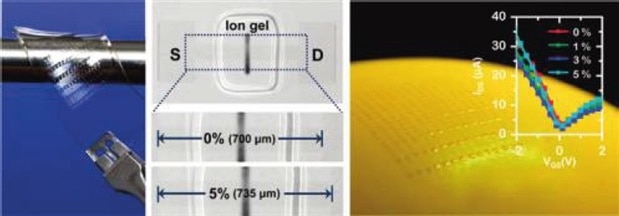
Final graphene material (left). Magnified transistor image (center). Transistors placed onto a balloon. (right) (Via Lee, American Chemical Society)
There appears to be legions of engineers and scientists pushing hard for stretchable electronics. The latest comes in the form of a transparent material containing sets of graphene transistors. Up to a 5% flex could be achieved before degradation of the electrical qualities.
In an effort that spans 10 schools, project lead Jeong Ho Cho from Soongsil University and Jong-Hyun Ahn from Sungkyunkwan University, both are South Korea, found a way to overcome common issues with making transparent and flexible electronics by using a different type of substrate. In past attempts, a slab of rubber or balloon surface was used with limited flexibility. Jeong and his team fabricated single layers of graphene onto copper foil. Using photolithography and etching tricks, the transistor components (electrodes, semiconducting channels) were forced into the graphene layers. The etched graphene was transferred to the clear rubber. A stretchable ion-gel was used in the final step to finish the transistor's components, gate insulators and electrodes.
Graphene can be printed at low, and even at room, temperatures. This gave the team an easy way to make and manipulate the organic graphene. At the same time, graphene's innate stretch ability was ultimately the key to their success. The fabricated material could bend at a maximum of 5% for 1,000 flexes. After which micro-cracks started forming dues to imperfections in the graphene layers.
As most researchers will say, the team vows to improve the capabilities of their transparent flex transistors. The team sees applications in medical biosensores that form to the human body and flex displays. 100% flexibility is what they need, but that final 95% is always the hardest.
Cabe
Although the researchers are using graphene transistors, the actual operation of which may be in question. The band-gap ratio for graphene is around 30. The larger the band gap, the more of an insulator the material becomes. For comparison, the band gap of silicon is 1.11.