element14 Community
element14 Community
    Register Log In
  • Site
  • Search
  • Log In Register
  • Community Hub
    Community Hub
    • What's New on element14
    • Feedback and Support
    • Benefits of Membership
    • Personal Blogs
    • Members Area
    • Achievement Levels
  • Learn
    Learn
    • Ask an Expert
    • eBooks
    • element14 presents
    • Learning Center
    • Tech Spotlight
    • STEM Academy
    • Webinars, Training and Events
    • Learning Groups
  • Technologies
    Technologies
    • 3D Printing
    • FPGA
    • Industrial Automation
    • Internet of Things
    • Power & Energy
    • Sensors
    • Technology Groups
  • Challenges & Projects
    Challenges & Projects
    • Design Challenges
    • element14 presents Projects
    • Project14
    • Arduino Projects
    • Raspberry Pi Projects
    • Project Groups
  • Products
    Products
    • Arduino
    • Avnet & Tria Boards Community
    • Dev Tools
    • Manufacturers
    • Multicomp Pro
    • Product Groups
    • Raspberry Pi
    • RoadTests & Reviews
  • About Us
  • Store
    Store
    • Visit Your Store
    • Choose another store...
      • Europe
      •  Austria (German)
      •  Belgium (Dutch, French)
      •  Bulgaria (Bulgarian)
      •  Czech Republic (Czech)
      •  Denmark (Danish)
      •  Estonia (Estonian)
      •  Finland (Finnish)
      •  France (French)
      •  Germany (German)
      •  Hungary (Hungarian)
      •  Ireland
      •  Israel
      •  Italy (Italian)
      •  Latvia (Latvian)
      •  
      •  Lithuania (Lithuanian)
      •  Netherlands (Dutch)
      •  Norway (Norwegian)
      •  Poland (Polish)
      •  Portugal (Portuguese)
      •  Romania (Romanian)
      •  Russia (Russian)
      •  Slovakia (Slovak)
      •  Slovenia (Slovenian)
      •  Spain (Spanish)
      •  Sweden (Swedish)
      •  Switzerland(German, French)
      •  Turkey (Turkish)
      •  United Kingdom
      • Asia Pacific
      •  Australia
      •  China
      •  Hong Kong
      •  India
      • Japan
      •  Korea (Korean)
      •  Malaysia
      •  New Zealand
      •  Philippines
      •  Singapore
      •  Taiwan
      •  Thailand (Thai)
      • Vietnam
      • Americas
      •  Brazil (Portuguese)
      •  Canada
      •  Mexico (Spanish)
      •  United States
      Can't find the country/region you're looking for? Visit our export site or find a local distributor.
  • Translate
  • Profile
  • Settings
Publications
  • Learn
  • More
Publications
Blog University of Bristol creates quantum computing chip in silicon
  • Blog
  • Documents
  • Events
  • Files
  • Members
  • Mentions
  • Sub-Groups
  • Tags
  • More
  • Cancel
  • New
Join Publications to participate - click to join for free!
  • Share
  • More
  • Cancel
Group Actions
  • Group RSS
  • More
  • Cancel
Engagement
  • Author Author: Catwell
  • Date Created: 13 Sep 2012 5:41 PM Date Created
  • Views 543 views
  • Likes 1 like
  • Comments 0 comments
  • quantum
  • research
  • industry
  • hmi
  • photonics
  • on_campus
  • cabeatwell
  • prototyping
  • university
  • innovation
  • communication
Related
Recommended

University of Bristol creates quantum computing chip in silicon

Catwell
Catwell
13 Sep 2012

imageimage

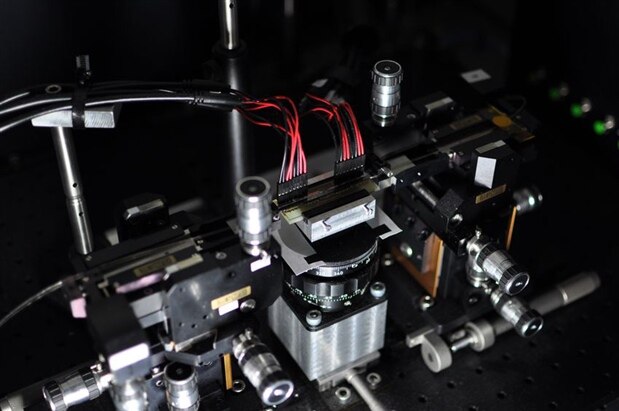
(Left) Quantum programming rig, the chip is central, we assume. (Right) The chip next to a USA quarter coin for comparison


A team of scientist working at the University of Bristol's Centre for Quantum Photonics have created a silicon chip capable of manipulating individual light particles for computational processing. The photons and  the processor in which they are used take advantage of the quantum mechanical effects such as entanglement and superposition to perform calculations. Using such a chip made from silicon, would make it compatible with modern electronics and ready to be mass produced through currently used manufacturing techniques.


The announcement was made at the 2012 British Science Festival and has also been published in the New Journal of Physics. Dr Mark Thompson, the physicists leading the team, has stated, “Using silicon to manipulate light, we have made circuits over 1000 times smaller than current glass-based technologies.” Other than being compatible with modern microelectronics, the silicon also saves the quantum processors the trouble from having to be created using a complicated glass architecture. Additionally, the smaller size will allow the chip to be integrated into systems and devices that were not possible before. Even with their small size, quantum computing will have excessive computational power and will be able to perform better than today's supercomputers.


Scientists are stating we may see quantum processors integrated into modern technologies within 3 to 5 years. Their current system is using 20 photons or 10 quantum bits to perform calculations faster than ordinary computers. Dr Thompson is expecting within ten years we will have quantum systems using hundreds of quantum bits to perform computational tasks. Such tasks will have the strongest applications in biology, chemistry, and physics.


Cabe

http://twitter.com/Cabe_e14

  • Sign in to reply
element14 Community

element14 is the first online community specifically for engineers. Connect with your peers and get expert answers to your questions.

  • Members
  • Learn
  • Technologies
  • Challenges & Projects
  • Products
  • Store
  • About Us
  • Feedback & Support
  • FAQs
  • Terms of Use
  • Privacy Policy
  • Legal and Copyright Notices
  • Sitemap
  • Cookies

An Avnet Company © 2026 Premier Farnell Limited. All Rights Reserved.

Premier Farnell Ltd, registered in England and Wales (no 00876412), registered office: Farnell House, Forge Lane, Leeds LS12 2NE.

ICP 备案号 10220084.

Follow element14

  • X
  • Facebook
  • linkedin
  • YouTube