


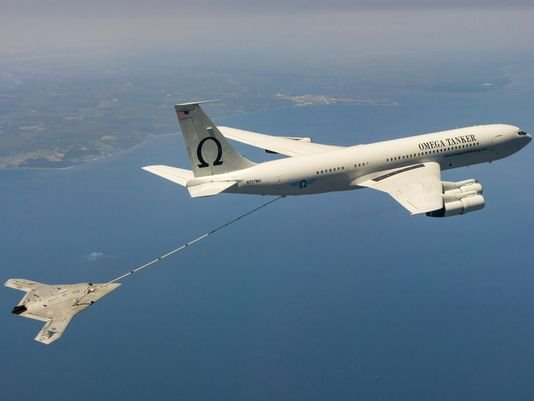
The U.S. Navy's X-47B unmanned combat air system demonstrator (UCAS-D) successfully completed its first aerial refueling last week, quite an achievement given that it doesn't have a pilot to help maneuver it to capture the tanker's fueling probe in mid-air.
The X-47B vehicle 2, also known as Salty Dog 502, was launched from the Naval Air Station at Patuxent River, Maryland. It received over 4,000 lbs. of fuel from an Omega Aerial Refueling Services Boeing 707 tanker aircraft while flying off the coast of Maryland and Virginia.
The X-47B uses preset software programs and is not remotely piloted. When it was 1 mile. behind and 1,000 ft. below the tanker, it requested permission to move closer using GPS. The operator on the ground at Patuxent River then only had to push a button to initiate the refueling process subroutine, after which the computer on the aircraft took over. Once it was 20 ft. behind the tanker the X-47B navigated using a vision system comprised of two electro-optical and two infrared cameras, which provided a three-dimensional image of the tanker and drogue. When the two aircraft were eight feet apart the vehicle extended a fueling probe to meet up with the tanker's hose and drogue. The refueling process lasted over 11 minutes, during which time the two aircraft were “station keeping”—maintaining their relative position while flying in close formation. After refueling the X-47B autonomously disengaged the drogue, maneuvered away from the tanker and returned to base.
The X-47B was built by Northrop Grumman to demonstrate that an unmanned aircraft can be integrated into an aircraft carrier's operations. In July, 2013 it made the first unmanned-aircraft arrested landing and catapult takeoff from an aircraft carrier at sea. Since it was never meant to be an operational aircraft the X-48B will now be retired to make way for the next generation Unmanned Carrier Launched Airborne Surveillance and Strike system (UCLASS), which is scheduled to begin operations in the early 2020s.