


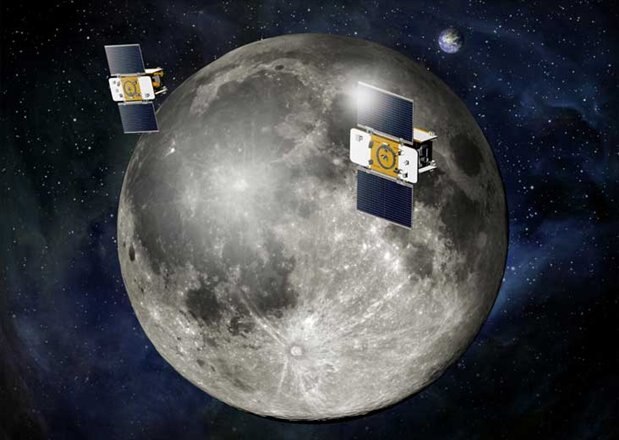
GRAIL probes render. (via NASA)
According to the North American Aerospace Defense Command, there are over 9800+ the Earth. As many now know, this is . Our reach does not stop at our geosynchronous orbits, the Earth's moon now has two satellites.
NASA launched two satellites that, as of December 31, 2011 and January 1, 2012, have taken their positions around the moon. The "GRAIL probes" launched back in September of 2011 for the dubious sole-goal of mapping the moon's gravitational field. The mission principal scientist, MIT's Maria Zuber, said the purpose best, "We don't actually know why the near side and far side are different."
Circling the moon at 55 km above its average surface, the GRAIL probes will use microwave signals to measure the distance between themselves that changes based on the gravitational differences on the surface of the planet. Accuracy will be within a width of a human-hair. According to NASA, the maps will be "100 times" better than previous recorded near side gravity maps, and "1000 times" for the far side. Zuber again, "When we can improve by a factor of two, we can learn a lot, and improving by a factor of 1000 is transformative."
Currently the probes are collecting "better than expected" energy via their solar panels. Zuber stated that the team believes that the GRAIL satellites should be able to store enough energy to stay functional during the pending lunar eclipse in June of 2012. At which time the team will lower the probes to 25 km above the surface a perform a "treetop-skimming" study of the structures of craters. External mapping and internal structure are
Another purpose of the mission is to prove, or dis-prove, the University of California's claim that the Earth had two moons at one time. Where the current moon collided with its smaller, 1300 km diameter, sibling at low speeds. Where, instead of forming a typical crater, the strike merged the two. The far side is more mountainous that the front, and they aim to get to the bottom of the mystery.
Cabe
