element14 Community
element14 Community
    Register Log In
  • Site
  • Search
  • Log In Register
  • Community Hub
    Community Hub
    • What's New on element14
    • Feedback and Support
    • Benefits of Membership
    • Personal Blogs
    • Members Area
    • Achievement Levels
  • Learn
    Learn
    • Ask an Expert
    • eBooks
    • element14 presents
    • Learning Center
    • Tech Spotlight
    • STEM Academy
    • Webinars, Training and Events
    • Learning Groups
  • Technologies
    Technologies
    • 3D Printing
    • FPGA
    • Industrial Automation
    • Internet of Things
    • Power & Energy
    • Sensors
    • Technology Groups
  • Challenges & Projects
    Challenges & Projects
    • Design Challenges
    • element14 presents Projects
    • Project14
    • Arduino Projects
    • Raspberry Pi Projects
    • Project Groups
  • Products
    Products
    • Arduino
    • Avnet & Tria Boards Community
    • Dev Tools
    • Manufacturers
    • Multicomp Pro
    • Product Groups
    • Raspberry Pi
    • RoadTests & Reviews
  • About Us
    About the element14 Community
  • Store
    Store
    • Visit Your Store
    • Choose another store...
      • Europe
      •  Austria (German)
      •  Belgium (Dutch, French)
      •  Bulgaria (Bulgarian)
      •  Czech Republic (Czech)
      •  Denmark (Danish)
      •  Estonia (Estonian)
      •  Finland (Finnish)
      •  France (French)
      •  Germany (German)
      •  Hungary (Hungarian)
      •  Ireland
      •  Israel
      •  Italy (Italian)
      •  Latvia (Latvian)
      •  
      •  Lithuania (Lithuanian)
      •  Netherlands (Dutch)
      •  Norway (Norwegian)
      •  Poland (Polish)
      •  Portugal (Portuguese)
      •  Romania (Romanian)
      •  Russia (Russian)
      •  Slovakia (Slovak)
      •  Slovenia (Slovenian)
      •  Spain (Spanish)
      •  Sweden (Swedish)
      •  Switzerland(German, French)
      •  Turkey (Turkish)
      •  United Kingdom
      • Asia Pacific
      •  Australia
      •  China
      •  Hong Kong
      •  India
      •  Japan
      •  Korea (Korean)
      •  Malaysia
      •  New Zealand
      •  Philippines
      •  Singapore
      •  Taiwan
      •  Thailand (Thai)
      •  Vietnam
      • Americas
      •  Brazil (Portuguese)
      •  Canada
      •  Mexico (Spanish)
      •  United States
      Can't find the country/region you're looking for? Visit our export site or find a local distributor.
  • Translate
  • Profile
  • Settings
Publications
  • Learn
  • More
Publications
Blog USB 3.0 cables to deliver 100 watts of power
  • Blog
  • Documents
  • Events
  • Files
  • Members
  • Mentions
  • Sub-Groups
  • Tags
  • More
  • Cancel
  • New
Join Publications to participate - click to join for free!
  • Share
  • More
  • Cancel
Group Actions
  • Group RSS
  • More
  • Cancel
Engagement
  • Author Author: Catwell
  • Date Created: 7 Aug 2012 6:20 PM Date Created
  • Views 824 views
  • Likes 1 like
  • Comments 4 comments
  • research
  • standardization
  • industry
  • hmi
  • power_management
  • usb
  • prototyping
  • power
  • energy
  • innovation
Related
Recommended

USB 3.0 cables to deliver 100 watts of power

Catwell
Catwell
7 Aug 2012

image

(via USB.org)


Since the launch of the Thunderbolt cables over a year ago, there has been a subtle competition with the Universal Serial Bus (USB) cables. Thunderbolt cables offer 10Gbps of transfer rate while SuperSpeed USB cables only offer 5Gbps. In addition, Thunderbolt offers 10W of power through the cables to a device. However, the cables are much more expensive, $49.00 compared to $4.49, USB being the later. Recently the USB 3.0 promoter group has stepped up the competition and approved the power delivery spec for up to 100W over a USB cable.


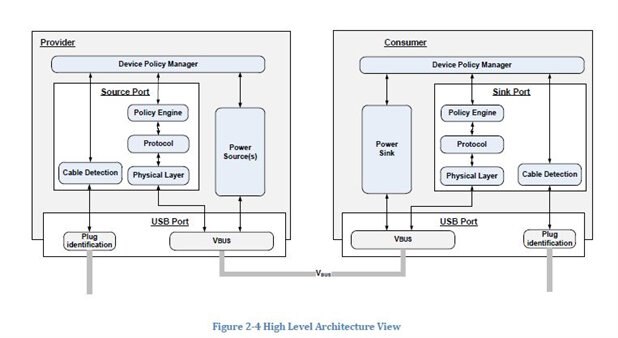
The power delivery system has been designed to work with new and older cables alike. To accomplish this, the cables include an intelligent system to locate and check for USB wires and determine their capabilities. For example, a full sized cable would be able to handle 5A of current through it while a micro USB cable would safely be able to handle 3A. The system will also know whether it is working with a low quality wire to keep things as safe as possible.


In addition to the smart check system, the cables would be capable of switching direction of power flow. This can allow laptops to charge a device and also use it for a power source if necessary. While delivering power it will be delivered in steps between 10W and 100W, each one ideally doubling the one before. As a result, they can ramp power up or down between profiles. With much more power to work with now, USB ports on laptops can possibly double as a charging port. USB is looking to stay ahead of the competition and remain one of the most successful interfaces in the history of personal computing.
 

image

USB architecture (via USB.org)


Cabe

http://twitter.com/Cabe_e14

  • Sign in to reply
Parents
  • DAB
    DAB over 13 years ago

    I think that there will be a lot of problems pushing that much current down the cables for any but short lengths.

    I also worry about ground loops being formed between devices, especially with high frequency data.  Unless the developers are very careful, they could generate a lot of EM interference with even short distances between devices.


    I would caution all device manufactures to plan on an internal power source and limit any drain pulled from the main device to USB3 peripherals.  Otherwise I think that we may create some nasty problems and fire hazards.


    Just my opinion,

    DAB

    • Cancel
    • Vote Up 0 Vote Down
    • Sign in to reply
    • More
    • Cancel
  • Catwell
    Catwell over 13 years ago in reply to DAB

    I'm sure the early USB 3 specs are subject to change.


    Only certain systems will be able to supply the 100W. In this case USB 3 profile 5, 20V@5A is available.

    Many PCs will be limited to 12V@3A, due to the 12V rails in power supplies, and the current carry of a micro USB cable (3A). So a max of ~30W or so.


    Since each port negotiates with the connected device for power needed, and available. It should be ok. These numbers do not seem like a major EMI sources.


    Cabe

    • Cancel
    • Vote Up 0 Vote Down
    • Sign in to reply
    • More
    • Cancel
Comment
  • Catwell
    Catwell over 13 years ago in reply to DAB

    I'm sure the early USB 3 specs are subject to change.


    Only certain systems will be able to supply the 100W. In this case USB 3 profile 5, 20V@5A is available.

    Many PCs will be limited to 12V@3A, due to the 12V rails in power supplies, and the current carry of a micro USB cable (3A). So a max of ~30W or so.


    Since each port negotiates with the connected device for power needed, and available. It should be ok. These numbers do not seem like a major EMI sources.


    Cabe

    • Cancel
    • Vote Up 0 Vote Down
    • Sign in to reply
    • More
    • Cancel
Children
  • RWM
    RWM over 13 years ago in reply to Catwell

    I think that even 30W is enough for wide range of applications.

    • Cancel
    • Vote Up 0 Vote Down
    • Sign in to reply
    • More
    • Cancel
element14 Community

element14 is the first online community specifically for engineers. Connect with your peers and get expert answers to your questions.

  • Members
  • Learn
  • Technologies
  • Challenges & Projects
  • Products
  • Store
  • About Us
  • Feedback & Support
  • FAQs
  • Terms of Use
  • Privacy Policy
  • Legal and Copyright Notices
  • Sitemap
  • Cookies

An Avnet Company © 2026 Premier Farnell Limited. All Rights Reserved.

Premier Farnell Ltd, registered in England and Wales (no 00876412), registered office: Farnell House, Forge Lane, Leeds LS12 2NE.

ICP 备案号 10220084.

Follow element14

  • X
  • Facebook
  • linkedin
  • YouTube