element14 Community
element14 Community
    Register Log In
  • Site
  • Search
  • Log In Register
  • Community Hub
    Community Hub
    • What's New on element14
    • Feedback and Support
    • Benefits of Membership
    • Personal Blogs
    • Members Area
    • Achievement Levels
  • Learn
    Learn
    • Ask an Expert
    • eBooks
    • element14 presents
    • Learning Center
    • Tech Spotlight
    • STEM Academy
    • Webinars, Training and Events
    • Learning Groups
  • Technologies
    Technologies
    • 3D Printing
    • FPGA
    • Industrial Automation
    • Internet of Things
    • Power & Energy
    • Sensors
    • Technology Groups
  • Challenges & Projects
    Challenges & Projects
    • Design Challenges
    • element14 presents Projects
    • Project14
    • Arduino Projects
    • Raspberry Pi Projects
    • Project Groups
  • Products
    Products
    • Arduino
    • Avnet & Tria Boards Community
    • Dev Tools
    • Manufacturers
    • Multicomp Pro
    • Product Groups
    • Raspberry Pi
    • RoadTests & Reviews
  • About Us
  • Store
    Store
    • Visit Your Store
    • Choose another store...
      • Europe
      •  Austria (German)
      •  Belgium (Dutch, French)
      •  Bulgaria (Bulgarian)
      •  Czech Republic (Czech)
      •  Denmark (Danish)
      •  Estonia (Estonian)
      •  Finland (Finnish)
      •  France (French)
      •  Germany (German)
      •  Hungary (Hungarian)
      •  Ireland
      •  Israel
      •  Italy (Italian)
      •  Latvia (Latvian)
      •  
      •  Lithuania (Lithuanian)
      •  Netherlands (Dutch)
      •  Norway (Norwegian)
      •  Poland (Polish)
      •  Portugal (Portuguese)
      •  Romania (Romanian)
      •  Russia (Russian)
      •  Slovakia (Slovak)
      •  Slovenia (Slovenian)
      •  Spain (Spanish)
      •  Sweden (Swedish)
      •  Switzerland(German, French)
      •  Turkey (Turkish)
      •  United Kingdom
      • Asia Pacific
      •  Australia
      •  China
      •  Hong Kong
      •  India
      • Japan
      •  Korea (Korean)
      •  Malaysia
      •  New Zealand
      •  Philippines
      •  Singapore
      •  Taiwan
      •  Thailand (Thai)
      • Vietnam
      • Americas
      •  Brazil (Portuguese)
      •  Canada
      •  Mexico (Spanish)
      •  United States
      Can't find the country/region you're looking for? Visit our export site or find a local distributor.
  • Translate
  • Profile
  • Settings
Publications
  • Learn
  • More
Publications
Blog Using friction to power devices
  • Blog
  • Documents
  • Events
  • Files
  • Members
  • Mentions
  • Sub-Groups
  • Tags
  • More
  • Cancel
  • New
Join Publications to participate - click to join for free!
  • Share
  • More
  • Cancel
Group Actions
  • Group RSS
  • More
  • Cancel
Engagement
  • Author Author: Catwell
  • Date Created: 30 Nov 2012 7:18 PM Date Created
  • Views 480 views
  • Likes 2 likes
  • Comments 0 comments
  • research
  • alternative_energy
  • industry
  • hmi
  • on_campus
  • cabeatwell
  • prototyping
  • energy_harvesting
  • university
  • energy
  • sensor
Related
Recommended

Using friction to power devices

Catwell
Catwell
30 Nov 2012

image

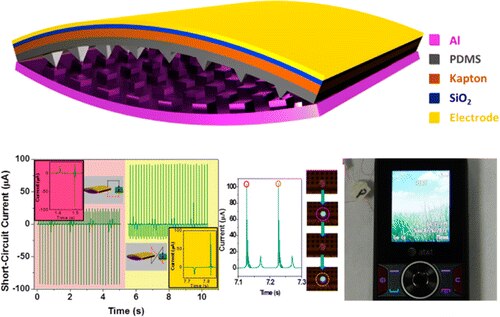
Arched material mesh concept for the triboelectric nanogenerator, aka TENG (via NANO Letters)


As we walk about in dry months desperately avoiding static shocks, we may soon encourage this effect. Zhong Lin Wang, the same professor of materials science working on the pyroelectric nanogenerators, has been leading a team working with piezoelectric nanogenerators. Unlike, the pyroelectric effect, which uses temperature fluctuations to harvest energy, the piezoelectric effect works by using mechanical motions to harvest and collect energy. The team has been hard at work for some time now trying to use the effect to create an efficient system. However, all of their previous experiments have yielded results that have not held any high hopes.


Nonetheless, the team has found that by combining static electricity with their previous system they have produced improved results. Using materials on the nanoscale, they create static electricity when moved against each other, just as a static charge builds on a balloon when rubbed against hair. The materials used within their system are a metal and polyethylene terephthalate, a plastic material. When these two materials come into contact, they create a charge which in return can produce a current when the films are flexed. By using nanotechnology and increasing the surface area of the materials, the team is hoping to increase the output produced by the device.


Although the technology is far from working, its way into our modern society it is still a step toward creating everpresent renewable energy sources. Shashank Priya, director of the Center for Energy Harvesting and Systems at Virginia Tech stated, “ I'm impressed with the power density here, other smart materials haven't produced enough power for practical applications.” The nanogenerator used can convert 10 to 15 percent of mechanical motion energy into electrical energy. By optimizing the geometry and taking advantage of nanotechnology, the team is hoping to convert up to 40 percent of the mechanical energy into electricity. Their next step is to demonstrate that it could work outside the lab. Wang envisions the device being used within an armband to collect energy.


Cabe

http://twitter.com/Cabe_e14

  • Sign in to reply
element14 Community

element14 is the first online community specifically for engineers. Connect with your peers and get expert answers to your questions.

  • Members
  • Learn
  • Technologies
  • Challenges & Projects
  • Products
  • Store
  • About Us
  • Feedback & Support
  • FAQs
  • Terms of Use
  • Privacy Policy
  • Legal and Copyright Notices
  • Sitemap
  • Cookies

An Avnet Company © 2026 Premier Farnell Limited. All Rights Reserved.

Premier Farnell Ltd, registered in England and Wales (no 00876412), registered office: Farnell House, Forge Lane, Leeds LS12 2NE.

ICP 备案号 10220084.

Follow element14

  • X
  • Facebook
  • linkedin
  • YouTube