element14 Community
element14 Community
    Register Log In
  • Site
  • Search
  • Log In Register
  • Community Hub
    Community Hub
    • What's New on element14
    • Feedback and Support
    • Benefits of Membership
    • Personal Blogs
    • Members Area
    • Achievement Levels
  • Learn
    Learn
    • Ask an Expert
    • eBooks
    • element14 presents
    • Learning Center
    • Tech Spotlight
    • STEM Academy
    • Webinars, Training and Events
    • Learning Groups
  • Technologies
    Technologies
    • 3D Printing
    • FPGA
    • Industrial Automation
    • Internet of Things
    • Power & Energy
    • Sensors
    • Technology Groups
  • Challenges & Projects
    Challenges & Projects
    • Design Challenges
    • element14 presents Projects
    • Project14
    • Arduino Projects
    • Raspberry Pi Projects
    • Project Groups
  • Products
    Products
    • Arduino
    • Avnet & Tria Boards Community
    • Dev Tools
    • Manufacturers
    • Multicomp Pro
    • Product Groups
    • Raspberry Pi
    • RoadTests & Reviews
  • About Us
  • Store
    Store
    • Visit Your Store
    • Choose another store...
      • Europe
      •  Austria (German)
      •  Belgium (Dutch, French)
      •  Bulgaria (Bulgarian)
      •  Czech Republic (Czech)
      •  Denmark (Danish)
      •  Estonia (Estonian)
      •  Finland (Finnish)
      •  France (French)
      •  Germany (German)
      •  Hungary (Hungarian)
      •  Ireland
      •  Israel
      •  Italy (Italian)
      •  Latvia (Latvian)
      •  
      •  Lithuania (Lithuanian)
      •  Netherlands (Dutch)
      •  Norway (Norwegian)
      •  Poland (Polish)
      •  Portugal (Portuguese)
      •  Romania (Romanian)
      •  Russia (Russian)
      •  Slovakia (Slovak)
      •  Slovenia (Slovenian)
      •  Spain (Spanish)
      •  Sweden (Swedish)
      •  Switzerland(German, French)
      •  Turkey (Turkish)
      •  United Kingdom
      • Asia Pacific
      •  Australia
      •  China
      •  Hong Kong
      •  India
      • Japan
      •  Korea (Korean)
      •  Malaysia
      •  New Zealand
      •  Philippines
      •  Singapore
      •  Taiwan
      •  Thailand (Thai)
      • Vietnam
      • Americas
      •  Brazil (Portuguese)
      •  Canada
      •  Mexico (Spanish)
      •  United States
      Can't find the country/region you're looking for? Visit our export site or find a local distributor.
  • Translate
  • Profile
  • Settings
Publications
  • Learn
  • More
Publications
Blog Wait, Our Electronics Are Organic?
  • Blog
  • Documents
  • Events
  • Files
  • Members
  • Mentions
  • Sub-Groups
  • Tags
  • More
  • Cancel
  • New
Join Publications to participate - click to join for free!
  • Share
  • More
  • Cancel
Group Actions
  • Group RSS
  • More
  • Cancel
Engagement
  • Author Author: Catwell
  • Date Created: 18 Apr 2012 7:20 PM Date Created
  • Views 465 views
  • Likes 2 likes
  • Comments 0 comments
  • research
  • oled
  • organic_electronics
  • industry
  • conductive_polymers
  • on_campus
  • Design
  • cabeatwell
  • prototyping
  • measurement
  • organic
  • university
  • amoled
  • energy
  • solar
  • sensor
  • innovation
  • photovoltaic
Related
Recommended

Wait, Our Electronics Are Organic?

Catwell
Catwell
18 Apr 2012

>Click the image<

image

>Click the image<


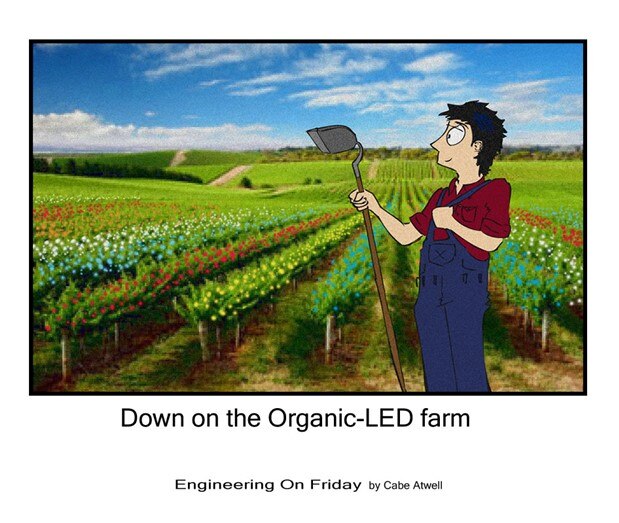
We are not  talking about food here, it is the "organic electronics" that are  finding their way into our electrical lives. It is not just a label, but  a growing industry with potential to bring us new-age efficiency and  creativity. Organic electronics do not grow from the earth. Instead, the  components involve a lot of chemistry, generally stemming from carbon  based compounds, and how it bonds with oxygen and hydrogen to create  unique substances like conductive polymers. Carbon-based (Organic)  molecules are not generally known for their conductivity, but rather  their properties such as low cost to produce, flexibility, and light  weight.


imageimage

Prototype flixible organic displays, showing the potential of organically derived electronics.
 

image

"Melanin" switch, an active organic polymer voltage-controlled device (circa 1974 in the Smithsonian collection)


Organic compounds used in electronics dates back to 1862. Henry Letheby made a partly conductive material, polyaniline, by anodic oxidation of aniline in sulfuric acid. The 1950s and 60s brought more experimentation in conductive compounds. In 1973, the journal Science reported that a organic-polymer electrical device was possible. Flash forward to the year 2000,a group of researchers were awarded the Nobel Prize in Chemistry for the "discovery and development" of conductive polymers. It seems the team may have been riding on the shoulders of generations that proceeded. Their compound was an oxidized and iodine-doped polyacetylene.


Currently, organic materials are being used to create electronics such as LEDs, semiconductors, transistors, and solar cell products. OLEDs, organic light emitting diodes, consist of thin layers of organic compounds placed between two electrodes. OLEDs remove the need for backlighting, achieving deeper colors and higher contrast ratios. Many new televisions, monitors, and smart phone displays currently use them. Additionally, semiconductors created from organic materials create a more energy efficient product. A combination of p-type positive charge carriers or holes and n-type negative charge carriers or electrons transmit a current only when their bits are flipping. Organic semiconductors also possess similar characteristics as non organic semiconductors which allow for doping by an oxidization-reduction process.


The future of organic electronics will lead to many innovations to sustainably meet consumer demands. Affordable costs will lead to the development of everyday products with smart functionality. The more immediate applications we may see include photovoltaics (solar cells), radio frequency identification tags (RFID), and printed electronics. One thing we can count on is organic technologies bringing people together in hopes to extend the planet's resources while making a profit.


In order to progress in this field chemists, electrical engineers, material engineers, and others within the electrical design and fabrication communities have to work together.


Cabe

http://twitter.com/Cabe_e14


See more Engineering On Friday comics in the Engineering Life group.

  • Sign in to reply
element14 Community

element14 is the first online community specifically for engineers. Connect with your peers and get expert answers to your questions.

  • Members
  • Learn
  • Technologies
  • Challenges & Projects
  • Products
  • Store
  • About Us
  • Feedback & Support
  • FAQs
  • Terms of Use
  • Privacy Policy
  • Legal and Copyright Notices
  • Sitemap
  • Cookies

An Avnet Company © 2025 Premier Farnell Limited. All Rights Reserved.

Premier Farnell Ltd, registered in England and Wales (no 00876412), registered office: Farnell House, Forge Lane, Leeds LS12 2NE.

ICP 备案号 10220084.

Follow element14

  • X
  • Facebook
  • linkedin
  • YouTube