element14 Community
element14 Community
    Register Log In
  • Site
  • Search
  • Log In Register
  • Community Hub
    Community Hub
    • What's New on element14
    • Feedback and Support
    • Benefits of Membership
    • Personal Blogs
    • Members Area
    • Achievement Levels
  • Learn
    Learn
    • Ask an Expert
    • eBooks
    • element14 presents
    • Learning Center
    • Tech Spotlight
    • STEM Academy
    • Webinars, Training and Events
    • Learning Groups
  • Technologies
    Technologies
    • 3D Printing
    • FPGA
    • Industrial Automation
    • Internet of Things
    • Power & Energy
    • Sensors
    • Technology Groups
  • Challenges & Projects
    Challenges & Projects
    • Design Challenges
    • element14 presents Projects
    • Project14
    • Arduino Projects
    • Raspberry Pi Projects
    • Project Groups
  • Products
    Products
    • Arduino
    • Avnet & Tria Boards Community
    • Dev Tools
    • Manufacturers
    • Multicomp Pro
    • Product Groups
    • Raspberry Pi
    • RoadTests & Reviews
  • About Us
  • Store
    Store
    • Visit Your Store
    • Choose another store...
      • Europe
      •  Austria (German)
      •  Belgium (Dutch, French)
      •  Bulgaria (Bulgarian)
      •  Czech Republic (Czech)
      •  Denmark (Danish)
      •  Estonia (Estonian)
      •  Finland (Finnish)
      •  France (French)
      •  Germany (German)
      •  Hungary (Hungarian)
      •  Ireland
      •  Israel
      •  Italy (Italian)
      •  Latvia (Latvian)
      •  
      •  Lithuania (Lithuanian)
      •  Netherlands (Dutch)
      •  Norway (Norwegian)
      •  Poland (Polish)
      •  Portugal (Portuguese)
      •  Romania (Romanian)
      •  Russia (Russian)
      •  Slovakia (Slovak)
      •  Slovenia (Slovenian)
      •  Spain (Spanish)
      •  Sweden (Swedish)
      •  Switzerland(German, French)
      •  Turkey (Turkish)
      •  United Kingdom
      • Asia Pacific
      •  Australia
      •  China
      •  Hong Kong
      •  India
      • Japan
      •  Korea (Korean)
      •  Malaysia
      •  New Zealand
      •  Philippines
      •  Singapore
      •  Taiwan
      •  Thailand (Thai)
      • Vietnam
      • Americas
      •  Brazil (Portuguese)
      •  Canada
      •  Mexico (Spanish)
      •  United States
      Can't find the country/region you're looking for? Visit our export site or find a local distributor.
  • Translate
  • Profile
  • Settings
Publications
  • Learn
  • More
Publications
Blog Waste heat recapture gets a boost and IBM's solar desalination
  • Blog
  • Documents
  • Events
  • Files
  • Members
  • Mentions
  • Sub-Groups
  • Tags
  • More
  • Cancel
  • New
Join Publications to participate - click to join for free!
  • Share
  • More
  • Cancel
Group Actions
  • Group RSS
  • More
  • Cancel
Engagement
  • Author Author: Catwell
  • Date Created: 4 Oct 2012 5:49 PM Date Created
  • Views 603 views
  • Likes 1 like
  • Comments 1 comment
  • research
  • alternative_energy
  • test
  • waste_heat
  • energy_scavenging
  • industry
  • hmi
  • on_campus
  • cabeatwell
  • prototyping
  • measurement
  • university
  • energy
  • solar
  • solar_cell
  • ibm
  • sensor
  • innovation
Related
Recommended

Waste heat recapture gets a boost and IBM's solar desalination

Catwell
Catwell
4 Oct 2012

In the world of energy generation, waste is the number one enemy. Engineers and researchers have fought long and hard against inefficiencies even though thermodynamics tells us they will always be present. The only thing left to do is get creative, connecting systems that exploit the wasted energy of others. Researchers at IBM and Northwestern University are in the midst of exploring exciting options that will make inefficiencies useful.
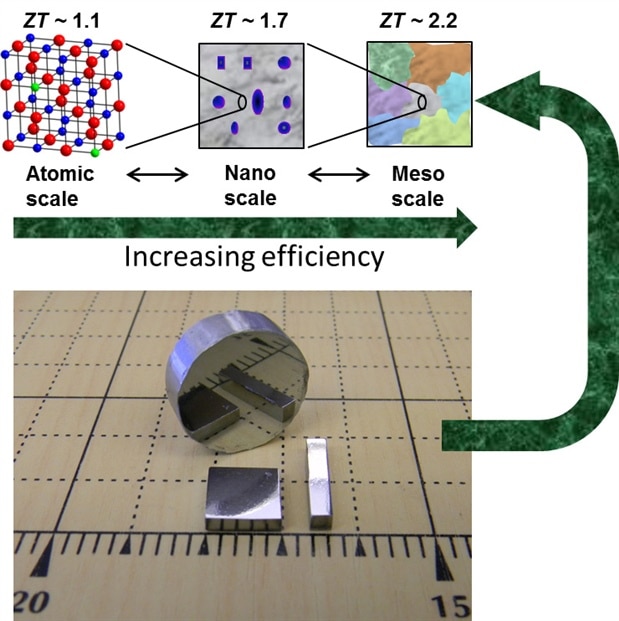


image

Slowing the flow of heat at three scales. (Via Northwestern & Mercouri Kanatzidis)


At Northwestern, researchers have found a way to improve on thermoelectric material that converts wasted heat into electricity. A temperature gradient within these materials, like the one caused by exhaust heat transferring to the ambient air, causes a current that can be harnessed. Working on atomic-, nano- and meso-scale structuring, the researchers were able to improve the ZT, or the thermoelectric efficiency, of PbTe above the 2.0 mark that had always been elusive.


Their approach involved structuring of the thermoelectric materials in a way that allowed for a scattering of a wider portion of the phonon spectrum. Phonons can be thought of as quasiparticles that make up the vibrations in heat. Scattering these phonons, scientists can extract electrons from them more efficiently. The experiment was conducted using p-type PbTe endotaxially nanostructured with SrTe and mesostructured (affecting grain size) with power processing and spark plasma sintering.


This resulted in a ZT of 2.2 at 915 K and consequently an efficiency of 20% in converting waste heat. This is a huge leap from ZT’s that had never reached 2 and efficiencies of 5-7%.


The implication of these results could have a tremendous effect on the efficiency of solar panels as most of their inefficiencies are due to energy being lost as rogue phonons (wasted heat).


imageimage

Solar dish focusing sunlight on to the IBM's prototype concentrated photovoltaic system. IBM claims a total efficiency at 18% (via IBM)


IBM has also come up with a method that will boost solar energy generation plus have the added benefit of using the excess heat to desalinate water by applying cooling methods, currently used to cool supercomputers, to PV cells.


IBM’s approach is to integrate water circuitry into solar cells to cool them and keep them at a temperature where they generate effectively. In a collaboration with the Egypt Nanotechnology Center in Cairo they have built a system that puts a small area of 1- cm high-efficiency solar cells in the focal point of a sun tracking and light collecting 1.5 meter dish. This concentrated photovoltaic system or CPV intensifies sunlight 150 times and causes temperatures to rise to around 120 degrees C.  The PV cell has embedded microchannels filled with water that cool it to ensure optimal photovoltaic temperatures. IBM then chose to use the heated water as part of a multi-effect boiling desalination process.


The efficiency of the CPV setup is 18%, but this is the first prototype to be demonstrated. IBMer Bruno Michel says the aim is to hit the 40% efficiency using better cooling systems that would allow solar arrays to function at 5000 times the normal intensity of the sun at temperatures of 70-90 degrees C. Michel states, “we know how to engineer these cooling packages for computers so we're confident we can make this contribution to solar energy."


Capturing these inefficiencies and using them with adjacent systems is the next step towards bringing the world closer to sustainability. It is likely that not a single system will provide us with adequate amounts of renewable energy but a diverse intertwined network, like those proposed by the Northwestern and IMB projects, will. Got to love energy engineering.


Cabe

http://twitter.com/Cabe_e14

  • Sign in to reply
  • DAB
    DAB over 13 years ago

    I am glad that researchers are looking beyond single technology implementations.  There are many things we could do to extract many more benefits from normal activities.  The heat wasted by power plants could  be harnessed for many subsidiary uses.  Desalinization, material dessication and even product blending would be easy targets.  All we need to do is co-located industries with power plants.  Just think about the heat wasted in cracking oil.  If we combined a oil thermal cracking plant with a nuclear power plant and a desalinization plant, we could greatly increase the return on investment by just reusing the heat generated.


    Hopefully, more people will get in on the idea and begin looking at reusing energy, instead of just increasing the Universal entropy.


    Just a thought,

    DAB

    • Cancel
    • Vote Up 0 Vote Down
    • Sign in to reply
    • More
    • Cancel
element14 Community

element14 is the first online community specifically for engineers. Connect with your peers and get expert answers to your questions.

  • Members
  • Learn
  • Technologies
  • Challenges & Projects
  • Products
  • Store
  • About Us
  • Feedback & Support
  • FAQs
  • Terms of Use
  • Privacy Policy
  • Legal and Copyright Notices
  • Sitemap
  • Cookies

An Avnet Company © 2026 Premier Farnell Limited. All Rights Reserved.

Premier Farnell Ltd, registered in England and Wales (no 00876412), registered office: Farnell House, Forge Lane, Leeds LS12 2NE.

ICP 备案号 10220084.

Follow element14

  • X
  • Facebook
  • linkedin
  • YouTube