


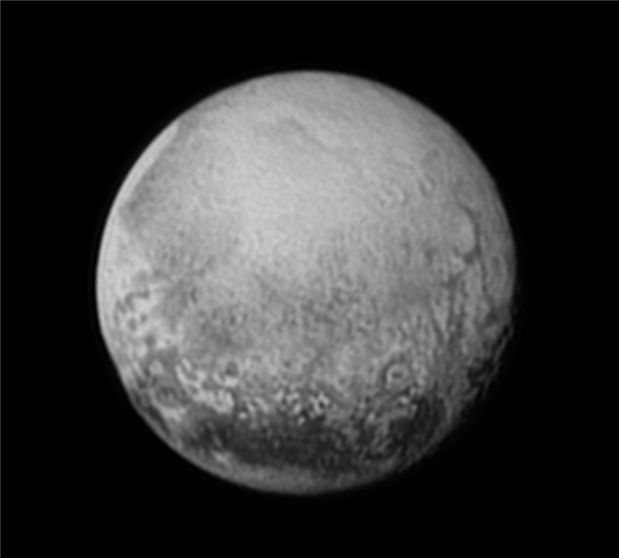
Are we there yet? After a nine-and-a-half year voyage the answer on July 14 will finally be “Yes!” as the New Horizons spacecraft passes just inside the orbit of Pluto’s moon Charon and to within 12,500 km (7,750 mi.) of the dwarf planet’s surface (when New Horizons launched from Cape Canaveral on Jan. 19, 2006 Pluto was considered a full-fledged planet, proving once again that a lot can happen in a decade).
The payload that this spacecraft carries is comprised of seven scientific instruments, which will make hundreds of observations and collect an estimated 70 gigabytes of data in the period before, during and after closest approach; at 1,000-4,000 kilobytes per second it will take about a year and a half for all of this data to make the 4 billion mile trek back to Earth.
Among the questions scientists hope New Horizons will help to answer include the composition of Pluto’s atmosphere, what its surface looks like (including major geological features) and to determine its atmospheric pressure and temperature. To do this the New Horizons science payload includes three optical instruments, two plasma instruments, a dust sensor and a radio science receiver/radiometer.
Let’s take a closer look at key elements of the instrument package:
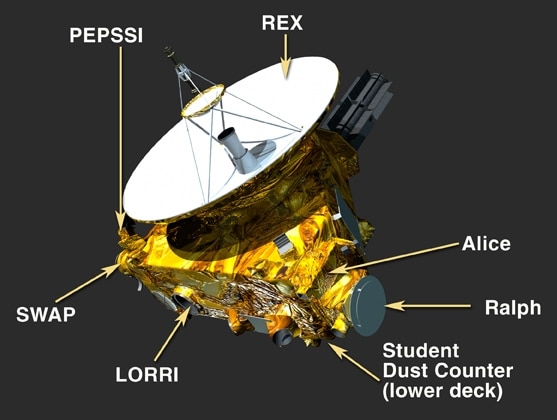
“Ralph,” the main eyes of New Horizon, will provide the closest images we have ever seen of Pluto when the spacecraft arrives at the dwarf planet. Ralph is not an acronym, but instead is named after the TV character Ralph Kramden of the 1950s sitcom, "The Honeymooners". Ralph consists of three panchromatic (black-and-white) and four color imagers inside its Multispectral Visible Imaging Camera (MVIC), as well as an infrared compositional mapping spectrometer called the Linear Etalon Imaging Spectral Array (LEISA). LEISA is an advanced, miniaturized short-wavelength infrared (1.25-2.50 micron) spectrometer provided by scientists from NASA’s Goddard Space Flight Center. Ralph is designed to help scientists map the surface geology of Pluto and its moons, and investigate Kuiper Belt objects. Ralph weighs only 23 pounds and operates on approximately seven watts. The device is designed to function in the 220 K (-60 degrees F) cold darkness of the outer solar system. Ralph was developed by the Ball Aerospace Corporation, NASA Goddard Space Flight Center and the Southwest Research Institute.
“Alice” is an ultraviolet imaging spectrometer designed to probe the composition and structure of Pluto’s atmosphere. Like its “Honeymooners” namesake it is the companion to Ralph. It consists of a compact telescope, a spectrograph, and a sensitive electronic detector. Alice is designed to probe the composition and structure of Pluto’s atmosphere. The instrument will try to detect a variety of chemicals in Pluto’s atmosphere, and determine their relative abundance. Alice weighs 9.9 lbs. and was developed by the Southwest Research Institute.
Weighing just 3.5oz., REX is the smallest instrument on the spacecraft. REX is an acronym for Radio Science Experiment. REX consists of a small printed circuit board containing signal-processing electronics integrated into the New Horizons telecommunications system. Because the telecom system is a critical component of New Horizons, the spacecraft carries two REX copies. REX will use an occultation technique to probe Pluto’s atmosphere and to search for an atmosphere around Charon. After New Horizons flies by Pluto, its 2.1-meter (83-inch) dish antenna will point back at Earth. On Earth, transmitters in NASA’s Deep Space Network will beam radio signals to the spacecraft as it passes behind Pluto. The radio waves will bend according to the average molecular weight of gas in the atmosphere and the atmospheric temperature. REX will also measure the weak radio emissions from Pluto and other bodies the spacecraft flies by, such as Charon. Scientists will use the data to derive day-side and night-side temperature measurements. Also, by using REX to track slight changes in the spacecraft’s path, scientists will measure the masses of Pluto and Charon and possibly the masses of additional Kuiper Belt Objects. REX was developed for the mission by the Johns Hopkins University Applied Physics Laboratory and Stanford University.
LORRI, (Long Range Reconnaissance Imager) is essentially a digital camera with a large telephoto telescope. The panchromatic high-magnification imager consists of a telescope with an 8.2-inch (20.8-centimeter) aperture that focuses visible light onto a charge-coupled device (CCD). LORRI images of Pluto have already surpassed Hubble-quality resolution as the spacecraft has travelled toward the dwarf planet. LORRI images will give scientists an unprecedented look at the geology on Pluto and its moons– including the number and size of craters on each surface, revealing the history of impacting objects. LORRI has no color filters or moving parts – operators take images by pointing the LORRI side of the spacecraft directly at their target. LORRI was developed by the Johns Hopkins University Applied Physics Laboratory.
The Solar Wind Around Pluto (SWAP) instrument will measure interactions of Pluto with the solar wind – the stream of fast-charged particles flowing from the Sun. By measuring how the solar wind is perturbed by the interaction with Pluto’s escaping atmosphere, SWAP will determine the escape rate of atmospheric material from Pluto. SWAP was developed by the Southwest Research Institute.
The Pluto Energetic Particle Spectrometer Science Investigation (PEPSSI), from the Johns Hopkins University Applied Physics Laboratory, is the most compact, lowest-power directional energetic particle spectrometer ever flown on a space mission. It will search for neutral atoms that escape Pluto’s atmosphere and become charged by their interaction with the solar wind. It will detect materials such as molecular nitrogen, carbon monoxide and methane, which break up into ions and electrons after absorbing the Sun’s ultraviolet light, and stream away from Pluto as “pickup” ions carried by the solar wind. PEPSSI can measure energetic particles up to 1,000 kiloelectron volts (keV), many times more energetic than what SWAP can measure.
Designed and built by students at the University of Colorado at Boulder, the Student Dust Counter (SDC) detects microscopic dust grains produced by collisions among asteroids, comets, and even Kuiper Belt Objects during New Horizons’ long journey. SDC is the first science instrument on a NASA planetary mission to be designed and built by students. When interplanetary dust hits the 18 X-12-in. detector, the student-built unit’s electronics register its mass and velocity. SDC will also be used to search for dust in the Pluto system, generated by impacts on Pluto’s small moons.
Top Comments
-

e14 Contributor
-
Cancel
-
Vote Up
0
Vote Down
-
-
Sign in to reply
-
More
-
Cancel
Comment-

e14 Contributor
-
Cancel
-
Vote Up
0
Vote Down
-
-
Sign in to reply
-
More
-
Cancel
Children