element14 Community
element14 Community
    Register Log In
  • Site
  • Search
  • Log In Register
  • Community Hub
    Community Hub
    • What's New on element14
    • Feedback and Support
    • Benefits of Membership
    • Personal Blogs
    • Members Area
    • Achievement Levels
  • Learn
    Learn
    • Ask an Expert
    • eBooks
    • element14 presents
    • Learning Center
    • Tech Spotlight
    • STEM Academy
    • Webinars, Training and Events
    • Learning Groups
  • Technologies
    Technologies
    • 3D Printing
    • FPGA
    • Industrial Automation
    • Internet of Things
    • Power & Energy
    • Sensors
    • Technology Groups
  • Challenges & Projects
    Challenges & Projects
    • Design Challenges
    • element14 presents Projects
    • Project14
    • Arduino Projects
    • Raspberry Pi Projects
    • Project Groups
  • Products
    Products
    • Arduino
    • Avnet & Tria Boards Community
    • Dev Tools
    • Manufacturers
    • Multicomp Pro
    • Product Groups
    • Raspberry Pi
    • RoadTests & Reviews
  • About Us
  • Store
    Store
    • Visit Your Store
    • Choose another store...
      • Europe
      •  Austria (German)
      •  Belgium (Dutch, French)
      •  Bulgaria (Bulgarian)
      •  Czech Republic (Czech)
      •  Denmark (Danish)
      •  Estonia (Estonian)
      •  Finland (Finnish)
      •  France (French)
      •  Germany (German)
      •  Hungary (Hungarian)
      •  Ireland
      •  Israel
      •  Italy (Italian)
      •  Latvia (Latvian)
      •  
      •  Lithuania (Lithuanian)
      •  Netherlands (Dutch)
      •  Norway (Norwegian)
      •  Poland (Polish)
      •  Portugal (Portuguese)
      •  Romania (Romanian)
      •  Russia (Russian)
      •  Slovakia (Slovak)
      •  Slovenia (Slovenian)
      •  Spain (Spanish)
      •  Sweden (Swedish)
      •  Switzerland(German, French)
      •  Turkey (Turkish)
      •  United Kingdom
      • Asia Pacific
      •  Australia
      •  China
      •  Hong Kong
      •  India
      • Japan
      •  Korea (Korean)
      •  Malaysia
      •  New Zealand
      •  Philippines
      •  Singapore
      •  Taiwan
      •  Thailand (Thai)
      • Vietnam
      • Americas
      •  Brazil (Portuguese)
      •  Canada
      •  Mexico (Spanish)
      •  United States
      Can't find the country/region you're looking for? Visit our export site or find a local distributor.
  • Translate
  • Profile
  • Settings
Publications
  • Learn
  • More
Publications
Blog Why Do They Even Make Tantalum Capacitors?
  • Blog
  • Documents
  • Events
  • Files
  • Members
  • Mentions
  • Sub-Groups
  • Tags
  • More
  • Cancel
  • New
Join Publications to participate - click to join for free!
  • Share
  • More
  • Cancel
Group Actions
  • Group RSS
  • More
  • Cancel
Engagement
  • Author Author: gervasi
  • Date Created: 29 Apr 2012 12:45 AM Date Created
  • Views 498 views
  • Likes 1 like
  • Comments 1 comment
  • capacitors
Related
Recommended

Why Do They Even Make Tantalum Capacitors?

gervasi
gervasi
29 Apr 2012

Someone asked me the other day what is the purpose of tantalum capacitors, especially ones with lower values.  In the 90s I used them all the time.  We liked them because you could get large values in modest package sizes, and they had lower ESR and better reliability than aluminum electrolytics.  When the tantalum shortage happened in 2000, I was perplexed by an order to use no tants on a design.  A colleague said that’s like asking us to design boards with one hand tied behind our backs.  image
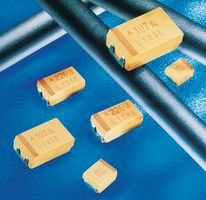
 

Without any publicized revolution in capacitor technology, over the next decade the maximum capacitance per package size of ceramic caps grew dramatically.  I would do a search for a 10uF cap and be surprised to find there was a ceramic option in an SMT package.  More than once I saw a switching power regulator datasheet say that designers using ceramics need to put a resistor in series because their part was designed to work with higher-ESR tants and aluminum electrolytics. 


So apart from special cases where you want at least some ESR, what’s the point of tants?  It’s not price:


2.2uF - 0402

TypePart NumberVoltage RatingToleranceCost
CeramicC1005X5R0J225M6.3VX5R 20%$0.044 @ 10k qty
TantalumTACK225M006QTA6.3V20%$2.51 @ 2k qty


2.2uF - 0805

TypePart NumberVoltage RatingToleranceCost
CeramicC2012X5R1A225M 10V X5R 20%$0.035 @ 2k qty
TantalumTAJR225M010RNJ10V20%$0.32 @ 2.5k qty


100uF -1210

TypePart NumberVoltage RatingToleranceCost
CeramicC1210C107M9PACTU6.3VX5R 20%$0.459 @ 2k
TantalumTCJB107M006R00706.3V20%$0.295 @ 2k


There is a good app note from Kemet on comparing tantalums and ceramics.  It explains the tradeoffs and makes it clear why we still need tants. 


Here is quick summary of the merits of tantalum caps:

  1. Ceramic values decay over time.  Soldering them recovers their full capacitance, which can cause them to exceed their rated capacitance for around day.  After this they can lose around 10% of their capacitance over a few years.
  2. Ceramics’ capacitance is a function of bias voltage.  Capacitance can decay nearly in half from 0 to rated voltage.
  3. Piezo electric effect - Signals in the capacitor can create audible vibrations.  Vibrations of the capacitor can create electrical noise.
  4. Vulnerable to failure due to mechanical strain.
  5. Capacitance is lower at DC than AC. (An AVX source listed this as a drawback that could cause instability when ceramics are used for AC coupling, but I question if in practice this ever impacts designs.)


Most people will be more familiar with the drawbacks of tantalum caps:

  1. Polar
  2. Can catch fire when they fail
  3. The need to avoid using tants at over half their rated voltage (I had wondered if it was engineering folklore, but the AVX app note says this rules is related to changes that can take place during soldering.)
  4. Lower capacitance at higher frequencies
  5. Higher leakage
  6. Higher ESR than ceramic (although lower than aluminum)


The issue on this list that stands out the most is the capacitance change over time.  I try to avoid using any large value caps for timing or high-tolerance applications.  In cases where I need moderately large values and tight tolerances, I will consider tants.


I would love to hear stories about how the introduction of high-value small-package ceramics has affected other engineers. 

  • Sign in to reply
  • DAB
    DAB over 13 years ago

    Given the short life span of today's products, you can probably get by with ceramics.  But if you are building devices with a longer lifespan, then a tantalum will keep your circuit closer to spec longer.


    At this point, I think that is your major decision point.  The expected lifetime of the device.


    Just my opinion,

    DAB

    • Cancel
    • Vote Up 0 Vote Down
    • Sign in to reply
    • More
    • Cancel
element14 Community

element14 is the first online community specifically for engineers. Connect with your peers and get expert answers to your questions.

  • Members
  • Learn
  • Technologies
  • Challenges & Projects
  • Products
  • Store
  • About Us
  • Feedback & Support
  • FAQs
  • Terms of Use
  • Privacy Policy
  • Legal and Copyright Notices
  • Sitemap
  • Cookies

An Avnet Company © 2025 Premier Farnell Limited. All Rights Reserved.

Premier Farnell Ltd, registered in England and Wales (no 00876412), registered office: Farnell House, Forge Lane, Leeds LS12 2NE.

ICP 备案号 10220084.

Follow element14

  • X
  • Facebook
  • linkedin
  • YouTube