



William Grant Moggridge (via IDEO)
The technology world has lost another innovative pioneer as William Moggridge succumbed to his battle with cancer at age 69 on September 8, 2012. Born on June 25, 1943 in London, England, William went on to study industrial design (1962-65) at Central St Martins College of Art and Design where he eventually left his home country to find work in the US shortly after finishing school. He found work at the American Sterilizing Company (in Pennsylvania) where he established a foot-hold in equipment design (hospital equipment), which would lead him down a life-long path of technology design. Eventually William returned to England and in 1969 returned to college to study typography and communications, which would tremendously benefit him later on in life. In the same year, he started his first company (from the top floor of his home), called Moggridge Associates, where his first successful marketable design was a toaster for Hoover (UK Branch) and in 1973 designed a space heater for the company that was featured on the cover of a popular UK design magazine. While designing industrial appliances for Hoover, William started to become interested in computer design and actually created the ‘Mini Computer’ for UK-based Computer Technology LTD., however it was never produced.
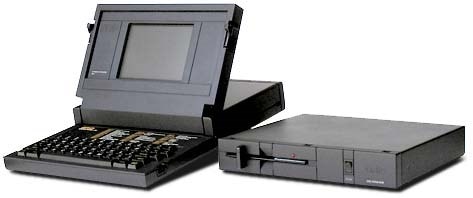
The GRiD Compass 1101 portable computer
In 1979, William returned to the US and opened up his second design company called ID Two where he garnered an early client known as Grid Systems Corporation (founded by John Ellenby). It was for Grid that he designed, what is arguably (if you take into account Xerox’s Dynabook project), the first laptop computer known widely as the GRiD Compass (the lower-cased i was a nod to Intel who assisted in helping get the company off the ground). The clam-shell portable PC was originally designed for wealthy business executives (as it cost $8150 US) but was quickly adopted by the US military Special Forces as a ‘field’ computer and by NASA for use on early Space Shuttle missions in the 80’s and even into the 90s! It has also been rumored that the GRiD was used in conjunction with the President’s ‘Nuclear Football,’ which is used to authorize a nuclear attack while away from designated command and control centers. Surprisingly the laptop had some pretty incredible power, considering the technology available at the time, even compared to desktops and featured an 8086 Intel processor (clocked in a blistering 8MHz) along with 256K of memory and 384K of bubble RAM for the hard-drive. The GRiD housed a fold-flat 6 inch electroluminescent (ELD) screen with a resolution of 80X24 for text and a surprising 320X240 for graphics which is astounding considering the IBM PC was not even around when it was being developed back in 1979 (and sold at market 3 years later). The early iteration of the GRiD ran the GRiD OS and was eventually outfitted with MS-DOS in later revisions. The laptop itself was housed in a ‘calm-shell’ like case made from a magnesium alloy and weighed in at 10 pounds, which isn’t so bad considering top-tier gaming laptops weigh in at around 7-8 pounds.

IDEO logo
While designing laptops and computer systems William also became interested in ‘interaction design’ (human-computer interaction through hardware/software) and began teaching at Stanford University’s Product Design Program as an associate consulting professor beginning in 1982 where he met another engineering designer David Kelley. The two, along with Mike Nutall (founder of Matrix Product Design), went on to found IDEO (design and innovation consultancy) in 1991 where he spent the next 19 years working on notable projects such as Apple’s first mouse and the Palm V PDA. In 2010, Moggridge left IDEO and became the director for the Cooper-Hewitt, National Design Museum (the first to do so without having a museum background) which is associated with the Smithsonian Institution and is centered on exhibits from the past 240 years on historical contemporary design. During his time with IDEO, William also became a notable author and had two books published with 1 in 2006 called ‘Designing Interactions’, which is a compilation of over 40 interviews he conducted with designers and entrepreneurs such as Douglas Englebart (internet pioneer) and Will Wright (game designer for EA) to showcase human/technology interaction. His second book, ‘Designing Media’, was published in 2010 and centered on human interaction with media and featured interviews with media giants such as Mark Zuckerberg (Facebook) and Chad Hurley (YouTube). William Grant Moggridge passed away at a hospice in San Francisco from a battle with cancer, but his technological legacy will live on thanks to his ingenious laptop design which manufacturers have been basing theirs on (flip-up screens/inlaid keyboards) even to this day. He is survived by his wife Karen, his sons Alex and Erik and his brother Hal.
William Grant Moggridge
1943-2012
Cabe