element14 Community
element14 Community
    Register Log In
  • Site
  • Search
  • Log In Register
  • Community Hub
    Community Hub
    • What's New on element14
    • Feedback and Support
    • Benefits of Membership
    • Personal Blogs
    • Members Area
    • Achievement Levels
  • Learn
    Learn
    • Ask an Expert
    • eBooks
    • element14 presents
    • Learning Center
    • Tech Spotlight
    • STEM Academy
    • Webinars, Training and Events
    • Learning Groups
  • Technologies
    Technologies
    • 3D Printing
    • FPGA
    • Industrial Automation
    • Internet of Things
    • Power & Energy
    • Sensors
    • Technology Groups
  • Challenges & Projects
    Challenges & Projects
    • Design Challenges
    • element14 presents Projects
    • Project14
    • Arduino Projects
    • Raspberry Pi Projects
    • Project Groups
  • Products
    Products
    • Arduino
    • Avnet & Tria Boards Community
    • Dev Tools
    • Manufacturers
    • Multicomp Pro
    • Product Groups
    • Raspberry Pi
    • RoadTests & Reviews
  • About Us
  • Store
    Store
    • Visit Your Store
    • Choose another store...
      • Europe
      •  Austria (German)
      •  Belgium (Dutch, French)
      •  Bulgaria (Bulgarian)
      •  Czech Republic (Czech)
      •  Denmark (Danish)
      •  Estonia (Estonian)
      •  Finland (Finnish)
      •  France (French)
      •  Germany (German)
      •  Hungary (Hungarian)
      •  Ireland
      •  Israel
      •  Italy (Italian)
      •  Latvia (Latvian)
      •  
      •  Lithuania (Lithuanian)
      •  Netherlands (Dutch)
      •  Norway (Norwegian)
      •  Poland (Polish)
      •  Portugal (Portuguese)
      •  Romania (Romanian)
      •  Russia (Russian)
      •  Slovakia (Slovak)
      •  Slovenia (Slovenian)
      •  Spain (Spanish)
      •  Sweden (Swedish)
      •  Switzerland(German, French)
      •  Turkey (Turkish)
      •  United Kingdom
      • Asia Pacific
      •  Australia
      •  China
      •  Hong Kong
      •  India
      • Japan
      •  Korea (Korean)
      •  Malaysia
      •  New Zealand
      •  Philippines
      •  Singapore
      •  Taiwan
      •  Thailand (Thai)
      • Vietnam
      • Americas
      •  Brazil (Portuguese)
      •  Canada
      •  Mexico (Spanish)
      •  United States
      Can't find the country/region you're looking for? Visit our export site or find a local distributor.
  • Translate
  • Profile
  • Settings
Publications
  • Learn
  • More
Publications
Blog Wireless brake for bicycles, almost perfectly safe
  • Blog
  • Documents
  • Events
  • Files
  • Members
  • Mentions
  • Sub-Groups
  • Tags
  • More
  • Cancel
  • New
Join Publications to participate - click to join for free!
  • Share
  • More
  • Cancel
Group Actions
  • Group RSS
  • More
  • Cancel
Engagement
  • Author Author: Catwell
  • Date Created: 3 Nov 2011 7:34 PM Date Created
  • Views 424 views
  • Likes 0 likes
  • Comments 0 comments
  • research
  • bicycle
  • industrial
  • industry
  • hmi
  • robotics
  • robot
  • bike
  • brake
  • cabeatwell:dit
  • germany
  • sensor
  • innovation
  • communication
Related
Recommended

Wireless brake for bicycles, almost perfectly safe

Catwell
Catwell
3 Nov 2011
image
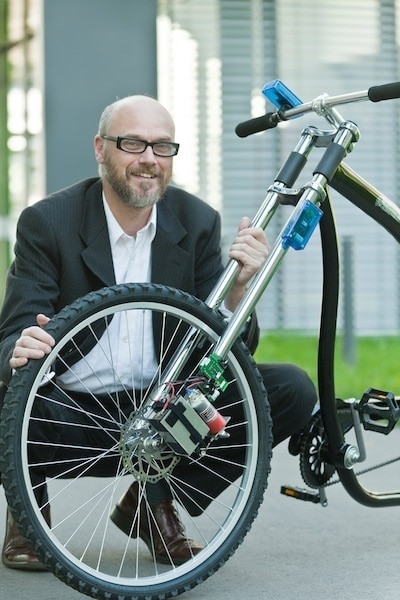
Professor Holger Hermanns and the wireless brake system (via Saarland University)
 
What is 99.999999999997 safe and has a 250 milli-second delay? It is the wireless bicycle brake from Saarland University. Professor Holger Hermanns, lead designer on the project, had this to say about the reliability, "... out of a trillion braking attempts, we have three failures. That is not perfect, but acceptable."
 
With pressure sensors in the bicycle's grips, the rider has to just squeeze. The system interprets how hard the person in squeezing, and adjusts the brake's clamping power proportionately. The transmitter, blue box on the handle bars, relays the signal to the breaking apparatus. The system uses a TDMA-based communication link (2.4GHz ISM band, MyriaNed wireless node). Each node is run with an Atmel atxmega128A1 and a Nordic Semiconductor NRF24L01GNRF24L01G+ transceiver. According to the design team, adding additional signal repeaters does not increase the reliability. 
 

image
 
The clamping force is applied with what looks to be a stepper motor or large solenoid. The power demands of a stepper motor would be less strenuous, so I am leaning in that direction. Either way, the team stated that making a anti-lock brake system is entirely possible. Right now the team is more focused on defeating the 250milli-second delay. As they stated, "Its current configuration enables the cruiser bike to brake within 250 milliseconds. This means that at a speed of 30 kilometers per hour, the cyclist has to react two meters before reaching the dangerous situation."
 
Looking for a job in Germany? Professor Hermanns is looking for engineers who understand his concept of wireless braking to help with his efforts. The project is funded by the German Research Foundation under the "Automatic Verification and Analysis of Complex Systems (AVACS)" label. Read more about the fundamentals and technology behind the wireless brake in Professor Hermanns's paper, "A Verified Wireless Safety Critical Hard Real-Time Design." Note the file name, "wowmom.pdf."
 
Cabe
http://twitter.com/Cabe_e14
  • Sign in to reply
element14 Community

element14 is the first online community specifically for engineers. Connect with your peers and get expert answers to your questions.

  • Members
  • Learn
  • Technologies
  • Challenges & Projects
  • Products
  • Store
  • About Us
  • Feedback & Support
  • FAQs
  • Terms of Use
  • Privacy Policy
  • Legal and Copyright Notices
  • Sitemap
  • Cookies

An Avnet Company © 2025 Premier Farnell Limited. All Rights Reserved.

Premier Farnell Ltd, registered in England and Wales (no 00876412), registered office: Farnell House, Forge Lane, Leeds LS12 2NE.

ICP 备案号 10220084.

Follow element14

  • X
  • Facebook
  • linkedin
  • YouTube