element14 Community
element14 Community
    Register Log In
  • Site
  • Search
  • Log In Register
  • Community Hub
    Community Hub
    • What's New on element14
    • Feedback and Support
    • Benefits of Membership
    • Personal Blogs
    • Members Area
    • Achievement Levels
  • Learn
    Learn
    • Ask an Expert
    • eBooks
    • element14 presents
    • Learning Center
    • Tech Spotlight
    • STEM Academy
    • Webinars, Training and Events
    • Learning Groups
  • Technologies
    Technologies
    • 3D Printing
    • FPGA
    • Industrial Automation
    • Internet of Things
    • Power & Energy
    • Sensors
    • Technology Groups
  • Challenges & Projects
    Challenges & Projects
    • Design Challenges
    • element14 presents Projects
    • Project14
    • Arduino Projects
    • Raspberry Pi Projects
    • Project Groups
  • Products
    Products
    • Arduino
    • Avnet & Tria Boards Community
    • Dev Tools
    • Manufacturers
    • Multicomp Pro
    • Product Groups
    • Raspberry Pi
    • RoadTests & Reviews
  • About Us
  • Store
    Store
    • Visit Your Store
    • Choose another store...
      • Europe
      •  Austria (German)
      •  Belgium (Dutch, French)
      •  Bulgaria (Bulgarian)
      •  Czech Republic (Czech)
      •  Denmark (Danish)
      •  Estonia (Estonian)
      •  Finland (Finnish)
      •  France (French)
      •  Germany (German)
      •  Hungary (Hungarian)
      •  Ireland
      •  Israel
      •  Italy (Italian)
      •  Latvia (Latvian)
      •  
      •  Lithuania (Lithuanian)
      •  Netherlands (Dutch)
      •  Norway (Norwegian)
      •  Poland (Polish)
      •  Portugal (Portuguese)
      •  Romania (Romanian)
      •  Russia (Russian)
      •  Slovakia (Slovak)
      •  Slovenia (Slovenian)
      •  Spain (Spanish)
      •  Sweden (Swedish)
      •  Switzerland(German, French)
      •  Turkey (Turkish)
      •  United Kingdom
      • Asia Pacific
      •  Australia
      •  China
      •  Hong Kong
      •  India
      • Japan
      •  Korea (Korean)
      •  Malaysia
      •  New Zealand
      •  Philippines
      •  Singapore
      •  Taiwan
      •  Thailand (Thai)
      • Vietnam
      • Americas
      •  Brazil (Portuguese)
      •  Canada
      •  Mexico (Spanish)
      •  United States
      Can't find the country/region you're looking for? Visit our export site or find a local distributor.
  • Translate
  • Profile
  • Settings
Publications
  • Learn
  • More
Publications
Blog World’s largest, Thirty Meter Telescope cleared for construction in Mauna Kea, Hawaii
  • Blog
  • Documents
  • Events
  • Files
  • Members
  • Mentions
  • Sub-Groups
  • Tags
  • More
  • Cancel
  • New
Join Publications to participate - click to join for free!
  • Share
  • More
  • Cancel
Group Actions
  • Group RSS
  • More
  • Cancel
Engagement
  • Author Author: Catwell
  • Date Created: 26 Apr 2013 7:57 PM Date Created
  • Views 465 views
  • Likes 0 likes
  • Comments 0 comments
  • research
  • test
  • privatizedspacerace
  • hmi
  • telescope
  • space_race
  • on_campus
  • space
  • cabeatwell
  • prototyping
  • university
  • innovation
  • communication
Related
Recommended

World’s largest, Thirty Meter Telescope cleared for construction in Mauna Kea, Hawaii

Catwell
Catwell
26 Apr 2013

image

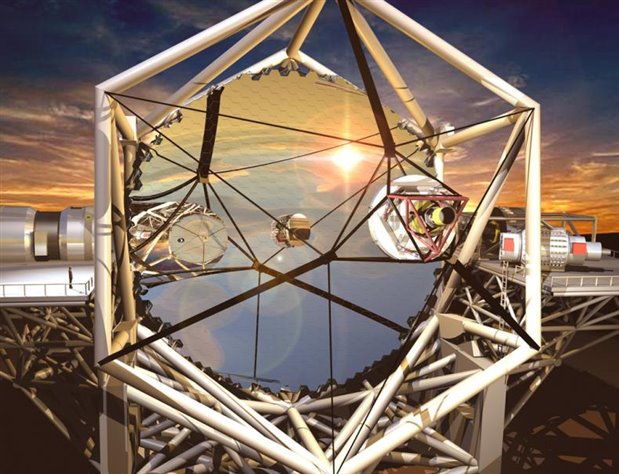
The Thirty Meter Telescope (TMT) concept render (via California Institute of Technology)


It may be awhile before humans can venture far into deep space in search of answers to questions regarding the universe and the nature of existence - however, that is not stopping scientists from peering out into space to see what they can find. The long-awaited Thirty Meter Telescope (TMT), which will soon be the largest telescope on Earth, has finally been cleared for construction atop the summit of Mauna Kea, Hawaii. Though construction is not slated to start until April of 2014, the decision to build comes after years of development and opposition from local natives who were concerned with the impact the telescope would have on their sacred land.


The TMT originally began as the California Extremely Large Telescope back in the early 90s, but thanks to an overwhelmingly positive response on the project has since gained several partnerships and a new name in the early 2000s. TMT collaborators are comprised of many major universities, such as: the California Institute of Technology, the University of California, he Association of Canadian Universities for Research in Astronomy, the National Astronomical Observatory of Japan, a consortium of Chinese institutions led by the National Astronomical Observatories of the Chinese Academy of Sciences, and institutions in India supported by the Department of Science and Technology of India.


Opposition for the TMT’s construction came heavily from the local Hawaiian community with concerns about the protection of Mauna Kea’s sacred environment. In February of this year, a final hearing was held where the approval was made to go forward with construction as long as the community’s wishes were respected. The plan will now move forward to benefit both the advancement of science and the local Hawaiian natives - honoring their cherished land full of cultural and historical significance with careful construction and providing annual funding for local education.
 

image

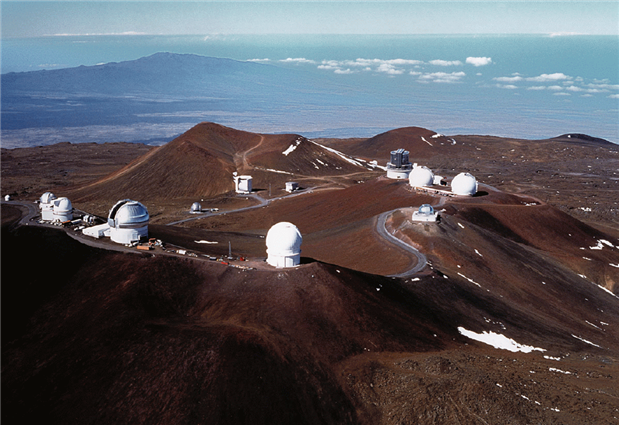
Mauna Kea (Hawaii) from 2001, already littered with various telescopes, what is one more - right? (via I.M. Gioia)


The name TMT is a direct reference to the telescope’s 30-meter diameter primary meter that is in fact made up of 492 smaller hexagonal mirrors, each of which can be controlled actively. The entire rig will be fitted atop an altitude-alzimuth mount capable of re-orienting the direction of the telescope between any two celestial objects within 5 minutes at an accuracy of 2 arc seconds (one arc second = one-sixtieth of a degree). Observations will be made in the near ultraviolet to mid-infrared light range utilizing an adaptive focus system that eliminates blurring effects caused by the atmosphere for a crystal clear look into deep space. When complete, the TMT will allow scientists to peer into the sky to study the Milky Way, its neighboring galaxies, and forming galaxies near the edge of the observable Universe. The following list was provided by the TMT Foundation to showcase the telescope’s intended purpose and capability:


  • Dark energydark matterStandard Model of particle physics
  • Characterization of the first starsgalaxies
  • Characterization of the epoch of reionization
  • Galaxy assembly and evolution over the past 13 billion years
  • Connections between supermassive black holes
  • Star-by-star dissection of galaxies out to 10 million parsecs
  • Physics of planetstar formation
  • Exoplanet
  • Kuiper belt
  • Solar system planetary atmosphere
  • The search for life


If all goes well, astronomers will begin observation in 2021. For more information on TMT, please visit their website at http://www.tmt.org


C

See more news at:

http://twitter.com/Cabe_e14

  • Sign in to reply
element14 Community

element14 is the first online community specifically for engineers. Connect with your peers and get expert answers to your questions.

  • Members
  • Learn
  • Technologies
  • Challenges & Projects
  • Products
  • Store
  • About Us
  • Feedback & Support
  • FAQs
  • Terms of Use
  • Privacy Policy
  • Legal and Copyright Notices
  • Sitemap
  • Cookies

An Avnet Company © 2026 Premier Farnell Limited. All Rights Reserved.

Premier Farnell Ltd, registered in England and Wales (no 00876412), registered office: Farnell House, Forge Lane, Leeds LS12 2NE.

ICP 备案号 10220084.

Follow element14

  • X
  • Facebook
  • linkedin
  • YouTube