element14 Community
element14 Community
    Register Log In
  • Site
  • Search
  • Log In Register
  • Community Hub
    Community Hub
    • What's New on element14
    • Feedback and Support
    • Benefits of Membership
    • Personal Blogs
    • Members Area
    • Achievement Levels
  • Learn
    Learn
    • Ask an Expert
    • eBooks
    • element14 presents
    • Learning Center
    • Tech Spotlight
    • STEM Academy
    • Webinars, Training and Events
    • Learning Groups
  • Technologies
    Technologies
    • 3D Printing
    • FPGA
    • Industrial Automation
    • Internet of Things
    • Power & Energy
    • Sensors
    • Technology Groups
  • Challenges & Projects
    Challenges & Projects
    • Design Challenges
    • element14 presents Projects
    • Project14
    • Arduino Projects
    • Raspberry Pi Projects
    • Project Groups
  • Products
    Products
    • Arduino
    • Avnet & Tria Boards Community
    • Dev Tools
    • Manufacturers
    • Multicomp Pro
    • Product Groups
    • Raspberry Pi
    • RoadTests & Reviews
  • About Us
  • Store
    Store
    • Visit Your Store
    • Choose another store...
      • Europe
      •  Austria (German)
      •  Belgium (Dutch, French)
      •  Bulgaria (Bulgarian)
      •  Czech Republic (Czech)
      •  Denmark (Danish)
      •  Estonia (Estonian)
      •  Finland (Finnish)
      •  France (French)
      •  Germany (German)
      •  Hungary (Hungarian)
      •  Ireland
      •  Israel
      •  Italy (Italian)
      •  Latvia (Latvian)
      •  
      •  Lithuania (Lithuanian)
      •  Netherlands (Dutch)
      •  Norway (Norwegian)
      •  Poland (Polish)
      •  Portugal (Portuguese)
      •  Romania (Romanian)
      •  Russia (Russian)
      •  Slovakia (Slovak)
      •  Slovenia (Slovenian)
      •  Spain (Spanish)
      •  Sweden (Swedish)
      •  Switzerland(German, French)
      •  Turkey (Turkish)
      •  United Kingdom
      • Asia Pacific
      •  Australia
      •  China
      •  Hong Kong
      •  India
      • Japan
      •  Korea (Korean)
      •  Malaysia
      •  New Zealand
      •  Philippines
      •  Singapore
      •  Taiwan
      •  Thailand (Thai)
      • Vietnam
      • Americas
      •  Brazil (Portuguese)
      •  Canada
      •  Mexico (Spanish)
      •  United States
      Can't find the country/region you're looking for? Visit our export site or find a local distributor.
  • Translate
  • Profile
  • Settings
Publications
  • Learn
  • More
Publications
Blog X PRIZE, Star Trek Tricorder, and T-rays may usher in a medical revolution
  • Blog
  • Documents
  • Events
  • Files
  • Members
  • Mentions
  • Sub-Groups
  • Tags
  • More
  • Cancel
  • New
Join Publications to participate - click to join for free!
  • Share
  • More
  • Cancel
Group Actions
  • Group RSS
  • More
  • Cancel
Engagement
  • Author Author: Catwell
  • Date Created: 23 Jan 2012 9:04 PM Date Created
  • Views 596 views
  • Likes 1 like
  • Comments 1 comment
  • research
  • test
  • star_trek
  • hmi
  • on_campus
  • xprize
  • x_prize
  • Design
  • cabeatwell
  • prototyping
  • measurement
  • university
  • medical
  • technology_for_the_disabled
  • sensor
  • innovation
  • tricorder
  • communication
Related
Recommended

X PRIZE, Star Trek Tricorder, and T-rays may usher in a medical revolution

Catwell
Catwell
23 Jan 2012
image
X PRIZE Tricorder promotional image. (via X PRIZE)
 
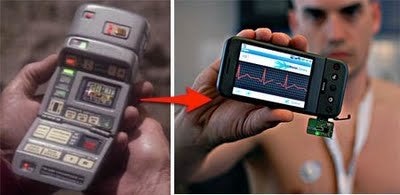
This year, 2012, marks the start of a new "X PRIZE," creating Star Trek's famous medical tricorders out of current technology. The X PRIZE foundation, along with Qualcomm, are putting up the $10 million USD for the "Tricorder X PRIZE." The foundation explained the goal of the contest, "The idea is to take advantage of the increasing power of mobile devices to make health care more accessible and easier to understand. With the equivalent of a board of physicians in your pocket, wireless sensors and imaging, you will be able to assess health and determine health care needs with a device in the palm of your hand."

Take the recent webOS based MRI system, a lot of people are close to making the device a reality. It is putting all supporting technology in one place that is key.

What may bring about the technology faster is producing Terahetz electromagnetic waves (T-rays) on a small scale. Currently, T-rays are the scanning base tech of airport scanners. With wavelength's 100 times longer than visible light, penetrating clothing (fabrics, plastics, etc) is easy. (Can also humiliate people as easily.) T-rays are already being used in medical fields.

T-rays can be used to detect increased blood flow around tumor like growths, see cancerous tumors, and even living DNA. (T-rays have relatively low photon energy compared to x-rays. So damage to tissue and DNA is low.) Some frequencies in the Terahetz band can penetrate several millimeters of tissue and even teeth.
 
image
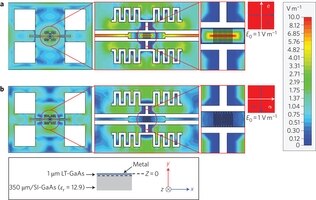
a, Photomixer with tip-to-tip nanogap electrodes. b,  Photomixer with typical interdigitated electrodes. Inset:  cross-sectional schematics of the devices and the axis convention used  in the simulation. (Via ASTAR)

Researchers from the Agency for Science, Technology, and Research (ASTAR) in Singapore (Institute of Materials Research and Engineering), along with the Imperial College London are boasting a way to create more efficient T-rays at room temperature by creating a 100 nm gap of two metal strips on a semiconductor wafer, creating a "nano-antenna." The result were T-rays 100 times more powerful than current technology.
 

image
Right: overall antenna structure with four bias pads and a modified  meander terahertz antenna design. Left: active region designs with  interdigitated electrodes (top) and tip-to-tip nanogap electrodes  (bottom).

Co-author of the study Stefan Maier said it best, "T-rays promise to revolutionize medical scanning to make it faster and more convenient, potentially relieving patients from the inconvenience of complicated diagnostic procedures and the stress of waiting for accurate results." See more of the study, "Greatly enhanced continuous-wave terahertz emission by nano-electrodes in a photoconductive photomixer," after the length.

At 100x the power, the new T-ray source could penetrate the entire human body. The technology exists; It will be the analysis of the resultant scans that will win the X PRIZE.

Cabe
http://twitter.com/Cabe_e14
  • Sign in to reply
  • DAB
    DAB over 13 years ago

    Hi Cabe,


    I agree.  Once they have the basic hardware to send and record the data, we already have tons of analysis software ready to use the inputs for all kinds of processing.  You are basically using a sonar system to penetrate the body.  The USN has funded many projects for bringing coherent information from the data.  This device would just be another source of data.


    Cool.


    DAB

    • Cancel
    • Vote Up 0 Vote Down
    • Sign in to reply
    • More
    • Cancel
element14 Community

element14 is the first online community specifically for engineers. Connect with your peers and get expert answers to your questions.

  • Members
  • Learn
  • Technologies
  • Challenges & Projects
  • Products
  • Store
  • About Us
  • Feedback & Support
  • FAQs
  • Terms of Use
  • Privacy Policy
  • Legal and Copyright Notices
  • Sitemap
  • Cookies

An Avnet Company © 2026 Premier Farnell Limited. All Rights Reserved.

Premier Farnell Ltd, registered in England and Wales (no 00876412), registered office: Farnell House, Forge Lane, Leeds LS12 2NE.

ICP 备案号 10220084.

Follow element14

  • X
  • Facebook
  • linkedin
  • YouTube