

LAN parties offer the enjoyment of head to head gaming in a real-life social environment. In general, they are experiencing decline thanks to the convenience of Internet gaming, but Kenton Varda is a man who takes his LAN gaming very seriously. His LAN gaming house is a fascinating project, and best of all, Linux plays a part in making it all work.
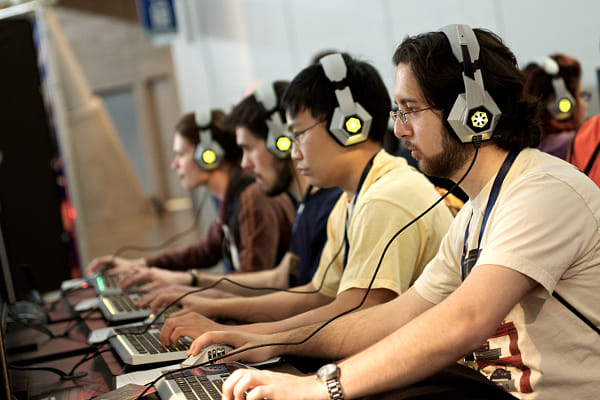
Varda has done his own write ups (short, long), so I'm only going to give an overview here. The setup is a large house with 12 gaming stations and a single server computer.
The client computers themselves are rack mounted in a server room, and they are linked to the gaming stations on the floor above via extension cables (HDMI for video and audio and USB for mouse and keyboard). Each client computer, built into a 3U rack mount case, is a well specced gaming rig in its own right, sporting an Intel Core i5 processor, 4GB of RAM and an Nvidia GeForce 560 along with a 60GB SSD drive.
Originally, the client computers ran Ubuntu Linux rather than Windows and the games executed under WINE, but Varda had to abandon this scheme. As he explains on his site:
"Amazingly, a majority of games worked fine, although many had minor bugs (e.g. flickering mouse cursor, minor rendering artifacts, etc.). Some games, however, did not work, or had bad bugs that made them annoying to play."
Subsequently, the gaming computers have been moved onto a more conventional gaming choice, Windows 7. It's a shame that WINE couldn't be made to work, but I can sympathize as it's rare to find modern games that work perfectly and at full native speed. Another problem with WINE is that it tends to suffer from regressions, which is hardly surprising when considering the difficulty of constantly improving the emulation of the Windows API. Varda points out that he preferred working with Linux clients as they were easier to modify and came with less licensing baggage.
Linux still runs the server and all of the tools used are open source software. The hardware here is a Intel Xeon E3-1230 with 4GB of RAM. The storage hanging off this machine is a bit more complex than the clients. In addition to the 60GB SSD, it also has 2x1TB drives and a 240GB SDD.
When the clients were running Linux, they booted over PXE using a toolchain that will be familiar to anyone who has setup Linux network booting. DHCP pointed the clients to the server which then supplied PXELINUX using TFTP. When booted, file access was accomplished through network block device (NBD). This is a very easy to use system that allows you to serve the contents of a file as a block device over the network. The client computer runs a user mode device driver and the device can be mounted within the file system using the mount command.
One snag with offering file access via NBD is that it's difficult to impose any security restrictions on different areas of the file system as the server only sees a single file. The advantage is perfomance as the client operating system simply sees a block device, and besides, these security issues aren't relevant in this setup.
Unfortunately, Windows 7 can't use NBD, so, Varda had to switch to iSCSI (which works in both server and client mode under Linux). His network cards are not compliant with this standard when doing a netboot, but fortunately, gPXE came to the rescue, and he boostraps it over PXE. gPXE is also available as an ISO image and is worth knowing about if you encounter an awkward machine that can't manage a network boot. It can also optionally boot from a HTTP server rather than the more traditional TFTP server.
According to Varda, booting all 12 machines over the Gigabit Ethernet network is surprisingly fast, and once booted, the machines don't seem noticeably slower than if they were using local storage. Once loaded, most games attempt to load in as much data as possible, filling the RAM, and the the disk and network bandwidth required is small. It's worth noting that these are aspects of this project that might differ from some other thin client scenarios.
At time of writing, it doesn't seem as though the local storage of the client machines is being utilized. Instead, the clients boot into Windows from an image on the server that contains the operating system and the games themselves. It uses the copy on write feature of LVM so that any writes from a client are added to a differencing image allocated to that client. As the administrator, Varda can log into the Linux server and authorize changes to the master image for updates etc.
VIA LINUX JOURNAL