element14 Community
element14 Community
    Register Log In
  • Site
  • Search
  • Log In Register
  • Community Hub
    Community Hub
    • What's New on element14
    • Feedback and Support
    • Benefits of Membership
    • Personal Blogs
    • Members Area
    • Achievement Levels
  • Learn
    Learn
    • Ask an Expert
    • eBooks
    • element14 presents
    • Learning Center
    • Tech Spotlight
    • STEM Academy
    • Webinars, Training and Events
    • Learning Groups
  • Technologies
    Technologies
    • 3D Printing
    • FPGA
    • Industrial Automation
    • Internet of Things
    • Power & Energy
    • Sensors
    • Technology Groups
  • Challenges & Projects
    Challenges & Projects
    • Design Challenges
    • element14 presents Projects
    • Project14
    • Arduino Projects
    • Raspberry Pi Projects
    • Project Groups
  • Products
    Products
    • Arduino
    • Avnet & Tria Boards Community
    • Dev Tools
    • Manufacturers
    • Multicomp Pro
    • Product Groups
    • Raspberry Pi
    • RoadTests & Reviews
  • About Us
    About the element14 Community
  • Store
    Store
    • Visit Your Store
    • Choose another store...
      • Europe
      •  Austria (German)
      •  Belgium (Dutch, French)
      •  Bulgaria (Bulgarian)
      •  Czech Republic (Czech)
      •  Denmark (Danish)
      •  Estonia (Estonian)
      •  Finland (Finnish)
      •  France (French)
      •  Germany (German)
      •  Hungary (Hungarian)
      •  Ireland
      •  Israel
      •  Italy (Italian)
      •  Latvia (Latvian)
      •  
      •  Lithuania (Lithuanian)
      •  Netherlands (Dutch)
      •  Norway (Norwegian)
      •  Poland (Polish)
      •  Portugal (Portuguese)
      •  Romania (Romanian)
      •  Russia (Russian)
      •  Slovakia (Slovak)
      •  Slovenia (Slovenian)
      •  Spain (Spanish)
      •  Sweden (Swedish)
      •  Switzerland(German, French)
      •  Turkey (Turkish)
      •  United Kingdom
      • Asia Pacific
      •  Australia
      •  China
      •  Hong Kong
      •  India
      •  Japan
      •  Korea (Korean)
      •  Malaysia
      •  New Zealand
      •  Philippines
      •  Singapore
      •  Taiwan
      •  Thailand (Thai)
      •  Vietnam
      • Americas
      •  Brazil (Portuguese)
      •  Canada
      •  Mexico (Spanish)
      •  United States
      Can't find the country/region you're looking for? Visit our export site or find a local distributor.
  • Translate
  • Profile
  • Settings
Community Hub
Community Hub
Member Blogs Analog Discovery 3 - Impedance Analyzer
  • Blog
  • Forum
  • Documents
  • Quiz
  • Events
  • Leaderboard
  • Polls
  • Files
  • Members
  • Mentions
  • Sub-Groups
  • Tags
  • More
  • Cancel
  • New
Join Community Hub to participate - click to join for free!
  • Share
  • More
  • Cancel
Group Actions
  • Group RSS
  • More
  • Cancel
Engagement
  • Author Author: kk99
  • Date Created: 9 Mar 2026 6:38 PM Date Created
  • Views 19 views
  • Likes 2 likes
  • Comments 0 comments
  • impedance analyzer
  • Analog Discovery 3
  • analog_circuits
Related
Recommended

Analog Discovery 3 - Impedance Analyzer

kk99
kk99
9 Mar 2026

image

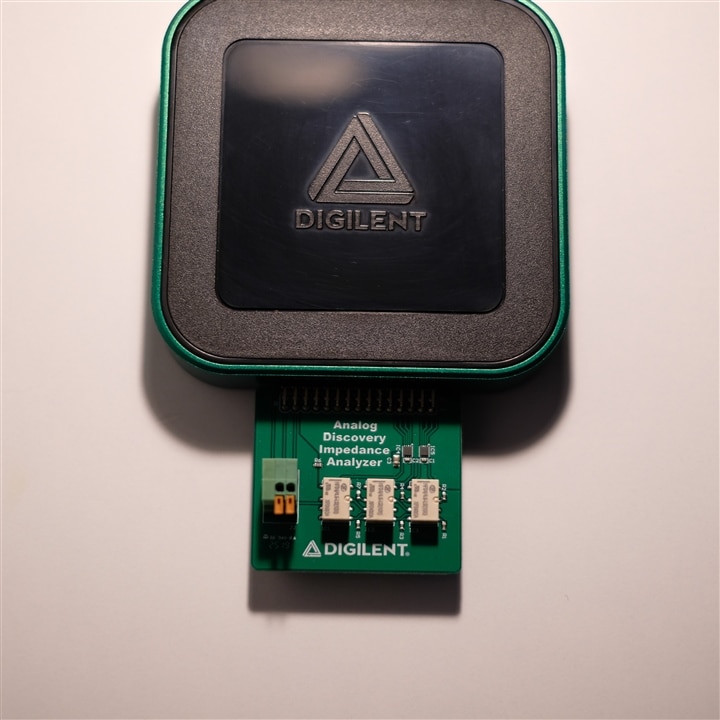
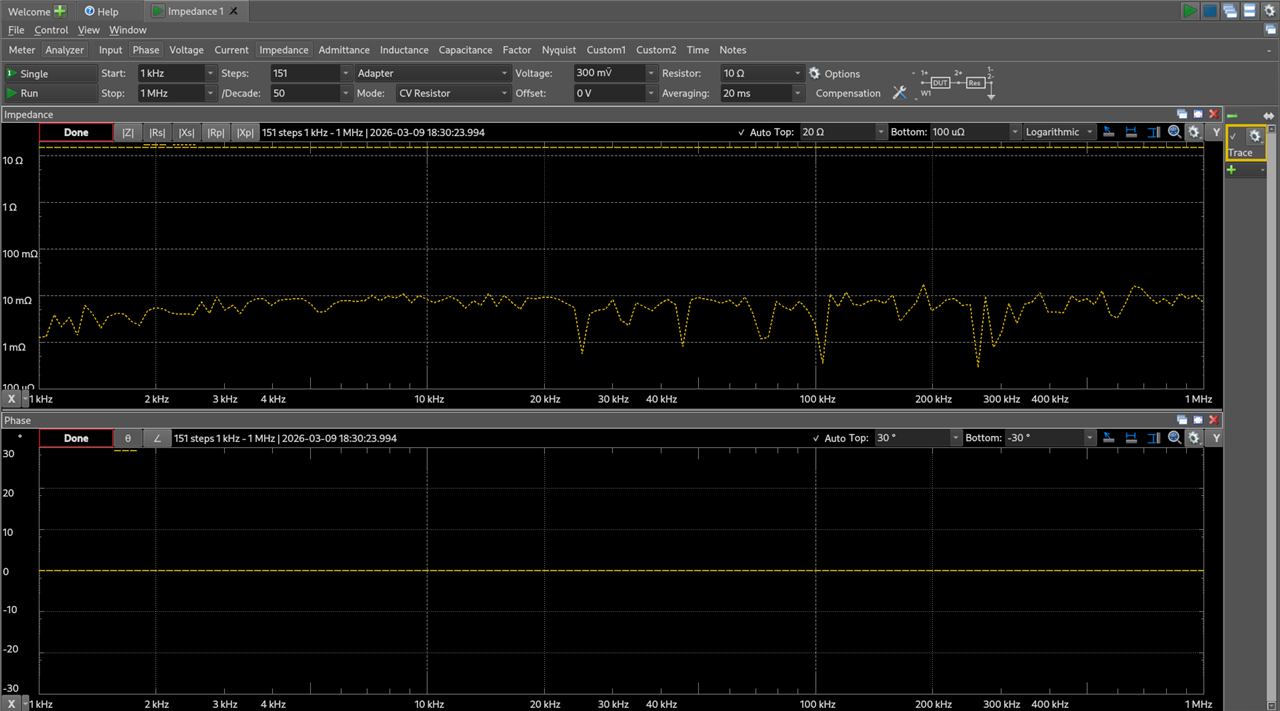
Today I have checked the adapter for an impedance analyzer which I recently received. I previously did some tests using a breadboard during which I manually chose resistors for measurement, but this adapter makes measurement easier, because we could select a reference resistor just from WaveForms or choose the automatic detection option. This adapter contains a set of precision 0.1 % resistors that can be selected from WaveForms. For the first measurement, I have chosen a 15 Ohm and 1Mohm 0.1% precision resistors. I performed meter and analyzer mode measurements. Below the results:
image

image

image

image

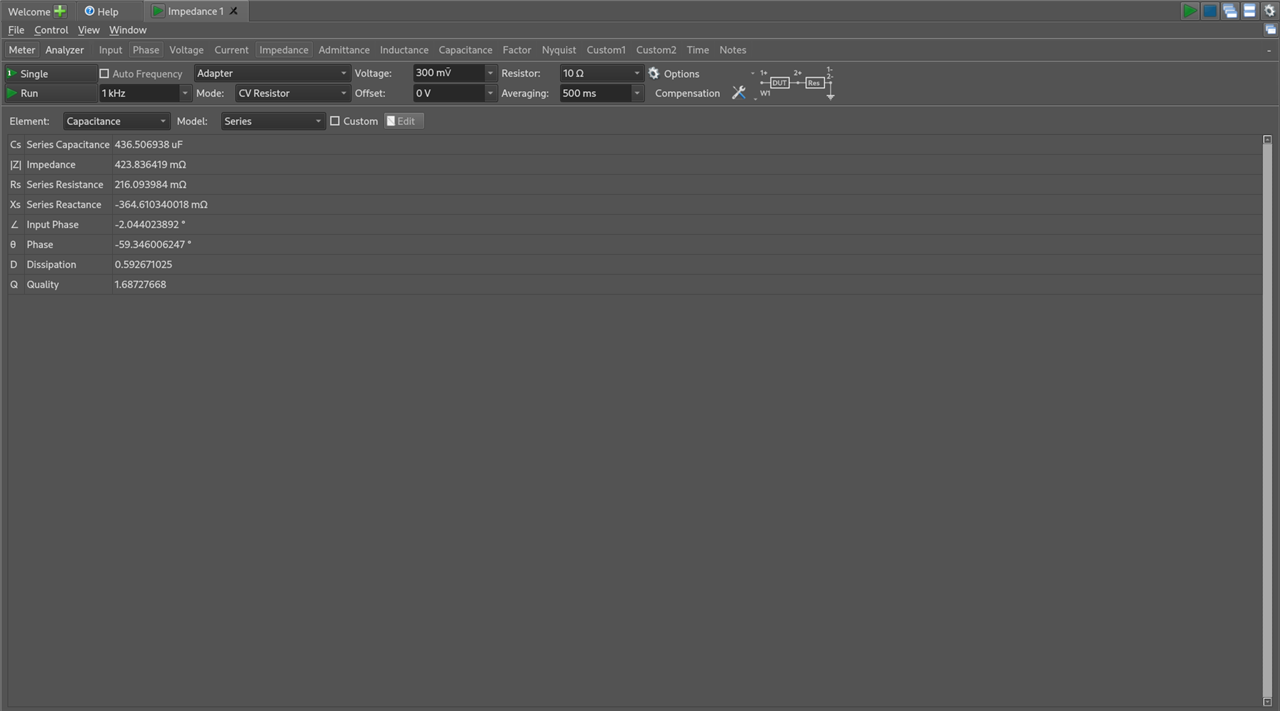
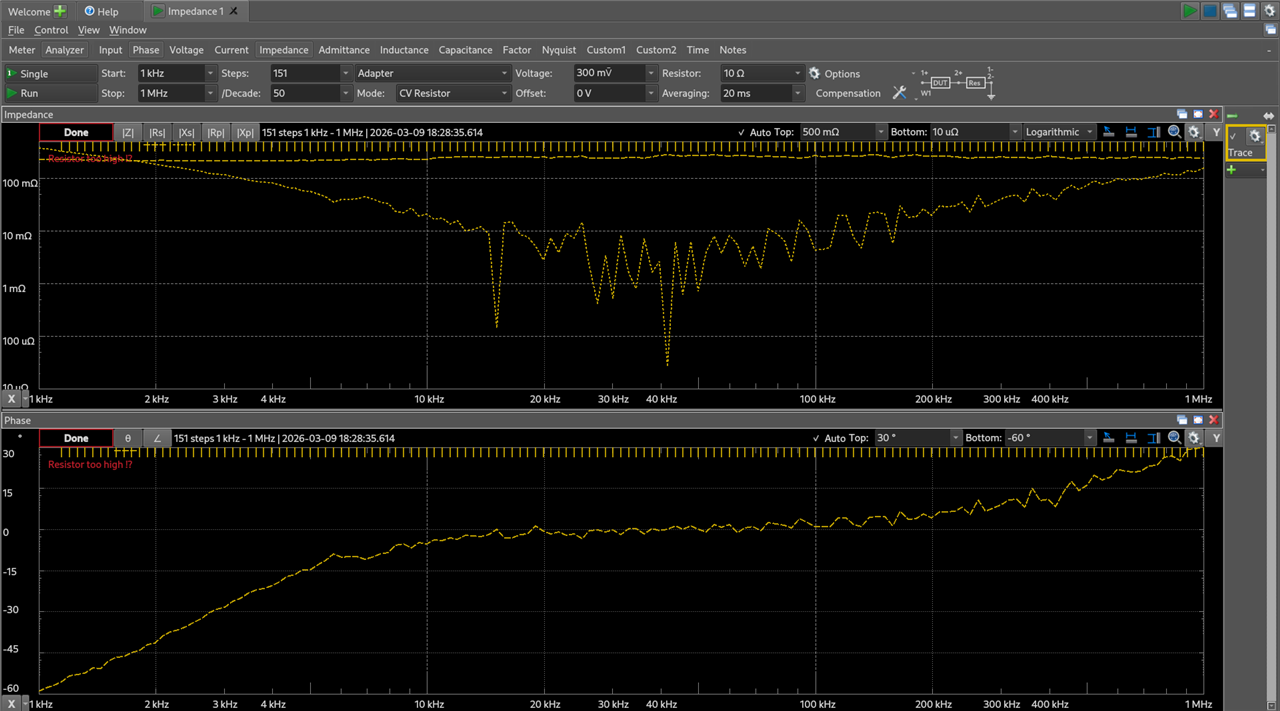
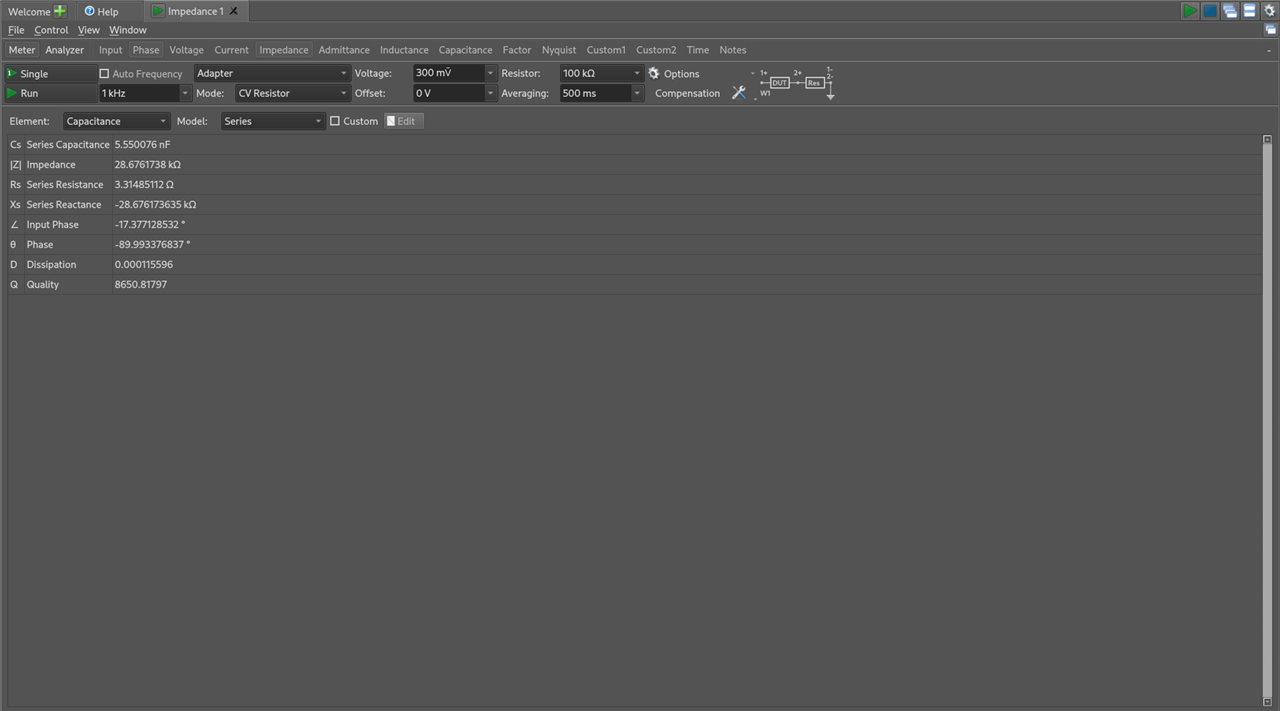
As we see, the results are fine. In case of 1 Mohm resistor we see influence of parasitic capacitance. Probably there could be improvement by performing calibration for an open and close circuit for each reference resistor, but I did these measurements without it. For the next measurements, I chose a set of different electrolytic capacitors: 4.7 uF 50V, 470uF 16V, tantalum 22 uF 10V and ceramic: 8.2 pF 50 V +- 0.5pF, 5.6 nF 100V -+ 5% X7R. Below are results in order of mentioned capacitors:
image

image

image

image

image

image

image

image

image

image

image

image

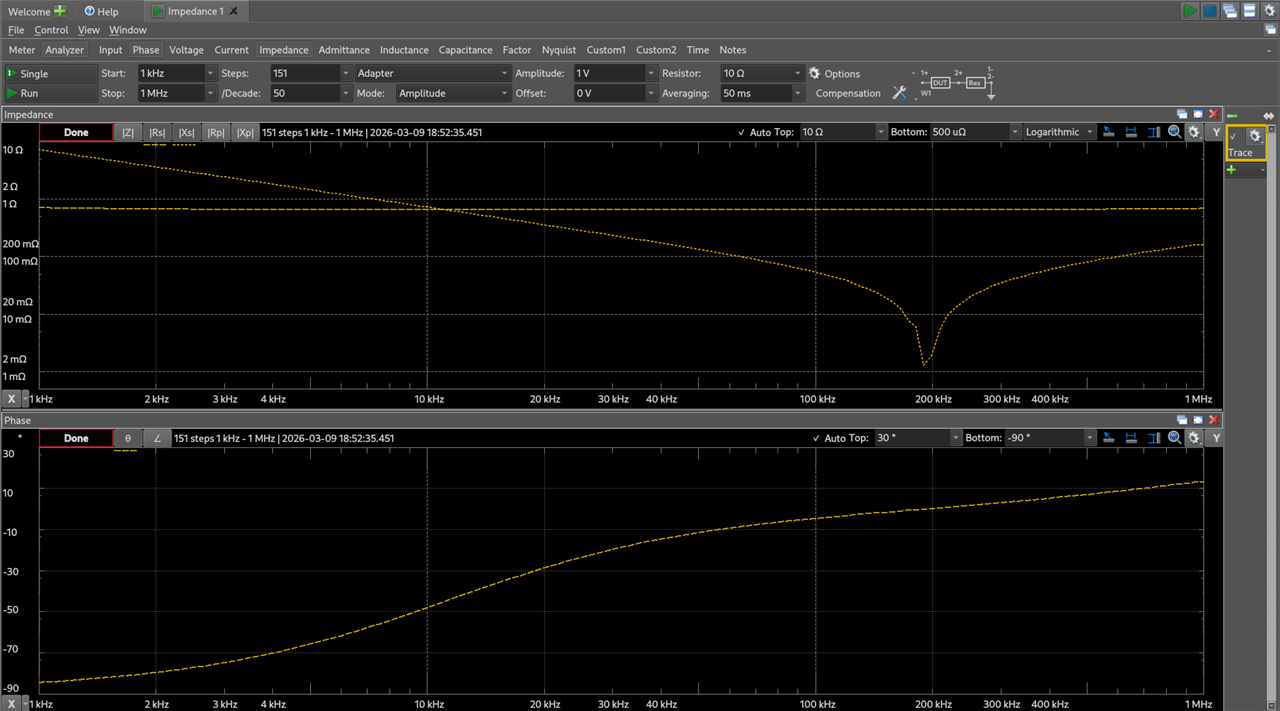
In the case of analyzer mode for 4.7 uF and 470 uF capacitors I have performed a comparison of modes CV resistor and amplitude. In the case of CV resistor or CC resistor, WaveForms will try adjusting the amplitude as well as the reference resistor used by the adapter to achieve the selected DUT voltage or current. In the case of amplitude mode, the reference resistor is fixed to selected by us value and only amplitude will be adjusted. In that case, the results are also fine. We see have different types of capacitors behaves differently of range in higher frequencies.

  • Sign in to reply
element14 Community

element14 is the first online community specifically for engineers. Connect with your peers and get expert answers to your questions.

  • Members
  • Learn
  • Technologies
  • Challenges & Projects
  • Products
  • Store
  • About Us
  • Feedback & Support
  • FAQs
  • Terms of Use
  • Privacy Policy
  • Legal and Copyright Notices
  • Sitemap
  • Cookies

An Avnet Company © 2026 Premier Farnell Limited. All Rights Reserved.

Premier Farnell Ltd, registered in England and Wales (no 00876412), registered office: Farnell House, Forge Lane, Leeds LS12 2NE.

ICP 备案号 10220084.

Follow element14

  • X
  • Facebook
  • linkedin
  • YouTube