


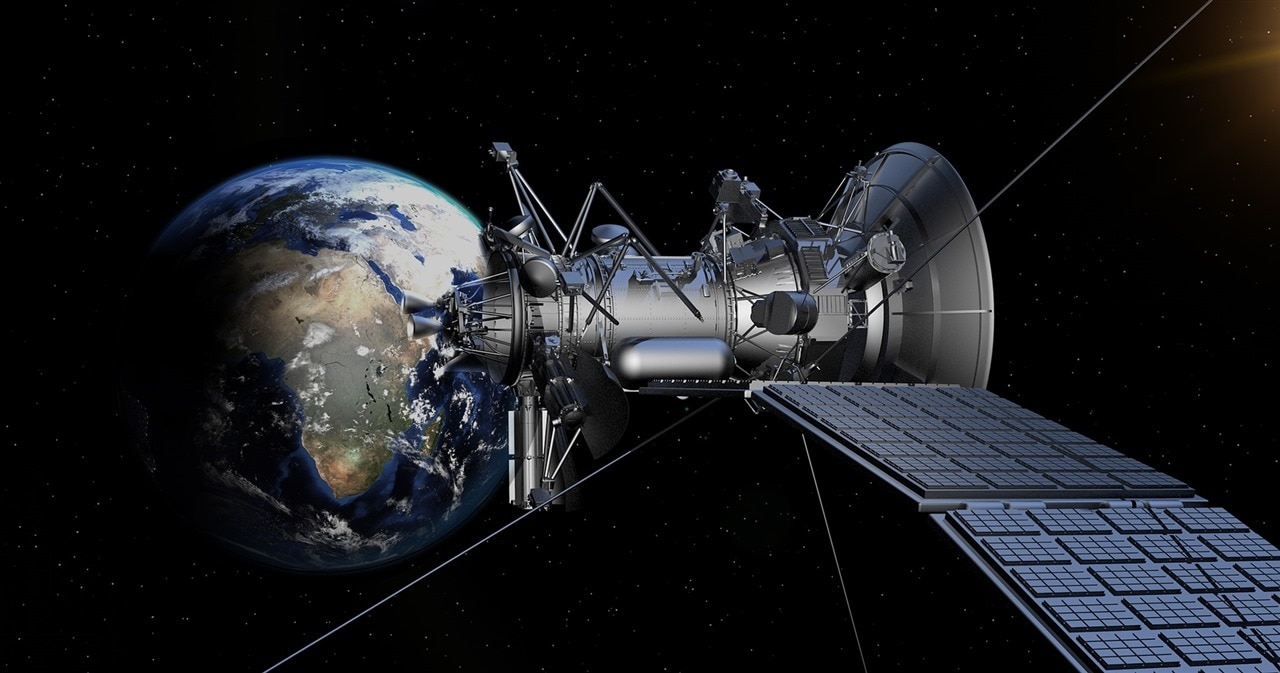
Space debris orbiting the Earth could claim human life in the upcoming decade. (Image Credit: pixabay/PIRO4D)
I was laying on my back on the top of a highrise building. Not sure how many stories up. Looking up at the sky… I just couldn’t shake the feeling I was about to get his with some sort of falling object. 651 miles up, the atmosphere ends, and there are zero things between you and space. That zero protection got me asking, how safe are we?
Human made space debris has been plummeting down to Earth for a while, injuring humans and damaging property. However, people may start wondering if the junk could eventually annihilate someone as it rains from the sky. Of course, these concerns may be left to our wildest imaginations after launching more rockets, satellites, and probes into space. Buckle up, skywatchers, and keep a close eye out, hawk-like, if you will, because there’s a 10% chance of space junk claiming a victim’s life over the next ten years.
Hazardous debris falls from space at every glaring moment on a daily basis. For starters, asteroid and comet dust constantly hit Earth’s atmosphere before landing on the surface, where it builds up to 40,000 tonnes of dust every year. This type of debris damaged the James Webb telescope earlier this year. Sometimes the planet may encounter meteorites, and every 100 years, an object measuring tens of meters across hurls through the atmosphere until it eventually produces a crater. Then, we have those impressive kilometer-sized rocks that lead to large-scale destruction and the end of life, as evidenced by a comet that drove dinosaurs into extinction.
The recent study focuses more on artificial space debris, like rocket stages from launches and satellites. The authors estimated exactly where that junk lands on Earth. This was achieved by using 30 years’ worth of satellite data and mathematical modeling of rocket parts’ orbits and inclinations in space along with the population density below.
They determined that parts could re-enter the atmosphere in the decade, expected to occur over southern latitudes. According to their estimations, the rocket parts could land in Jakarta, Indonesia, Dhaka, Bangladesh, or Lagos, Nigeria, rather than in New York, Beijing, or Moscow. In addition, the team calculated a 10% risk of uncontrolled rocket entries claiming the lives of one or two people over the next ten years. That all depends on if the debris spreads over a region of ten square meters.
So far, satellite and rocket debris pose an insignificant risk of damaging the Earth’s surface or atmosphere, affecting air traffic. Space debris studies focused on expired satellites in orbit that could interfere with active satellites. Plus, unused fuel and batteries create explosions that lead to more orbital waste.

Brad Tucker confirmed the space debris that landed in Australia potentially belongs to SpaceX. (Image Credit: Brad Tucker)
Space debris, now under investigation by the Australian Space Agency, that’s suspected to be from a November 2020 SpaceX mission, landed in a Dalgety, Australia, farmland. At the time, Mick Miners and Jock Wallace called up astrophysicist Brad Tucker after discovering the burnt-up object. The initial report matches a SpaceX spacecraft that re-entered the atmosphere at 7 am local time on July 9th.
SpaceX’s Dragon capsule broke apart over the same region where the sheep farmers discovered the debris. People in Canberra to Bendigo witnessed the re-entry process. Meanwhile, Tucker undertook a two-hour-long drive to the farm and helped determine if the object came from the capsule’s trunk, an essential structure for lift-off that’s released before re-entry.
Tucker compared it to a scorched tree at first glance, but after approaching the object, he realized it looked more like an alien obelisk. Tucker could tell the structure was legitimate because it was made of composite material that can survive extreme heat, including woven fiber for insulation. It also looks scorched as a result of re-entry. Plus, a panel has a part number, which makes it easy for SpaceX to verify it belongs to them.

China’s Long March 5B rocket split up into debris before hitting the Earth’s surface over the weekend. (Image Credit: CASC)
On July 31st, China announced its uncontrolled 25-ton core stage of a Long March 5B rocket plummeted down to Earth close to the Philippines. A large portion burned up in re-entry, but an estimated 20% to 40% survived the fall. They didn’t specify whether it hit the land or sea, but the landing area was at 119 degrees east longitude and 91 degrees north latitude. That region is in the waters southeast of Puerto Princesa on Palawan Island. The debris is part of the rocket that delivered a new lab module for the Tiangong space station on July 24th. Afterward, the core stage fell back to Earth via atmospheric drag, which took six days.
Some of the remaining parts have been discovered. For instance, locals found booster pieces in several areas along the re-entry path. Some are large enough to lead to injury or property damage if they hit a city or village. Additionally, locals at Sanggau regency found more debris potentially sourced from the rocket’s re-entry.
The United States verified the rocket successfully re-entered the atmosphere. While no injuries or damage were reported as a result of the debris’ descent, NASA criticized China for its actions. Bill Nelson, NASA administration, wrote that China didn’t share the rocket’s trajectory data while it descended.
"All spacefaring nations should follow established best practices, and do their part to share this type of information in advance to allow reliable predictions of potential debris impact risk, especially for heavy-lift vehicles, like the Long March 5B, which carry a significant risk of loss of life and property," Nelson posted on Twitter. "Doing so is critical to the responsible use of space and to ensure the safety of people here on Earth."
In May 2020, the first March 5B mission had some debris crashing down to Earth on Ivory Coast, a West African nation. Then, the leftover rocket parts fell over the Indian Ocean in April 2021. Another debris-falling event is expected to occur in the Fall, when the Long March 5B rocket delivers a module to the Tiangong space station.
Is it just me, or are you also concerned about falling space junk? There's enough up there to become a constant threat after all.