


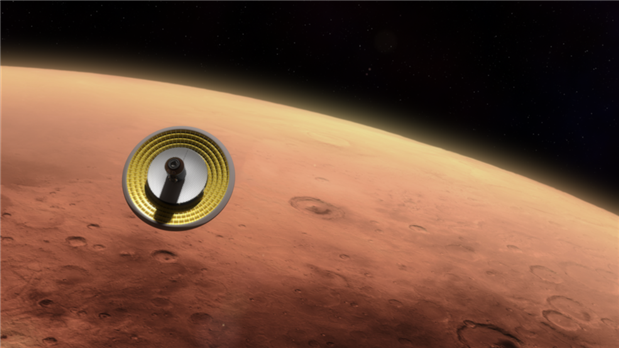
Could a student really solve this NASA issue? A new competition challenges students to design systems for NASA. (via NASA)
College and university students, NASA needs your help. No, this isn't a hoax. NASA is actually giving students a chance to take part of the agency's journey to mars with the Breakthrough, Innovative, and Game-changing (BIG) Idea challenge. This event is aimed at getting design help from students and to have them create a solution for slowing down NASA's payload with inflatable heat shields or hypersonic inflatable aerodynamic decelerator (HIAD) technology. If you remember, NASA successfully landed the Curiosity rover, but it's currently the heaviest payload ever landed on Mars at one ton. The next step the agency wants to take is send a crewed mission to Mars, adding between 15 – 30 tons to the payload. Since Mars' atmosphere is so thin slowing down the payload is an issue that needs to be addressed.
NASA is currently developing large aeroshells that provide enough aerodynamic drag to decelerate and deliver larger payload to address the issue. HIAD is the ideal technology because it can not only generate lift, but it can also be used for other missions as well.
"NASA is currently developing and flight testing HIADs -- a new class of relatively lightweight deployable aeroshells that could safely deliver more than 22 tons to the surface of Mars," said Steve Gaddis, GCD manager at NASA's Langley Research Center in Hampton, Virginia."A crewed spacecraft landing on Mars would weigh between 15 and 30 tons."
Students who are interested must turn in their initial concepts by November 15. Those who are chosen will hand in a detailed paper on their systems next spring. From there, four finalists will be picked to present their idea to a panel of judges at the BIG Idea Forum at Langley in April 2016. Rewards include a $6000 stipend and paid internship offers at Langley, where the winners will work with the Game Changing Development Program (GCD) team to turn their concept into a reality.
The chance to work with NASA and a paid internship? Looks like these students have to hit the books even harder if they want a shot at this larger than life opportunity.
C
See more news at: