element14 Community
element14 Community
    Register Log In
  • Site
  • Search
  • Log In Register
  • Community Hub
    Community Hub
    • What's New on element14
    • Feedback and Support
    • Benefits of Membership
    • Personal Blogs
    • Members Area
    • Achievement Levels
  • Learn
    Learn
    • Ask an Expert
    • eBooks
    • element14 presents
    • Learning Center
    • Tech Spotlight
    • STEM Academy
    • Webinars, Training and Events
    • Learning Groups
  • Technologies
    Technologies
    • 3D Printing
    • FPGA
    • Industrial Automation
    • Internet of Things
    • Power & Energy
    • Sensors
    • Technology Groups
  • Challenges & Projects
    Challenges & Projects
    • Design Challenges
    • element14 presents Projects
    • Project14
    • Arduino Projects
    • Raspberry Pi Projects
    • Project Groups
  • Products
    Products
    • Arduino
    • Avnet & Tria Boards Community
    • Dev Tools
    • Manufacturers
    • Multicomp Pro
    • Product Groups
    • Raspberry Pi
    • RoadTests & Reviews
  • About Us
  • Store
    Store
    • Visit Your Store
    • Choose another store...
      • Europe
      •  Austria (German)
      •  Belgium (Dutch, French)
      •  Bulgaria (Bulgarian)
      •  Czech Republic (Czech)
      •  Denmark (Danish)
      •  Estonia (Estonian)
      •  Finland (Finnish)
      •  France (French)
      •  Germany (German)
      •  Hungary (Hungarian)
      •  Ireland
      •  Israel
      •  Italy (Italian)
      •  Latvia (Latvian)
      •  
      •  Lithuania (Lithuanian)
      •  Netherlands (Dutch)
      •  Norway (Norwegian)
      •  Poland (Polish)
      •  Portugal (Portuguese)
      •  Romania (Romanian)
      •  Russia (Russian)
      •  Slovakia (Slovak)
      •  Slovenia (Slovenian)
      •  Spain (Spanish)
      •  Sweden (Swedish)
      •  Switzerland(German, French)
      •  Turkey (Turkish)
      •  United Kingdom
      • Asia Pacific
      •  Australia
      •  China
      •  Hong Kong
      •  India
      • Japan
      •  Korea (Korean)
      •  Malaysia
      •  New Zealand
      •  Philippines
      •  Singapore
      •  Taiwan
      •  Thailand (Thai)
      • Vietnam
      • Americas
      •  Brazil (Portuguese)
      •  Canada
      •  Mexico (Spanish)
      •  United States
      Can't find the country/region you're looking for? Visit our export site or find a local distributor.
  • Translate
  • Profile
  • Settings
Community Hub
Community Hub
Member Blogs Scientists develop world's first OLED tattoos
  • Blog
  • Forum
  • Documents
  • Quiz
  • Events
  • Leaderboard
  • Polls
  • Files
  • Members
  • Mentions
  • Sub-Groups
  • Tags
  • More
  • Cancel
  • New
Join Community Hub to participate - click to join for free!
  • Share
  • More
  • Cancel
Group Actions
  • Group RSS
  • More
  • Cancel
Engagement
  • Author Author: Catwell
  • Date Created: 9 Mar 2021 7:11 PM Date Created
  • Views 893 views
  • Likes 5 likes
  • Comments 2 comments
  • on_campus
  • cabeatwell
  • university
  • medical
  • Wearables
  • innovation
Related
Recommended

Scientists develop world's first OLED tattoos

Catwell
Catwell
9 Mar 2021

image

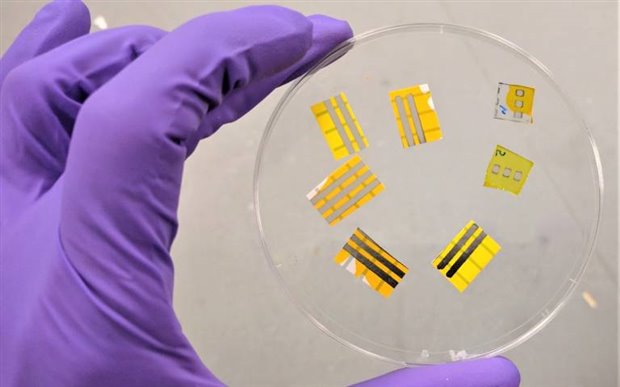
These ultrathin OLED tattoos are only 2.3 micrometers thick. (Image Credit: Jonathon Barsotti/Italian Institute of Technology)


Tattoos have been around for thousands of years as a way for people to express themselves, but now they can be used differently. Scientists at the University College London (UCL) and the Italian Institute of Technology have created a futuristic tattoo that uses the same OLEDs seen in smartphones and TVs. These (temporary) tattoos could have some unique medical applications in the future.


The ultrathin tattoo is 2.3 micrometers thick, which is one-third the diameter of a red blood cell. It contains an electroluminescent polymer that measures 76 nanometers thick and emits light when an electric field is applied. This is placed between two electrodes protected by an insulating layer. Afterward, the team applied the device to temporary commercial tattoo paper. The polymer was produced via spin coating, which involves applying the polymer to a substrate that is spun at high speed. This produces an ultrathin and even layer.


"The tattooable OLEDs that we have demonstrated for the first time can be made at scale and very cheaply. They can be combined with other forms of tattoo electronics for a very wide range of possible uses. These could be for fashion – for instance, providing glowing tattoos and light-emitting fingernails. In sports, they could be combined with a sweat sensor to signal dehydration. In healthcare they could emit light when there is a change in a patient's condition – or, if the tattoo was turned the other way into the skin, they could potentially be combined with light-sensitive therapies to target cancer cells, for instance," says UCL's Professor Franco Cacialli, senior author of the paper.


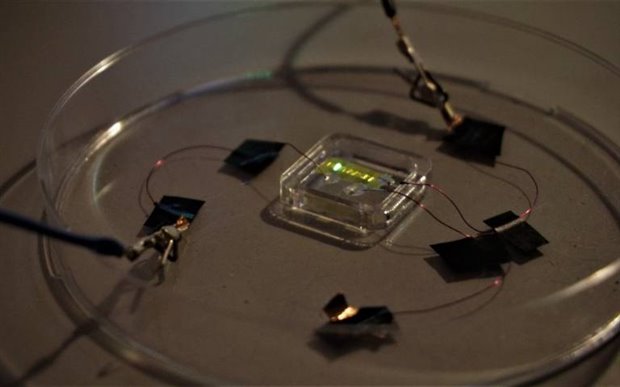
The tattoo can be applied on a surface by pressing and dabbing it with water. Removing it is just as easy. All the wearer needs to do is scrub it off with soap and water. The team demonstrated its ease of application by placing a green OLED tattoo on a pane of glass, plastic bottle, orange, and paper packaging.  
 

image

The OLED tattoos can be applied to the skin the same way as a regular tattoo. (Image Credit: Jonathon Barsotti/Italian Institute of Technology)


Senior author Dr. Virgilio Mattoli, a researcher at the Italian Institute of Technology said: "Tattoo electronics is a fast-growing field of research. At the Italian Institute of Technology, we have previously pioneered electrodes that we have tattooed onto people's skin that can be used to perform diagnostic tests such as electrocardiograms. The advantage of this technology is that it is low-cost, easy to apply and use, and washes off easily with soap and water."


The tattoo could also be used to notify a wearer when they've had too much sun exposure or applied to fruit to determine if it has passed its expiration date. These applications are a long way away, but there is still potential. The team needs to overcome some challenges, which include installing a supercapacitor or tiny battery into the tattoo and efficiently enclosing the OLEDs so they won't quickly degrade from air exposure.


Have a story tip? Message me at: http://twitter.com/Cabe_Atwell

  • Sign in to reply

Top Comments

  • Fred27
    Fred27 over 4 years ago +1
    The OLED tattoos can be applied to the skin the same way as a regular tattoo. Yeah - that's not what I think of as a "regular tattoo". That a kids' pretend tattoo transfer. In some ways this is more like…
  • colporteur
    colporteur over 4 years ago

    Now my Hula girl tattoo can really dance:)

    • Cancel
    • Vote Up 0 Vote Down
    • Sign in to reply
    • More
    • Cancel
  • Fred27
    Fred27 over 4 years ago

    The OLED tattoos can be applied to the skin the same way as a regular tattoo.

    Yeah - that's not what I think of as a "regular tattoo". That a kids' pretend tattoo transfer.


    In some ways this is more like a real tattoo.

    • Cancel
    • Vote Up +1 Vote Down
    • Sign in to reply
    • More
    • Cancel
element14 Community

element14 is the first online community specifically for engineers. Connect with your peers and get expert answers to your questions.

  • Members
  • Learn
  • Technologies
  • Challenges & Projects
  • Products
  • Store
  • About Us
  • Feedback & Support
  • FAQs
  • Terms of Use
  • Privacy Policy
  • Legal and Copyright Notices
  • Sitemap
  • Cookies

An Avnet Company © 2026 Premier Farnell Limited. All Rights Reserved.

Premier Farnell Ltd, registered in England and Wales (no 00876412), registered office: Farnell House, Forge Lane, Leeds LS12 2NE.

ICP 备案号 10220084.

Follow element14

  • X
  • Facebook
  • linkedin
  • YouTube