element14 Community
element14 Community
    Register Log In
  • Site
  • Search
  • Log In Register
  • Community Hub
    Community Hub
    • What's New on element14
    • Feedback and Support
    • Benefits of Membership
    • Personal Blogs
    • Members Area
    • Achievement Levels
  • Learn
    Learn
    • Ask an Expert
    • eBooks
    • element14 presents
    • Learning Center
    • Tech Spotlight
    • STEM Academy
    • Webinars, Training and Events
    • Learning Groups
  • Technologies
    Technologies
    • 3D Printing
    • FPGA
    • Industrial Automation
    • Internet of Things
    • Power & Energy
    • Sensors
    • Technology Groups
  • Challenges & Projects
    Challenges & Projects
    • Design Challenges
    • element14 presents Projects
    • Project14
    • Arduino Projects
    • Raspberry Pi Projects
    • Project Groups
  • Products
    Products
    • Arduino
    • Avnet & Tria Boards Community
    • Dev Tools
    • Manufacturers
    • Multicomp Pro
    • Product Groups
    • Raspberry Pi
    • RoadTests & Reviews
  • About Us
    About the element14 Community
  • Store
    Store
    • Visit Your Store
    • Choose another store...
      • Europe
      •  Austria (German)
      •  Belgium (Dutch, French)
      •  Bulgaria (Bulgarian)
      •  Czech Republic (Czech)
      •  Denmark (Danish)
      •  Estonia (Estonian)
      •  Finland (Finnish)
      •  France (French)
      •  Germany (German)
      •  Hungary (Hungarian)
      •  Ireland
      •  Israel
      •  Italy (Italian)
      •  Latvia (Latvian)
      •  
      •  Lithuania (Lithuanian)
      •  Netherlands (Dutch)
      •  Norway (Norwegian)
      •  Poland (Polish)
      •  Portugal (Portuguese)
      •  Romania (Romanian)
      •  Russia (Russian)
      •  Slovakia (Slovak)
      •  Slovenia (Slovenian)
      •  Spain (Spanish)
      •  Sweden (Swedish)
      •  Switzerland(German, French)
      •  Turkey (Turkish)
      •  United Kingdom
      • Asia Pacific
      •  Australia
      •  China
      •  Hong Kong
      •  India
      •  Japan
      •  Korea (Korean)
      •  Malaysia
      •  New Zealand
      •  Philippines
      •  Singapore
      •  Taiwan
      •  Thailand (Thai)
      •  Vietnam
      • Americas
      •  Brazil (Portuguese)
      •  Canada
      •  Mexico (Spanish)
      •  United States
      Can't find the country/region you're looking for? Visit our export site or find a local distributor.
  • Translate
  • Profile
  • Settings
Community Hub
Community Hub
Member Blogs Simple Transistor Current Sources (and Sinks)
  • Blog
  • Forum
  • Documents
  • Quiz
  • Events
  • Leaderboard
  • Polls
  • Files
  • Members
  • Mentions
  • Sub-Groups
  • Tags
  • More
  • Cancel
  • New
Join Community Hub to participate - click to join for free!
  • Share
  • More
  • Cancel
Group Actions
  • Group RSS
  • More
  • Cancel
Engagement
  • Author Author: fmilburn
  • Date Created: 4 May 2022 4:06 AM Date Created
  • Views 17801 views
  • Likes 16 likes
  • Comments 24 comments
  • transistor
  • current source
  • current sink
Related
Recommended

Simple Transistor Current Sources (and Sinks)

fmilburn
fmilburn
4 May 2022

Current sources and sinks have applications in many circuits and there are many ways to make them.  This blog is a brief introduction to single transistor current sources.   Horowitz and Hill cover this material in a more detailed fashion in The Art of Electronics 3rd Edition in section 2.2.6 Current Sources. 

The figure below shows four different single transistor circuits.  The NPN transistor circuits are current sinks while the PNP circuit is a current source.
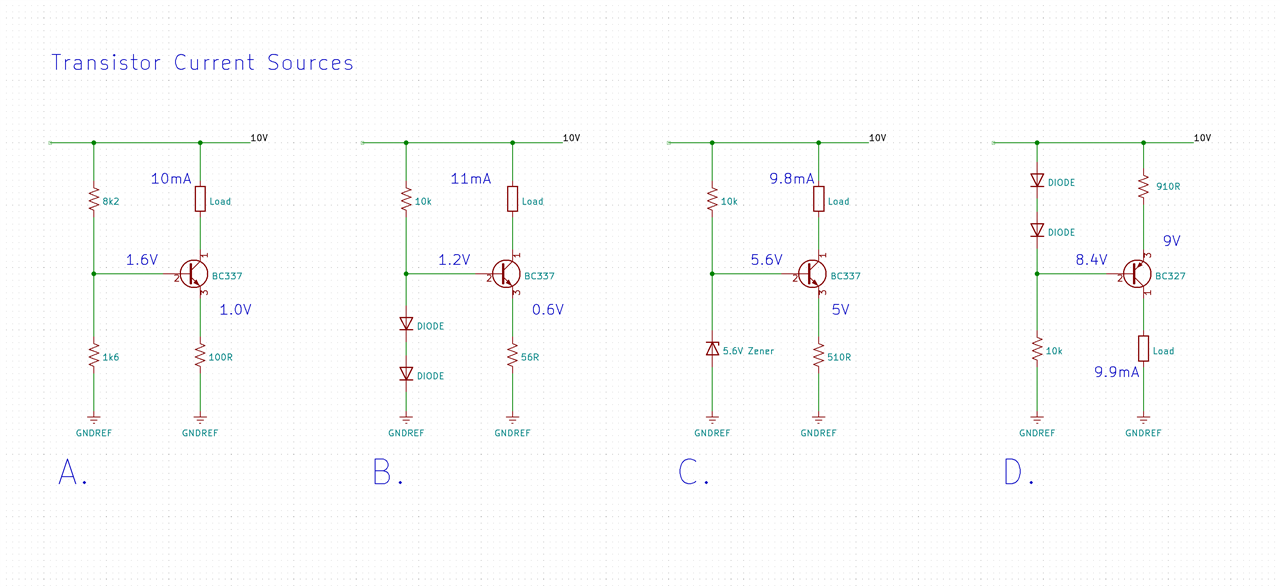
Transistor Current Sources

Three current source biasing methods for the transistor are shown:

Figure A:  A voltage divider is used to set the Vb to 1.6 Volts.  This is acceptable as long as the voltage divider is stiff enough but can cause problems if the source voltage or load varies excessively.

Figure B: Forward-biased diodes are used to set Vb to 1.2V.

Figure C: A 5.6V zener diode is used to set Vb.

The biasing resistor is sized to allow the transistor to come into conduction.  Knowing the voltage at the base of the transistor, Vb, the emitter voltage is easily calculated since it will be 0.6V below Vb. Ohm's Law can then be used to size the emitter resistor for the desired current.  The base current will be ignored since it is much smaller than the collector current.

Using the circuit in Figure B as an example:

Bias Voltage:  The two silicon diodes have approximately a 0.6V drop each, for a total of 1.2V

Emitter Voltage: Base Voltage - 0.6V = 1.2 - 0.6 = 0.6V

Collector Current: Emitter Voltage / 56 Ohms = 0.6 / 56 = 10.7mA

Figure D: The circuit uses forward-biased diodes as in Figure B, but for a PNP current sink.

In the short 3-minute video below, the circuit in Figure B is demonstrated on a breadboard.

You don't have permission to edit metadata of this video.
Edit media
x
image
Upload Preview
image

These circuits perform well compared to a resistor biased from a fixed voltage such as commonly used for LEDs but as shown in the video they are not precision sources.  Improved circuits with additional transistors, op-amps, and IC current sources exist.  As an example, see the zero tempco constant current sources using the LM334Z in this design for a milliohm meter.  Horowitz and Hill also cover improved designs in The Art of Electronics.

  • Sign in to reply

Top Comments

  • Andrew J
    Andrew J over 3 years ago +1
    Good video Frank; can I call out the lack of err’s and umm’s and fluffed lines and the sound was fine. Loved the Lego men holding the wires, start he day with a smile. You could follow up with a video…
  • beacon_dave
    beacon_dave over 3 years ago in reply to fmilburn +1
    Yes, good gain structure helps. You ideally want your vocals to be lined up at around -18dBFS by the time you import into the editor. Unfortunately a lot of the consumer end kit doesn't provide useful…
  • dang74
    dang74 over 3 years ago +1
    One day I will sit down with the Art of Electronics while having SPICE open and ready. I figure running a few simulations of the example circuits will add to the experience and really nail concepts into…
Parents
  • shabaz
    shabaz over 3 years ago

    Hi Frank,

    It was definitely interesting, great demo, and everything was clear, including audio : )

    I thought you were using dedicated camera, until I read the content after viewing the video, and realized it was a camera in a phone. Great results.

    • Cancel
    • Vote Up 0 Vote Down
    • Sign in to reply
    • More
    • Cancel
  • fmilburn
    fmilburn over 3 years ago in reply to shabaz

    Hi Shabaz,

    Thanks, I think the audio is “good enough” for me now although the transition between recorded bits can be improved. The newer phones do make good video in the right light - I bought an inexpensive attachment for my tripod to steady things. The sound quality on mine is not good though. Maybe that will be my excuse to buy a new camera. 

    • Cancel
    • Vote Up 0 Vote Down
    • Sign in to reply
    • More
    • Cancel
  • shabaz
    shabaz over 3 years ago in reply to fmilburn

    Speaking of lights, I tried a few different lights (I cannot rely much on natural window lighting in this part of the world!) and it was all getting a bit much, too pricey, awkward to plug in multiple units or charge them and so on, and then I simplified it all. Now I nearly always use just one light, and it seems to work pretty good for project-sized lighting areas.

    I'm now using a ring light, the kind intended for beauty/makeup type stuff. It's about 14" in diameter. Ordinarily they are no good for photography because of the ring that gets visible in people's eyes, but if (like me) you're usually not facing the camera and only need to light up your circuits and maybe a hand or two, then I think it's a nice methods, since it's just a single light. 

    Mine is rechargeable but optionally can be plugged it. The non-rechargeable ones are probably better value for money if you're only working in one area.

    There is still occasionally the situation where there could be glare and visible ring reflecting off shiny desk, but I find that since I'm aware of that, I just remember to reposition it or move the camera angle slightly.

    • Cancel
    • Vote Up 0 Vote Down
    • Sign in to reply
    • More
    • Cancel
Comment
  • shabaz
    shabaz over 3 years ago in reply to fmilburn

    Speaking of lights, I tried a few different lights (I cannot rely much on natural window lighting in this part of the world!) and it was all getting a bit much, too pricey, awkward to plug in multiple units or charge them and so on, and then I simplified it all. Now I nearly always use just one light, and it seems to work pretty good for project-sized lighting areas.

    I'm now using a ring light, the kind intended for beauty/makeup type stuff. It's about 14" in diameter. Ordinarily they are no good for photography because of the ring that gets visible in people's eyes, but if (like me) you're usually not facing the camera and only need to light up your circuits and maybe a hand or two, then I think it's a nice methods, since it's just a single light. 

    Mine is rechargeable but optionally can be plugged it. The non-rechargeable ones are probably better value for money if you're only working in one area.

    There is still occasionally the situation where there could be glare and visible ring reflecting off shiny desk, but I find that since I'm aware of that, I just remember to reposition it or move the camera angle slightly.

    • Cancel
    • Vote Up 0 Vote Down
    • Sign in to reply
    • More
    • Cancel
Children
  • beacon_dave
    beacon_dave over 3 years ago in reply to shabaz

    You can often reduce the cost by using a light and a reflector panel which will give you a low cost 2:1 lighting ratio helping to soften the shadows but still retain a sense of depth.

    • Cancel
    • Vote Up 0 Vote Down
    • Sign in to reply
    • More
    • Cancel
  • fmilburn
    fmilburn over 3 years ago in reply to beacon_dave

    I sometimes use a bit of white poster board as a reflector - works good. I also have an umbrella reflector that wasn’t too expensive that I used for still photography years ago. 

    • Cancel
    • Vote Up 0 Vote Down
    • Sign in to reply
    • More
    • Cancel
  • fmilburn
    fmilburn over 3 years ago in reply to shabaz

    Inexpensive lighting is another thing I will look into purchasing. 

    • Cancel
    • Vote Up 0 Vote Down
    • Sign in to reply
    • More
    • Cancel
  • beacon_dave
    beacon_dave over 3 years ago in reply to fmilburn

    Some people use large polystyrene insulation sheets mounted on wooden frames as bounce reflectors. In photography I've seen them built into sentry box shapes with the subject positioned inside to wrap the light around them. It's a bit dodgy with hot tungsten lighting however.

    To help with audio you could perhaps do similar but using white towels to reflect the light as well as dampening down the acoustics.

    Some people record voice-overs in front of an open wardrobe with towels over the open doors to create a low-cost acoustic booth. Great for audio, not so good for video.

    • Cancel
    • Vote Up 0 Vote Down
    • Sign in to reply
    • More
    • Cancel
element14 Community

element14 is the first online community specifically for engineers. Connect with your peers and get expert answers to your questions.

  • Members
  • Learn
  • Technologies
  • Challenges & Projects
  • Products
  • Store
  • About Us
  • Feedback & Support
  • FAQs
  • Terms of Use
  • Privacy Policy
  • Legal and Copyright Notices
  • Sitemap
  • Cookies

An Avnet Company © 2026 Premier Farnell Limited. All Rights Reserved.

Premier Farnell Ltd, registered in England and Wales (no 00876412), registered office: Farnell House, Forge Lane, Leeds LS12 2NE.

ICP 备案号 10220084.

Follow element14

  • X
  • Facebook
  • linkedin
  • YouTube