
element14 Community
element14 Community
    Register Log In
  • Site
  • Search
  • Log In Register
  • Community Hub
    Community Hub
    • What's New on element14
    • Feedback and Support
    • Benefits of Membership
    • Personal Blogs
    • Members Area
    • Achievement Levels
  • Learn
    Learn
    • Ask an Expert
    • eBooks
    • element14 presents
    • Learning Center
    • Tech Spotlight
    • STEM Academy
    • Webinars, Training and Events
    • Learning Groups
  • Technologies
    Technologies
    • 3D Printing
    • FPGA
    • Industrial Automation
    • Internet of Things
    • Power & Energy
    • Sensors
    • Technology Groups
  • Challenges & Projects
    Challenges & Projects
    • Design Challenges
    • element14 presents Projects
    • Project14
    • Arduino Projects
    • Raspberry Pi Projects
    • Project Groups
  • Products
    Products
    • Arduino
    • Avnet & Tria Boards Community
    • Dev Tools
    • Manufacturers
    • Multicomp Pro
    • Product Groups
    • Raspberry Pi
    • RoadTests & Reviews
  • About Us
  • Store
    Store
    • Visit Your Store
    • Choose another store...
      • Europe
      •  Austria (German)
      •  Belgium (Dutch, French)
      •  Bulgaria (Bulgarian)
      •  Czech Republic (Czech)
      •  Denmark (Danish)
      •  Estonia (Estonian)
      •  Finland (Finnish)
      •  France (French)
      •  Germany (German)
      •  Hungary (Hungarian)
      •  Ireland
      •  Israel
      •  Italy (Italian)
      •  Latvia (Latvian)
      •  
      •  Lithuania (Lithuanian)
      •  Netherlands (Dutch)
      •  Norway (Norwegian)
      •  Poland (Polish)
      •  Portugal (Portuguese)
      •  Romania (Romanian)
      •  Russia (Russian)
      •  Slovakia (Slovak)
      •  Slovenia (Slovenian)
      •  Spain (Spanish)
      •  Sweden (Swedish)
      •  Switzerland(German, French)
      •  Turkey (Turkish)
      •  United Kingdom
      • Asia Pacific
      •  Australia
      •  China
      •  Hong Kong
      •  India
      •  Korea (Korean)
      •  Malaysia
      •  New Zealand
      •  Philippines
      •  Singapore
      •  Taiwan
      •  Thailand (Thai)
      • Americas
      •  Brazil (Portuguese)
      •  Canada
      •  Mexico (Spanish)
      •  United States
      Can't find the country/region you're looking for? Visit our export site or find a local distributor.
  • Translate
  • Profile
  • Settings
Community Hub
Community Hub
Member Blogs US Military Looks for Wireless Compromise and Proposals for a New Underwater Drone Mothership
  • Blog
  • Forum
  • Documents
  • Quiz
  • Events
  • Leaderboard
  • Polls
  • Files
  • Members
  • Mentions
  • Sub-Groups
  • Tags
  • More
  • Cancel
  • New
Join Community Hub to participate - click to join for free!
  • Share
  • More
  • Cancel
Group Actions
  • Group RSS
  • More
  • Cancel
Engagement
  • Author Author: Catwell
  • Date Created: 2 Aug 2013 7:26 PM Date Created
  • Views 423 views
  • Likes 0 likes
  • Comments 0 comments
  • defense
  • transportation
  • military
  • us_navy
  • cabeatwell
  • avionics
  • submarine
  • us_army
  • aerospace
  • innovation
Related
Recommended

US Military Looks for Wireless Compromise and Proposals for a New Underwater Drone Mothership

Catwell
Catwell
2 Aug 2013

image

Air Force Combat Controllers. (via US Army)


The US military relies heavily on wireless technology, more than the general public as military personnel use wireless for everything from communications to controlling drones. Because the military relies heavily on those systems, they in turn require a massive amount of wireless frequencies in the radio spectrum, which limits other wireless access to that spectrum. Not wanting to appear as a wireless bully, the DOD has extended an olive branch to US-based wireless carriers by auctioning off some of their airwave rights in specific wireless frequencies. Private carriers have been petitioning federal regulators, specifically the FCC, to get the military to free up some of their bandwidth in the 1755 to 1780 megahertz range for some years now but were reluctant to do so as they rely heavily on that frequency range for communications. In a move some private wireless carriers would call brazen, the military plans to move some wireless resources into the 1780 to 1850 megahertz band, which is already heavily in use. The DOD further stated that they would also shift resources into the 2025 to 2110 megahertz range, which is currently used by TV broadcasters for HD programming. Even though the military is willing to compromise with wireless carriers, several problems come along with the shift. The first is cost as the DOD estimates it will take approximately $3.5 billion US to move resources from the 1755 to 1780 frequency range, which is a hefty sum that will ultimately fall to the carriers themselves or taxpayers to foot the bill. Another problem is being raised by the National Association of Broadcasters who state that the military’s move into the 2025 to 2110 spectrum will cause disruptions in their TV broadcasts akin to what happened in the 70’s when CB radio interfered with TV programming. It is unclear at this time as to if and when the shift might take place but the military’s ‘olive branch’ will undoubtedly open the door to negotiations between the respective parties.
 

image

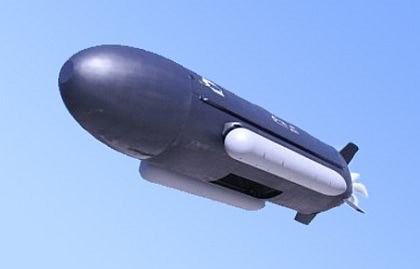
DARPA's Hydra concept. (via sUAS)


Speaking of military wireless technology, DARPA is holding a ‘Proposer’s Day’ on August 5 (2013) in Maryland for those interested in proposing designs for their Hydra maritime program. . The Hydra program falls under DARPA’s TTO (Tactical Technology Office) Innovative Systems for Military Missions project, which aims to bring novel concepts into military platforms that include ground, air, maritime and space-based systems. For their maritime initiative, DARPA envisions a revolutionary UUV (Underwater Unmanned Vehicle) design that is capable of launching other, smaller, UUVs. Yes, it is a ‘mothership’ of sorts and its purpose is to insert both UAVs and UUVs extremely close to enemy positions without putting human beings into harm’s way. While there is a vast array of combat drones already in service, this will be the first time a drone will be capable of deploying smaller drones with multiple mission roles (air and sea ops). The Hydra can be outfitted with any number of modular payloads that support both UUVs and UAVs with the ability to charge the batteries of each drone before being needed and launch both platforms without surfacing. It will also be able to operate in shallow waters for long periods of time before needing to be recharged itself. Those interested in participating in DARPA’s Proposer’s Day can head over to Johns Hopkins University’s Applied Physics Laboratory (assuming you have or can obtain a high enough security clearance). 


C

See more news at:

http://twitter.com/Cabe_e14

  • Sign in to reply
element14 Community

element14 is the first online community specifically for engineers. Connect with your peers and get expert answers to your questions.

  • Members
  • Learn
  • Technologies
  • Challenges & Projects
  • Products
  • Store
  • About Us
  • Feedback & Support
  • FAQs
  • Terms of Use
  • Privacy Policy
  • Legal and Copyright Notices
  • Sitemap
  • Cookies

An Avnet Company © 2025 Premier Farnell Limited. All Rights Reserved.

Premier Farnell Ltd, registered in England and Wales (no 00876412), registered office: Farnell House, Forge Lane, Leeds LS12 2NE.

ICP 备案号 10220084.

Follow element14

  • X
  • Facebook
  • linkedin
  • YouTube