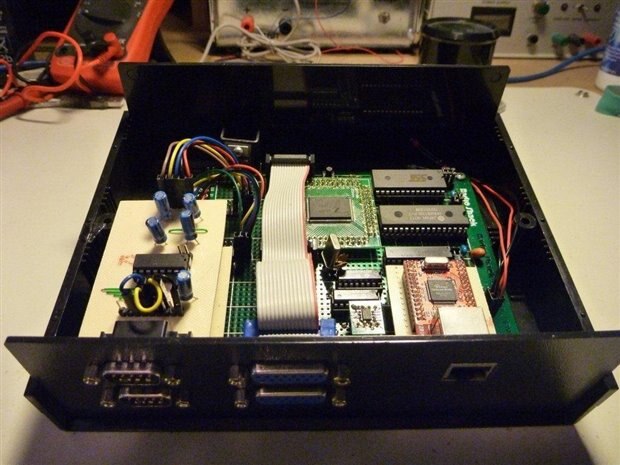
If you want to build a small real Z80 system then you could just deploy a single Zilog Z84C15 Highly Integrated Z80 IPC (Integrated Peripheral Controller).
It has inbuilt SIO, CTC and PIO and runs at 16Mhz
Just add RAM, Flash and your desired electrical interfaces - The pictured system has TCP/IP Ethernet capabilities, runs CP/M, has two true RS232 ports, 2 PIO parallel ports and some Timer Counters .
Alternatively you could use an eZ80 which can run at 50MHz with single cycle instruction fetch.
I agree with Workshopshed, I programmed in assembly many years ago but would have very little (if anything) to contribute to a current discussion. I would most likely follow it as time permits, but hand jamming assembly code no longer tops my list!
I still have a motorized Slit-N-Wrap and I still use it once in a while. It used to be really fast for wiring low-speed backplanes - much faster than manually soldering connectors on PCBs. I built a circuit that would make it automatically stop wrapping after 7 turns.
I never had problems with shorts. They have 2 types of wire, one with a Tefzel (Teflon) jacket that is thicker than normal Kynar, the other is a thin green enamel coating (a bit like magnet wire). I never had problems with either type although I was always careful not to let the green stuff rub on square pins.
I thought it was Slit-N-Wrap but I couldn't remember so I went for the long version. I thought Vector was still around, I wonder if they fixed the shorting
problem ?
I remember the Just Wrap too and I know I was very interested but for some reason, lost in the mists of time, I never bought one which is made even
more curious after all the Slit-N Wrap problems. I think I just went to pre-cut wire wrap wire (which I still cut to length) with an electric wire wrap tool but ...
No photos but the schematics were from a Mostek Z80 application note which I may still have. I used a tool from Vector called the Slit and Wrap which used
small spool of wire coated with a soft insulator kind of like magnet wire that was slit by the wrap bit just before it was wrapped on the post. It was a great tool
for speeding up wire wrapping with one fatal flaw. If two wires pressed against each other hard enough, they could displace the soft insulator and short.
When ever I powered it up and it did not work I would have to look for two wires pressed against each other in a rats nest of wires (actually I was more
systematic than that but there were always problem areas) and separate them. When the offending wires were separated it would usually make a distinctive
"plink" sound so I knew when I found it.
I used the same tool and a Z80 to wrap up a 256 x 240 x 4 bit/pixel graphics display controller. The schematic was from Byte Magazine and I modified it from
the original 1 bit/pixel configuration and to use static RAMs that were fast enough to allow the Z80 full speed access to the video RAM by interleaving the
accesses with video timing generator. The Z80 assembly language software had to be entered in by hand to be assembled and of course modified to handle
the multi-bit/pixel mod and to use a 8 bit parallel interface to the SDB-80. I believe it only had commands for pixel read/write, line and circle drawing.
Unfortunately after quite a few sessions of find the Slit and Wrap short I gave up and disassembled it for the parts and never used my Slit and Wrap again.
Like I said, fun (and sometimes frustrating) days.