element14 Community
element14 Community
    Register Log In
  • Site
  • Search
  • Log In Register
  • Community Hub
    Community Hub
    • What's New on element14
    • Feedback and Support
    • Benefits of Membership
    • Personal Blogs
    • Members Area
    • Achievement Levels
  • Learn
    Learn
    • Ask an Expert
    • eBooks
    • element14 presents
    • Learning Center
    • Tech Spotlight
    • STEM Academy
    • Webinars, Training and Events
    • Learning Groups
  • Technologies
    Technologies
    • 3D Printing
    • FPGA
    • Industrial Automation
    • Internet of Things
    • Power & Energy
    • Sensors
    • Technology Groups
  • Challenges & Projects
    Challenges & Projects
    • Design Challenges
    • element14 presents Projects
    • Project14
    • Arduino Projects
    • Raspberry Pi Projects
    • Project Groups
  • Products and Partners
    Products and Partners
    • Arduino
    • Avnet & Tria Boards Community
    • Dev Tools
    • Manufacturers
    • Multicomp Pro
    • Product Groups
    • Raspberry Pi
    • RoadTests & Reviews
  • About Us
    About the element14 Community
  • Store
    Store
    • Visit Your Store
    • Choose another store...
      • Europe
      •  Austria (German)
      •  Belgium (Dutch, French)
      •  Bulgaria (Bulgarian)
      •  Czech Republic (Czech)
      •  Denmark (Danish)
      •  Estonia (Estonian)
      •  Finland (Finnish)
      •  France (French)
      •  Germany (German)
      •  Hungary (Hungarian)
      •  Ireland
      •  Israel
      •  Italy (Italian)
      •  Latvia (Latvian)
      •  
      •  Lithuania (Lithuanian)
      •  Netherlands (Dutch)
      •  Norway (Norwegian)
      •  Poland (Polish)
      •  Portugal (Portuguese)
      •  Romania (Romanian)
      •  Russia (Russian)
      •  Slovakia (Slovak)
      •  Slovenia (Slovenian)
      •  Spain (Spanish)
      •  Sweden (Swedish)
      •  Switzerland(German, French)
      •  Turkey (Turkish)
      •  United Kingdom
      • Asia Pacific
      •  Australia
      •  China
      •  Hong Kong
      •  India
      •  Japan
      •  Korea (Korean)
      •  Malaysia
      •  New Zealand
      •  Philippines
      •  Singapore
      •  Taiwan
      •  Thailand (Thai)
      •  Vietnam
      • Americas
      •  Brazil (Portuguese)
      •  Canada
      •  Mexico (Spanish)
      •  United States
      Can't find the country/region you're looking for? Visit our export site or find a local distributor.
  • Translate
  • Profile
  • Settings
Community Hub
Community Hub
Member's Forum Is anyone interested with the Z80?
  • Blog
  • Forum
  • Documents
  • Quiz
  • Events
  • Leaderboard
  • Polls
  • Files
  • Members
  • Mentions
  • Sub-Groups
  • Tags
  • More
  • Cancel
  • New
Join Community Hub to participate - click to join for free!
Actions
  • Share
  • More
  • Cancel
Forum Thread Details
  • Replies 151 replies
  • Subscribers 648 subscribers
  • Views 10711 views
  • Users 0 members are here
  • z80
Related

Is anyone interested with the Z80?

COMPACT
COMPACT over 10 years ago

The Z80 is still manufactured today and I was wondering whether there is any interest for a community or discussion group.

  • Sign in to reply
  • Cancel
Parents
  • COMPACT
    COMPACT over 9 years ago

    Did you know that the Z80 has different memory access timings for instruction fetches and standard memory accesses?

    • Cancel
    • Vote Up +1 Vote Down
    • Sign in to reply
    • Cancel
  • gdstew
    gdstew over 9 years ago in reply to COMPACT

    I worked at Mostek maintaining the Fairchild Sentry testers used to test the Z80s when they first began to manufacturer them. The second computer I every

    built (parts, pcb, solder) was the SDB-80 which was the Mostek Software Development Board for the Z80 with 16K bytes (8 - MK4116 16K bit) dynamic RAMs

    which Mostek also made. The first wire wrap board I ever made was a 48K byte dynamic RAM board also using MK4116s that worked with the SDB-80. I can

    tell you there were a bunch of happy technicians when we were told that Mostek would be second sourcing the Z-80 and even happier when we were told we

    could buy SDB-80 kits and build them ourselves! Those were really fun days. I still have a Zilog Z80 in a ceramic package that says it was manufactured in

    Dallas even though Mostek was actually in Carrollton a suburb in Dallas County just north of north-west Dallas.

    • Cancel
    • Vote Up +6 Vote Down
    • Sign in to reply
    • Cancel
  • COMPACT
    COMPACT over 9 years ago in reply to gdstew

    Wow! that's amazing that you got such a large DRAM board working with Wire-wrap.

    Do you still have any photos or schematics of it?


    It was quite rare to come across Mostek parts in Australia. We usually got Zilog, SGS and Sharp.

    And from memory the SGS parts didn't support the undocumented instructions.

    • Cancel
    • Vote Up 0 Vote Down
    • Sign in to reply
    • Cancel
  • raylec
    raylec over 7 years ago in reply to shabaz

    Hi Shabaz,


    Let me try to recapture the lost part of my post with the Nestlé story first.


    I meant to argue that your and COMPACT's reply suggested the LH-5801 had less hardware facilities than the Z80:

    - "the PC-1500's CPU only has three registers" (you)

    - "a Z80 inspired CPU with the index registers missing " (C)

    For me this makes it a bit hard to understand, how a pocket computer with this CPU has been able to achieve such extraordinary results

    in numerous high-level applications. Or is this just a matter of clever trickery by the application programmers ?


    First of all (as far as I know), other than Z80, LH-5801 had 8-bit (full-width) registers - esp. in the accumulator.

    Program counter and stack pointer were even 16 bit.

    Secondly some items from the feature list of the Sharp CPU:

    - (3) Use of a 6-byte general purpose register. in addition to the accumulator. allows to comprise three pairs of 2-byte date pointers. (misspelling Sharp)

    -  (12) Reducing program steps by means of 28-kind single step vector subroutine jurnp

    If only there were a feature-by-feature or architecture comparison of the two microprocessors ...


    Judging from the applications side (remember I lack sufficient knowledge of micoprocessors), I would say, LH-5801 was - maybe inspired by some

    standard Z80, 6502, or even 6800 - yet an advanced proprietary design with a remarkable number of on-chip peripheral facilities. Your and COMPACT's

    observations concerning family traits, in one way or another, are very interesting and seem to confirm my assumption all along, that LH-5801 was just not

    your run-off-the-mill Z80 clone.


    As stated before, the Nestlé project utilized a MUX. Later someone else devised real multi-tasking software for the PC-1500A. I suppose that requires

    a quite sophisticated interrupt scheme/structure (esp. at a clock rate of only little more than 1 MHz), or can one do this by clever programming via a

    high-level language ?


    Last but not least: thank you all for a friendly welcome into this community !

    Cheers


    Ray

    • Cancel
    • Vote Up 0 Vote Down
    • Sign in to reply
    • Cancel
  • shabaz
    shabaz over 7 years ago in reply to raylec

    Hi Ray,


    That's interesting that it was used to control part of a Nestle production line. I do recall an episode on TV of 'How It's Made', which showed a production line in a factory which made piano music rolls, and part of it was controlled by an ancient Apple IIe machine. Since it worked, I guess the factory felt no need to port the code to anything more modern. Better to trust what is working : )


    Into modern times, and a lot of retail stores in my area run very suboptimal hardware - consumer PCs! - always clogging up with dust from the Manager's office, running slow, and on the floor getting kicked around.

    • Cancel
    • Vote Up +1 Vote Down
    • Sign in to reply
    • Cancel
  • raylec
    raylec over 7 years ago in reply to shabaz

    Hi Shabaz,


    Thank you for your reply. This was actually the first time ever (I'm 73) I participated in any professional community discussion on the Net.

    So please don't mind my many newbie mistakes - one of them not being a prompt replier.

    For everyone else here, interested in the Sharp PC-1500(A), your link to the pc-1500.info site is spot on, as this site offers the best,

    i.c. most comprehensive info there is.


    The LH-5801 microprocessor turned out to be a very powerful tool indeed in many applications of this pocket computer.

    One of the projects I've been involved in was at a Nestlé plant for the production of powdered milk. The Swiss manufacturer

    of the 5 parallel operating in-stream weighing-doseing units to be installed, required 5 full-fledged PCs as controllers - the chosen

    brand being Commodore. The engineer in charge however judged this brand to be below industrial reliability standards, and

    proposed the PC-1500A instead, i.e. 1 pocket computer instead of 5 PCs ! (a printer - not its 4-color plotter mate, CE-150 - was added).

    Later system SW for real multi-tasking was developped by a third party - we utilized a MUX.

    Before the mid-eighties there was also assembler/disassembler, hexmonitor, etc. software available; furthermore a C-compiler was offered,

    along with Forth and several extended BASICs.


    From your and Compacts reply it would seem the LH-5801 had only


    (continued in post nr. 106)

    • Cancel
    • Vote Up +2 Vote Down
    • Sign in to reply
    • Cancel
  • shabaz
    shabaz over 7 years ago in reply to COMPACT

    COMPACT  wrote:


    The native mnemonics have been made to look like 6800/6500 style ones.


    Interesting. For what reason would they do that? So it can look like a 6800/6500 derivative too? Or some other reason?

    • Cancel
    • Vote Up 0 Vote Down
    • Sign in to reply
    • Cancel
  • COMPACT
    COMPACT over 7 years ago in reply to Workshopshed

    The CPU used for the PC-1500 is the LH5801. The native mnemonics have been made to look like 6800/6500 style ones.

    Here is a quick partial cross reference between its mnemonics and Z80 equivalents.


    http://www.pc-1500.info/Data/LH5801-ASMCodes_Sharp.htm


    That's only a partial list of undocumented instructions.  There are various sets posted around the Internet including Z80 Undocumented Instructions .

    Also be aware that some instructions are used for alternate purposes of later generation Z80s and derivatives such as the Rabbit 2000, Z180, ez80 etc.

    For example the relatively useless LD L,L (0x6D) is not supported by the eZ80.

    • Cancel
    • Vote Up +1 Vote Down
    • Sign in to reply
    • Cancel
  • Workshopshed
    Workshopshed over 7 years ago in reply to shabaz

    I concur those don't look like Z80 comands.


    As an aside, when playing with my ZxSpectrum I found an interesting scenario when I was stepping through some code. It ran fine at full speed but errored in the debugger. There turned out to be a couple of commands that the chip knew about but the debugger (and documentation) did not.


    Turns out that the undocmented commands are now documented


    http://www.worldofspectrum.org/z88forever/dn327/z80undoc.htm

    • Cancel
    • Vote Up +1 Vote Down
    • Sign in to reply
    • Cancel
  • COMPACT
    COMPACT over 7 years ago in reply to shabaz

    One also has to remember that R650x and Z80 had altered instruction sets to evade intellectual property claims.

    Sharp did make Z80 products and to me the PC-1500 looks like a Z80 inspired CPU with the index registers missing (like the gameboy CPU) and altered object code and a disguised instruction set.

    e.g. BC = X pair and DE= Y pair.


    The Texas Instruments TI-84 Plus CE Calculator that does have a eZ80 (a Z80 derivative) in it.  With it one can play Gameboy and other games with it.

    The processor itself is running at 48MHz but is using wait states to interface its slower memory and i/o.

    If you do have one, don't upgrade to the latest firmware because it places unwanted scholastic restrictions upon it.


    You don't have permission to edit metadata of this video.
    Edit media
    x
    image
    Upload Preview
    image

    • Cancel
    • Vote Up 0 Vote Down
    • Sign in to reply
    • Cancel
  • shabaz
    shabaz over 7 years ago in reply to raylec

    Hi Ray,


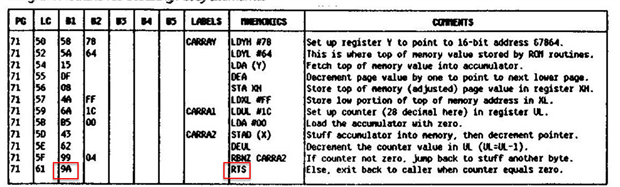
    I've not looked at Z80 for an extremely long time, so I could be wrong, but looking at this PC1500 machine code article (PDF) the instructions do not look like Z80.

    For instance, on the last page of the PDF, there is this example program:

    image

    Taking an example, the red instruction, the Z80 does not have an RTS instruction according to here: Z80 / R800 instruction set

    There's a RET instruction for the Z80, but it has a different opcode too (0xC9, not 0x9A).

    Also, according to here: Frank C. Odds : Probe! a disassembler for the Sharp PC-1500 - PC-1500.info

    the PC-1500's CPU only has three registers.

    So, I believe that while it may have similarities to CPUs such as the Z80 or indeed any other CPU from the time, it's not a Z80 derivative (or not a very close one), nor compatible with z80 at mnemonic or opcode level.

    • Cancel
    • Vote Up +1 Vote Down
    • Sign in to reply
    • Cancel
  • raylec
    raylec over 7 years ago in reply to COMPACT

    COMPACT  wrote:


    It was quite rare to come across Mostek parts in Australia. We usually got Zilog, SGS and Sharp.

    And from memory the SGS parts didn't support the undocumented instructions.


    The latest post in this thread was recent enough for me to dare 'reply' to this 2016 entry - hope that's OK with you ?

    During the '80s I've been professionally involved in a number of commercial projects, built around the PC-1500A pocket computer from Sharp.

    This was often referred to then as a 'BASIC programmable calculator', though its functionality, capabilities, and the actual applications surpassed

    that status by far.

    With only superficial knowledge of microprocessors, I've always wondered about Sharp's own LH-58xx family. As far as I know, it has only been

    utilized in the PC-1500 and its successor, the PC-1600. It wasn't until recently that I learned that Sharp had (and still has) its own line of OEM

    4 and 8 bit microprocessors. The LH-5080 e.g. is offered as a member of the Sharp  Z80 family, LH-0080.

    For me this raises several questions:

    - Is the LH-5801 really a Z80 derivative, as most sources over time have stated ? Doesn't the model number, 5800, seem odd, even peculiar,

       when one realizes the importance of the Motorola 6800 in those days ?! In other words: LH-0080 makes sense, better still: is clear - LH-5800

       is confusing. The only explanation I could think of, would be, Sharp meaning to discern her OEM products from her microprocessors intended

       only for use in her own apparati - i.c. her line of pocket computers. Btw Sharp herself makes no mention of the Z80 (nor any other microprocessor

       for that matter) in her Technical Reference Manual. (http://www.pc-1500.info/Data/Service_Manuals/PC-1500_Technical_Reference_Manual.pdf )

    - Anybody has a clue as to what the letters, LH, stand for, and what the 5 might refer to ?

      (Sharp being proud of her early chip design and production capabilities, called one of her seventies calculator lines: Elsi Mate, where Elsi stands

       for ELSI - Extra Large Scale Integration)

    - The CMOS LH-5801 had an impressive number of on-chip facilities/peripherals - probably more than the (standard ?) Z80.

       I have not been able to find a (useful*) comparison with the Z80 itself, derivatives, or other microprocessors from the same era. Anybody ?

        *(cpu-world hasn't brought me any further).

    Thanks or answering !

    Ray

    • Cancel
    • Vote Up +1 Vote Down
    • Sign in to reply
    • Cancel
  • COMPACT
    COMPACT over 9 years ago in reply to dougw

    The Slit-N-Wrap wire is 28AWG and normally 30AWG is used for Wire Wrapping.

    I usually use 24, 26 and 28AWG for prototyping because I find that 30AWG is a bit too flimsy.

    Dobs of glue are also useful for holding wires in place.

    • Cancel
    • Vote Up +3 Vote Down
    • Sign in to reply
    • Cancel
Reply
  • COMPACT
    COMPACT over 9 years ago in reply to dougw

    The Slit-N-Wrap wire is 28AWG and normally 30AWG is used for Wire Wrapping.

    I usually use 24, 26 and 28AWG for prototyping because I find that 30AWG is a bit too flimsy.

    Dobs of glue are also useful for holding wires in place.

    • Cancel
    • Vote Up +3 Vote Down
    • Sign in to reply
    • Cancel
Children
No Data
element14 Community

element14 is the first online community specifically for engineers. Connect with your peers and get expert answers to your questions.

  • Members
  • Learn
  • Technologies
  • Challenges & Projects
  • Products
  • Store
  • About Us
  • Feedback & Support
  • FAQs
  • Terms of Use
  • Privacy Policy
  • Legal and Copyright Notices
  • Sitemap
  • Cookies

An Avnet Company © 2026 Premier Farnell Limited. All Rights Reserved.

Premier Farnell Ltd, registered in England and Wales (no 00876412), registered office: Farnell House, Forge Lane, Leeds LS12 2NE.

Follow element14

  • X
  • Facebook
  • linkedin
  • YouTube