element14 Community
element14 Community
    Register Log In
  • Site
  • Search
  • Log In Register
  • Community Hub
    Community Hub
    • What's New on element14
    • Feedback and Support
    • Benefits of Membership
    • Personal Blogs
    • Members Area
    • Achievement Levels
  • Learn
    Learn
    • Ask an Expert
    • eBooks
    • element14 presents
    • Learning Center
    • Tech Spotlight
    • STEM Academy
    • Webinars, Training and Events
    • Learning Groups
  • Technologies
    Technologies
    • 3D Printing
    • FPGA
    • Industrial Automation
    • Internet of Things
    • Power & Energy
    • Sensors
    • Technology Groups
  • Challenges & Projects
    Challenges & Projects
    • Design Challenges
    • element14 presents Projects
    • Project14
    • Arduino Projects
    • Raspberry Pi Projects
    • Project Groups
  • Products
    Products
    • Arduino
    • Avnet & Tria Boards Community
    • Dev Tools
    • Manufacturers
    • Multicomp Pro
    • Product Groups
    • Raspberry Pi
    • RoadTests & Reviews
  • About Us
    About the element14 Community
  • Store
    Store
    • Visit Your Store
    • Choose another store...
      • Europe
      •  Austria (German)
      •  Belgium (Dutch, French)
      •  Bulgaria (Bulgarian)
      •  Czech Republic (Czech)
      •  Denmark (Danish)
      •  Estonia (Estonian)
      •  Finland (Finnish)
      •  France (French)
      •  Germany (German)
      •  Hungary (Hungarian)
      •  Ireland
      •  Israel
      •  Italy (Italian)
      •  Latvia (Latvian)
      •  
      •  Lithuania (Lithuanian)
      •  Netherlands (Dutch)
      •  Norway (Norwegian)
      •  Poland (Polish)
      •  Portugal (Portuguese)
      •  Romania (Romanian)
      •  Russia (Russian)
      •  Slovakia (Slovak)
      •  Slovenia (Slovenian)
      •  Spain (Spanish)
      •  Sweden (Swedish)
      •  Switzerland(German, French)
      •  Turkey (Turkish)
      •  United Kingdom
      • Asia Pacific
      •  Australia
      •  China
      •  Hong Kong
      •  India
      •  Japan
      •  Korea (Korean)
      •  Malaysia
      •  New Zealand
      •  Philippines
      •  Singapore
      •  Taiwan
      •  Thailand (Thai)
      •  Vietnam
      • Americas
      •  Brazil (Portuguese)
      •  Canada
      •  Mexico (Spanish)
      •  United States
      Can't find the country/region you're looking for? Visit our export site or find a local distributor.
  • Translate
  • Profile
  • Settings
Community Hub
Community Hub
Member's Forum Help with noise measurement and stability of regulator
  • Blog
  • Forum
  • Documents
  • Quiz
  • Events
  • Leaderboard
  • Polls
  • Files
  • Members
  • Mentions
  • Sub-Groups
  • Tags
  • More
  • Cancel
  • New
Join Community Hub to participate - click to join for free!
Actions
  • Share
  • More
  • Cancel
Forum Thread Details
  • Replies 12 replies
  • Subscribers 594 subscribers
  • Views 2903 views
  • Users 0 members are here
Related

Help with noise measurement and stability of regulator

Andrew J
Andrew J over 5 years ago

I'm looking for some help with resolving a noise and what I believe is stability problem of a -5V LDO regulator.  Here is the circuit:

image

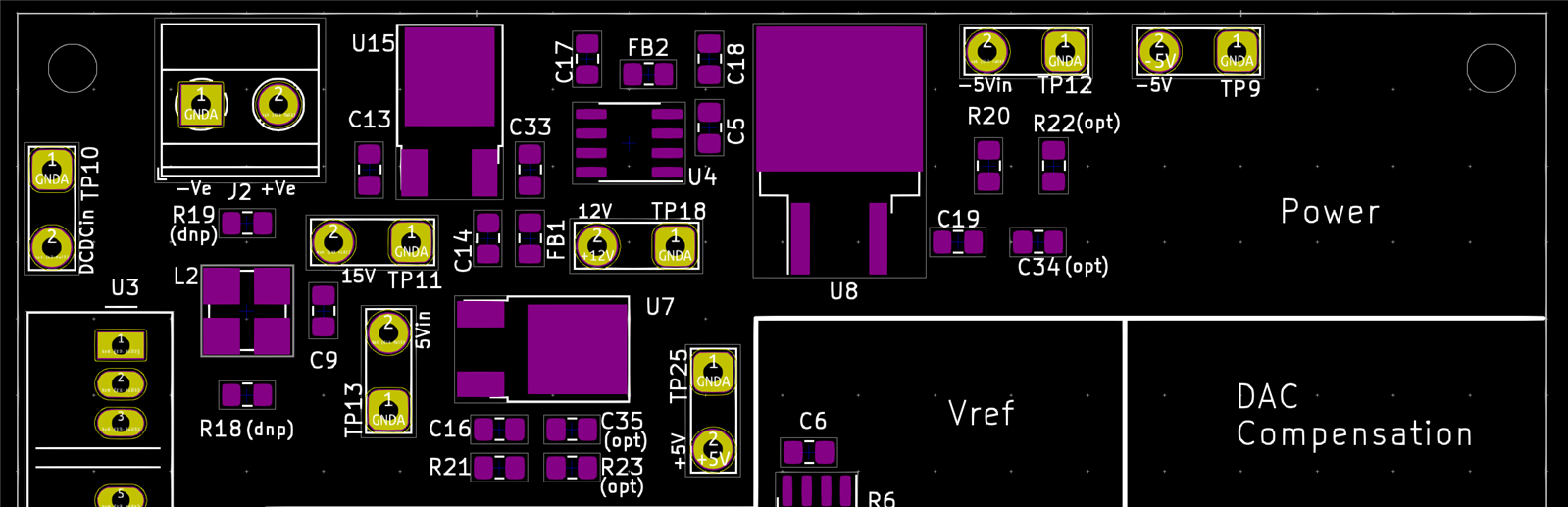
and in case it's useful, the relevant part of the PCB:
image


The circuit section I'm having difficulty with is the top right (yellow ICs).  I have a 285Ohm resistor soldered across terminals of TP9 and it draws 17.5mA.  R22 and C34 are not populated.


The TC7662TC7662 DC-DC charge pump, is fed from a regulated 12V and outputs -11.8V to feed into a -5V LDO regulatorMC7905CDMC7905CD which is outputting -5.011V.


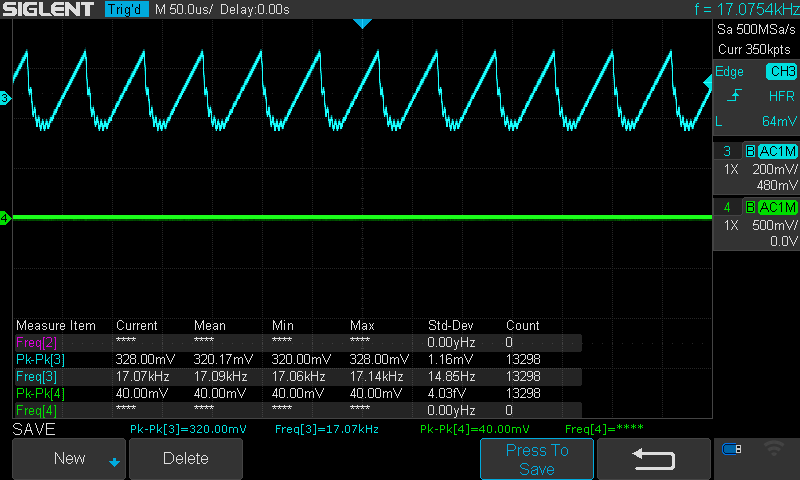
When I take measurements (AC coupled, BW 20MHz, 1xprobe with the pigtail rather than flying lead) of the charge pump output (at TP12) and -5V output (at TP9) I get:
image

CH3: Charge Pump output with HF reject on (matches what is expected in the datasheet).  I was expecting that the frequency of the output would be 35kHZ due to way I have pins 1 and 8 connected together.


image

CH4: -5 LDO output with LF reject on.


I think the LDO output looks like it is oscillating.  Looking at the circuit the input capacitor, C18, is too small and should be a 0.33uF tantalum for stability, according to the datasheet but I have used a 0.33 ceramic capacitor as I don't have any useable tantalums and my thinking was the ceramic should have a low ESR.  I've actually tried with 22uF and then a 68uF electrolytic capacitors, in parallel, but both have zero effect on the LDO output which remains steadfastly at 1.32V.  I've tried the circuit on a breadboard but unfortunately I only have a TI LM7905 - this seems to work ok even with the original capacitor value and doesn't oscillate.  I think the TI part behaves differently so it's not a great comparison.  Its output is slightly improved with a 22uF input capacitor.


I really thought that adding an electrolytic capacitor at the input would help (the ESR of the 22uF was around 2.2Ohm) but it makes no difference at all.  I'm out of ideas short of "it really needs a tantalum capacitor on the input", so I'm putting this out there to see if anyone can give me pointers or things to try.

  • Sign in to reply
  • Cancel

Top Replies

  • jw0752
    jw0752 over 5 years ago +3
    Hi Andrew, For the fun of it I decided to see if I could duplicate your problem. I fed a small adjustable DC switch mode converter with 15 volts from my power supply and regulated it down to 10 Volts.…
  • jc2048
    jc2048 over 5 years ago in reply to Andrew J +2
    I'm a bit late to this party, but this might be of interest. This is what Bob Pease [a National Semicondutor designer] wrote back in the early nineties. Sounds like the negative regulators were much more…
  • michaelkellett
    michaelkellett over 5 years ago +1
    I couldn't find any reference to it in data sheets but it may be that the 7905 does not like the 1uF ceramic output cap. Lots of older design monolithic regulators need some esr in the output cap to work…
  • jc2048
    jc2048 over 5 years ago in reply to Andrew J

    I'm a bit late to this party, but this might be of interest. This is what Bob Pease [a National Semicondutor designer] wrote back in the early nineties. Sounds like the negative regulators were much more touchy than the positive ones, though personally I don't remember being aware of that. I can remember some LDOs being difficult.


    You'll have problems with regulators when you don't provide the required, specified output bypassing. Most negative regulators and some other types, such as low-dropout regulators, require an electrolytic bypass capacitor to ground. If you insert a tantalum capacitor, you may be able to get away with a value of 1 or 2uF; if you use an aluminum electrolytic capacitor, you can get away with 20 to 100uF, or whatever the datasheet spells out. But in all cases, on all the parts I know, an electrolytic will work, and a film or ceramic won't work - its series resistance is just too small. Now, if you put a 1 ohm resistor in series with a 1uF ceramic capacitor, the filtering will probably be adequate at room temperature; the loss factor is then similar to a tantalum capacitor. But if you take it to -40 or +100C, the ceramic capacitor's value will shrink badly and the regulator will be unhappy again. It may start oscillating, or it might just start ringing really badly.


    Robert A Pease


    Troubleshooting Analog Circuits, 1991

    • Cancel
    • Vote Up +2 Vote Down
    • Sign in to reply
    • Cancel
  • Andrew J
    Andrew J over 5 years ago in reply to jc2048

    It's been my experience here too!  I had tried with a 22uF on the output but in parallel to the 1uF ceramic and approx. 3 cm away.  It didn't like that and that's the point I became stuck as I didn't know what else to try.  Once I removed the 1uF it started working so there's something else to bear in mind. 

    • Cancel
    • Vote Up +1 Vote Down
    • Sign in to reply
    • Cancel
<
element14 Community

element14 is the first online community specifically for engineers. Connect with your peers and get expert answers to your questions.

  • Members
  • Learn
  • Technologies
  • Challenges & Projects
  • Products
  • Store
  • About Us
  • Feedback & Support
  • FAQs
  • Terms of Use
  • Privacy Policy
  • Legal and Copyright Notices
  • Sitemap
  • Cookies

An Avnet Company © 2026 Premier Farnell Limited. All Rights Reserved.

Premier Farnell Ltd, registered in England and Wales (no 00876412), registered office: Farnell House, Forge Lane, Leeds LS12 2NE.

ICP 备案号 10220084.

Follow element14

  • X
  • Facebook
  • linkedin
  • YouTube