element14 Community
element14 Community
    Register Log In
  • Site
  • Search
  • Log In Register
  • Community Hub
    Community Hub
    • What's New on element14
    • Feedback and Support
    • Benefits of Membership
    • Personal Blogs
    • Members Area
    • Achievement Levels
  • Learn
    Learn
    • Ask an Expert
    • eBooks
    • element14 presents
    • Learning Center
    • Tech Spotlight
    • STEM Academy
    • Webinars, Training and Events
    • Learning Groups
  • Technologies
    Technologies
    • 3D Printing
    • FPGA
    • Industrial Automation
    • Internet of Things
    • Power & Energy
    • Sensors
    • Technology Groups
  • Challenges & Projects
    Challenges & Projects
    • Design Challenges
    • element14 presents Projects
    • Project14
    • Arduino Projects
    • Raspberry Pi Projects
    • Project Groups
  • Products
    Products
    • Arduino
    • Avnet & Tria Boards Community
    • Dev Tools
    • Manufacturers
    • Multicomp Pro
    • Product Groups
    • Raspberry Pi
    • RoadTests & Reviews
  • About Us
  • Store
    Store
    • Visit Your Store
    • Choose another store...
      • Europe
      •  Austria (German)
      •  Belgium (Dutch, French)
      •  Bulgaria (Bulgarian)
      •  Czech Republic (Czech)
      •  Denmark (Danish)
      •  Estonia (Estonian)
      •  Finland (Finnish)
      •  France (French)
      •  Germany (German)
      •  Hungary (Hungarian)
      •  Ireland
      •  Israel
      •  Italy (Italian)
      •  Latvia (Latvian)
      •  
      •  Lithuania (Lithuanian)
      •  Netherlands (Dutch)
      •  Norway (Norwegian)
      •  Poland (Polish)
      •  Portugal (Portuguese)
      •  Romania (Romanian)
      •  Russia (Russian)
      •  Slovakia (Slovak)
      •  Slovenia (Slovenian)
      •  Spain (Spanish)
      •  Sweden (Swedish)
      •  Switzerland(German, French)
      •  Turkey (Turkish)
      •  United Kingdom
      • Asia Pacific
      •  Australia
      •  China
      •  Hong Kong
      •  India
      • Japan
      •  Korea (Korean)
      •  Malaysia
      •  New Zealand
      •  Philippines
      •  Singapore
      •  Taiwan
      •  Thailand (Thai)
      • Vietnam
      • Americas
      •  Brazil (Portuguese)
      •  Canada
      •  Mexico (Spanish)
      •  United States
      Can't find the country/region you're looking for? Visit our export site or find a local distributor.
  • Translate
  • Profile
  • Settings
Community Hub
Community Hub
Member's Forum Compensating / "linearizing" an RC oscillator
  • Blog
  • Forum
  • Documents
  • Quiz
  • Events
  • Leaderboard
  • Polls
  • Files
  • Members
  • Mentions
  • Sub-Groups
  • Tags
  • More
  • Cancel
  • New
Join Community Hub to participate - click to join for free!
Actions
  • Share
  • More
  • Cancel
Forum Thread Details
  • Replies 10 replies
  • Subscribers 574 subscribers
  • Views 898 views
  • Users 0 members are here
  • vfo
  • linearity
  • compensating
  • theremin
  • rc
  • oscillator
  • 555
Related

Compensating / "linearizing" an RC oscillator

FredM
FredM over 13 years ago

It is well known that the worst form of oscillator to use as a theremin VFO is the RC type - The frequency of these oscillators is simply a function of R*C, and as the "antenna" to hand capacitance follows an inverse square law, pitch (from heterodyning the VFO with a fixed reference oscillator) response (linearity) is the worst possible.


LC oscillators without an equalizing inductor have a better response, and this is greatly improved (in most cases) by adding a suitable series inductor with the antenna..


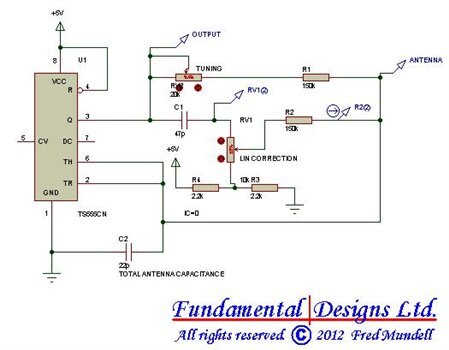
The circuit presented here has only been evaluated (not extensively) in simulation - It has not yet been built. The objective is to improve the "linearity" of a simple RC oscillator used as a theremin VFO.
 

image

In the above implementation which uses a TS555CD.TS555CD. as the oscillator, C1 RV1 and R2 form a 'monostable' type circuit which changes the charging and discharging paths for C2 (the antenna capacitance) - The effect of these components is to increase the frequency as the frequency increases - as in, if C2 reduces, the frequency will increase to a greater degree than would have occurred if C1 had not been present.


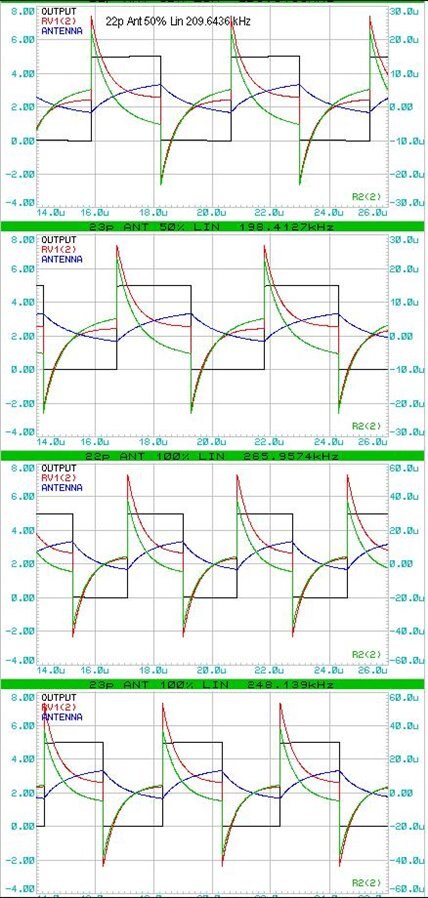
Waveforms shown below give a better understanding of the operation:
 

image

Shown are waveforms for an antenna capacitance of 22pF and 23pF, with linearity control set to 50% and 100%. It should be noted that the Tuning potentiometer (VR) and the linearity potentiometer are highly interactive. For higher VFO frequencies, C1 should be reduced.

Attachments:
image
image
  • Sign in to reply
  • Cancel

Top Replies

  • FredM
    FredM over 13 years ago in reply to DAB +1
    "Once in public domain, you cannot stop progress" Yes, this is the truth - and it is the way to beat the "big boys" if you are a small fish. It is, however, quite difficult to do - you spend a lot of time…
Parents
  • michaelkellett
    michaelkellett over 13 years ago

    Hello Fred,


    This is  a slightly tangential question !


    On you schematic it says All rights reserved C 2012........


    But you have posted this in a public place ... what rights are you reserving ?


    (Normally if a circuit is published like this I would expect to be allowed to build/modify it unless a patent was cited.)


    Michael Kellett

    • Cancel
    • Vote Up 0 Vote Down
    • Sign in to reply
    • Cancel
Reply
  • michaelkellett
    michaelkellett over 13 years ago

    Hello Fred,


    This is  a slightly tangential question !


    On you schematic it says All rights reserved C 2012........


    But you have posted this in a public place ... what rights are you reserving ?


    (Normally if a circuit is published like this I would expect to be allowed to build/modify it unless a patent was cited.)


    Michael Kellett

    • Cancel
    • Vote Up 0 Vote Down
    • Sign in to reply
    • Cancel
Children
  • FredM
    FredM over 13 years ago in reply to michaelkellett

    Yeah -


    No one can stop you doing whatever you want with this circuit, as you well know, LOL! ;-) .. Even if a patent was cited, there is nothing to stop anyone from exploring the idea, building one for their own use (perhaps technically this could be stopped, but in practice unless it was an extremely expensive item, no one gives a damn) etc..


    Publishing something in a public place, however, does not void any copyright the creator (intrinsically) has over the work - unless this is specifically declared (my understanding is that copyright is automatic and actually needs to be specifically revoked by the creator).


    So, Why do I sometimes make statements like this? Simply to (a) prevent people from copying the DOCUMENT (or diagram) and publishing it somewhere else under their name. (b)I think it gives a little bit of disincentive to those who take it for granted that they can abuse anything which is published. (c) it is a way to declare my 'authorship' with a little more 'formality' than appears if one simply says "designed by Fred Mundell".


    But - bottom line, as you know, if someone wants something you have created / invented / patented, and they are big enough, they will take it. The patent system is so corrupt that it is not worth any individual or small company going through the full process - If the patent is worth anything, it will be stolen - and the costs of obtaining a worthwhile patent are unmanagable.


    Please, go ahead and play with this oscillator!  I published it for that purpose. It would be nice to get some feedback occasionally from people who use stuff I have published -


    Fred.

    • Cancel
    • Vote Up 0 Vote Down
    • Sign in to reply
    • Cancel
element14 Community

element14 is the first online community specifically for engineers. Connect with your peers and get expert answers to your questions.

  • Members
  • Learn
  • Technologies
  • Challenges & Projects
  • Products
  • Store
  • About Us
  • Feedback & Support
  • FAQs
  • Terms of Use
  • Privacy Policy
  • Legal and Copyright Notices
  • Sitemap
  • Cookies

An Avnet Company © 2026 Premier Farnell Limited. All Rights Reserved.

Premier Farnell Ltd, registered in England and Wales (no 00876412), registered office: Farnell House, Forge Lane, Leeds LS12 2NE.

ICP 备案号 10220084.

Follow element14

  • X
  • Facebook
  • linkedin
  • YouTube