Hello,
I want to start designing my own circuits from scratch, but I don't know where to start.
What do I need to know before I can start to do that?
Hello,
I want to start designing my own circuits from scratch, but I don't know where to start.
What do I need to know before I can start to do that?
Hi Nicholas,
The first thing you need is a good vision of what you need to do. What is your device suppose to do? Next you have to decide on inputs to the device. What are you trying to detect and have the circuit react to. It could be as simple as a push of a switch. Next you have to decide what you want for an output. Will it be movement of a motor or the ringing of a bell? Next I usually look at resources. What parts do I have to work with? What is the environment in which my circuit must work. Next it is a matter of breaking the job of the circuit down into simpler pieces like power supply, logic, and drivers for the output to the real world. This is a real general overview of the process and I can come back if you have more detailed questions but I have to run right now.
John
Nicholas,
There are a lot of interesting projects that have been fully described on this website (search around). Find a project that is relatively simple and interesting and study it. When you come across something that you don't understand, try searching for more information on Google. Once something begins to make sense, try to replicate the design and once that works, try to modify in slightly. Bit by bit, you will be able to increase your understanding of electronics.
That being said, there is no better way to learn than to study electronics (books, school, tutorials, etc.). Electronics is a science, which adheres to rules. Learning the basic rules, like Ohm's law for example, is a fundamental aspect of understanding how to design electronic circuits.
Best of luck!
Gene
Hi Nicholas,
I have been a fan of the author Charles Platt and he will be releasing a new book in August that focuses on designing circuits.
You may want to check it out if you are still interested in August.
John
Thanks! These are some great tips!
But, I'm not sure how I would break down the circuit into smaller functional blocks.
Could you go into more detail about that?
I have to be general as we have no specific circuit but there are three parts to a circuit.
Input: This is the circuits connection where some stimulus is taken in and processed by the circuit. In the simplest of circuits it would be perhaps a switch. In more complicated circuits it may be multiple sensors or even the output of another circuit. The first components in a circuit that initially process the input stimulus can be considered the input section.
Output: This is the part of the circuit that puts some effect or action back into the real world or in more complicated situation is may pass information onto another circuit. If for example the output was a motor I would trace the motor wires back into the circuit and look at fist layer or two of components that are connected to the motor and this would likely be the output circuit.
Power: All circuits need a source of conditioned power. I say conditioned as the power requirements are usually quite specific. Other components are needed to raise/lower, filter, and regulate the power to the input and output sections of the circuit. Start with the source of the energy whether it is a battery or a plug in and look at the first components in the circuit that are connected. These are likely to be associated with the modification of the power for use by the input and output sections.
Suppose we want to design a very simple circuit where one can turn a light on and off. My first consideration might be the power section. Do I want to have battery power or mains power? What are my resources? Can I use the mains power safely? Next I might consider the Output. We want light but there are different types that run on different voltages. If I choose one type it may force me to go back and reconsider my choice of power. Finally we have input (the switch). What types of switches will work best for this application?
I am sure that you are thinking of more complicated circuits than the one above but it serves as a simple template for doing more complicated devices.
Homework Assignment:
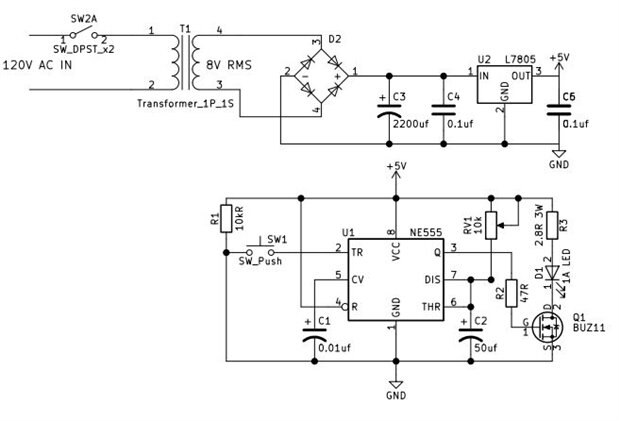
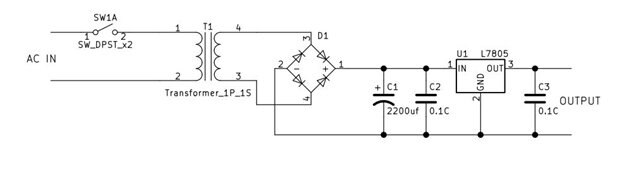
Suppose that I have a circuit that is going to require 5 volt DC to power a NE555 IC Chip. The source that I want to use is mains power. Your assignment is to design a simple linear power supply to provide the 5 Volts that we need.
I await your power supply design before we move on to designing and building the rest of our circuit.
John
Hi Nicholas,
That looks really good. What is the rms voltage of the transformer secondary and what DC voltage does this lead you to expect on the 2200 uF Cap?
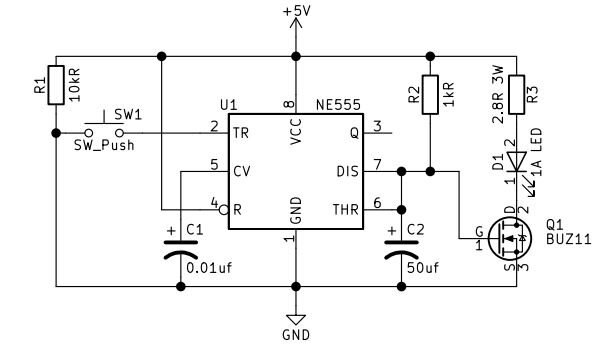
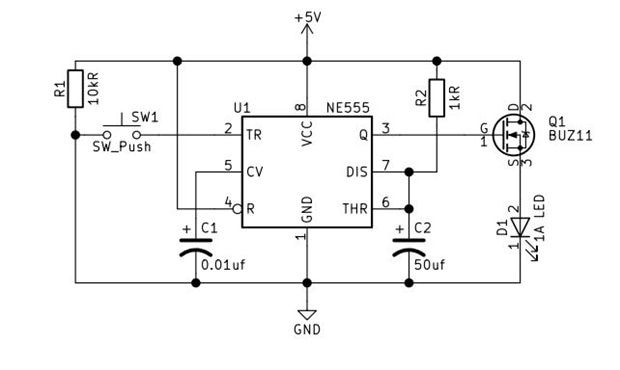
We are going to design a one shot timer using a 555 in monostable mode. We want to be able to push a button (Input) once and have an LED (output) light and stay on for a minute. The LED is a bright one and requires 1 AMP. It is going to run off the unregulated DC from the power supply. We will have to be thinking of how we are going to design the timer circuit. We will have to be thinking of how we are going to drive the LED since the 555 can't handle sufficient power to do it alone. See what you can come up with. Don't be afraid to borrow circuits and designs from open sources.
I will work with this more but I have to run for now.
John
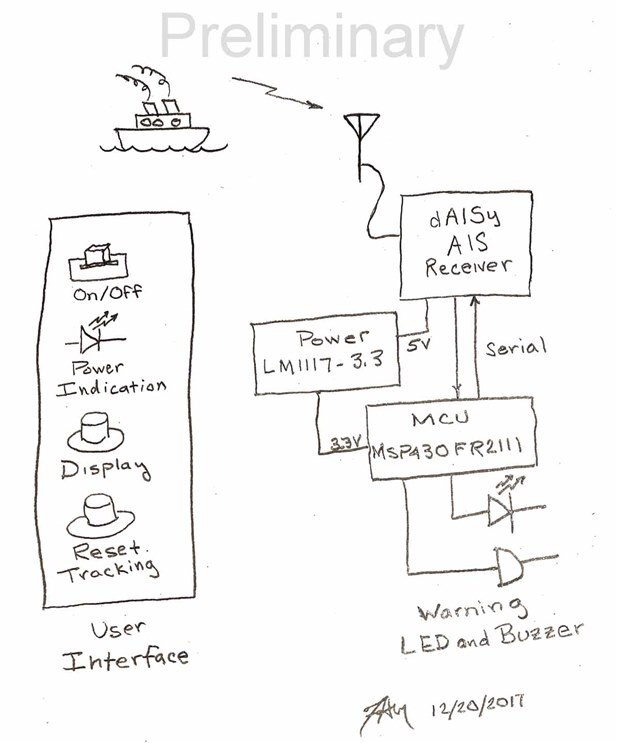
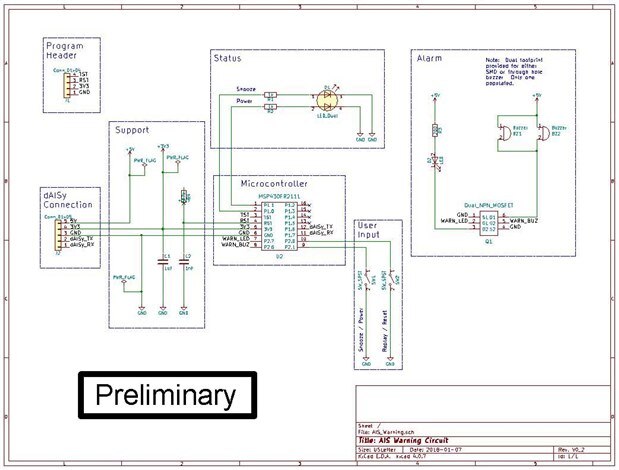
My first step in the design process is to draw a simplified block diagram of what I am trying to achieve. The idea is to capture the process and steps that John has described in one diagram. In my previous life we frequently had to communicate ideas upward in order to get approval for funding and additional resources. A simplified block diagram is very useful for this and can be the basis for more detailed schematics and other design drawings. To illustrate what I mean, here is a preliminary block diagram I recently posted on element14 at the start of a design:
This step forces the designer to simplify and think about the design objectives. The blocks in the design can then be broken down further. For this simple design I was able to fill them in and go straight to a schematic after making a few changes to the user interface and the makeup of the blocks. The blocks are still apparent as shown by the outlines around them in the schematic and now have the detail needed to start the design of the PCB. Further breakdown is necessary in more complicated designs (possibly with additional pages and pages of mechanical, instrument, civil, structural, etc. drawings). But it can always start with a single cartoon :-).
This is pretty much universal practice and is extremely helpful for sorting ideas out in your own mind as well as communicating to others.