element14 Community
element14 Community
    Register Log In
  • Site
  • Search
  • Log In Register
  • Community Hub
    Community Hub
    • What's New on element14
    • Feedback and Support
    • Benefits of Membership
    • Personal Blogs
    • Members Area
    • Achievement Levels
  • Learn
    Learn
    • Ask an Expert
    • eBooks
    • element14 presents
    • Learning Center
    • Tech Spotlight
    • STEM Academy
    • Webinars, Training and Events
    • Learning Groups
  • Technologies
    Technologies
    • 3D Printing
    • FPGA
    • Industrial Automation
    • Internet of Things
    • Power & Energy
    • Sensors
    • Technology Groups
  • Challenges & Projects
    Challenges & Projects
    • Design Challenges
    • element14 presents Projects
    • Project14
    • Arduino Projects
    • Raspberry Pi Projects
    • Project Groups
  • Products
    Products
    • Arduino
    • Avnet & Tria Boards Community
    • Dev Tools
    • Manufacturers
    • Multicomp Pro
    • Product Groups
    • Raspberry Pi
    • RoadTests & Reviews
  • About Us
  • Store
    Store
    • Visit Your Store
    • Choose another store...
      • Europe
      •  Austria (German)
      •  Belgium (Dutch, French)
      •  Bulgaria (Bulgarian)
      •  Czech Republic (Czech)
      •  Denmark (Danish)
      •  Estonia (Estonian)
      •  Finland (Finnish)
      •  France (French)
      •  Germany (German)
      •  Hungary (Hungarian)
      •  Ireland
      •  Israel
      •  Italy (Italian)
      •  Latvia (Latvian)
      •  
      •  Lithuania (Lithuanian)
      •  Netherlands (Dutch)
      •  Norway (Norwegian)
      •  Poland (Polish)
      •  Portugal (Portuguese)
      •  Romania (Romanian)
      •  Russia (Russian)
      •  Slovakia (Slovak)
      •  Slovenia (Slovenian)
      •  Spain (Spanish)
      •  Sweden (Swedish)
      •  Switzerland(German, French)
      •  Turkey (Turkish)
      •  United Kingdom
      • Asia Pacific
      •  Australia
      •  China
      •  Hong Kong
      •  India
      • Japan
      •  Korea (Korean)
      •  Malaysia
      •  New Zealand
      •  Philippines
      •  Singapore
      •  Taiwan
      •  Thailand (Thai)
      • Vietnam
      • Americas
      •  Brazil (Portuguese)
      •  Canada
      •  Mexico (Spanish)
      •  United States
      Can't find the country/region you're looking for? Visit our export site or find a local distributor.
  • Translate
  • Profile
  • Settings
Community Hub
Community Hub
Member's Forum Query re: datasheet values
  • Blog
  • Forum
  • Documents
  • Quiz
  • Events
  • Leaderboard
  • Polls
  • Files
  • Members
  • Mentions
  • Sub-Groups
  • Tags
  • More
  • Cancel
  • New
Join Community Hub to participate - click to join for free!
Actions
  • Share
  • More
  • Cancel
Forum Thread Details
  • State Verified Answer
  • Replies 13 replies
  • Answers 8 answers
  • Subscribers 567 subscribers
  • Views 1859 views
  • Users 0 members are here
Related

Query re: datasheet values

Andrew J
Andrew J over 6 years ago

I do struggle with making sure I understand what a data sheet is telling me so I'm hoping someone can confirm or otherwise explain my understanding of something.  I'm looking at the data sheet for a LTC1624 - http://www.farnell.com/datasheets/1713911.pdf?_ga=2.75130708.790743949.1554834791-441347304.1541859637&_gac=1.136456708.1554891125.EAIaIQobChMI16fD9tLD4QIVz5TtCh3QQglqEAAYAiAAEgKKrvD_BwE


The electrical characteristics state that Vfb feedback current is typically 10nA, max 50nA; Vfb feedback voltage is min 1.178v to max 1.20v.


I'm trying to analyse a circuit, not dissimilar to that shown as an example application in the data sheet, and have built it up in LTSpice.  When I simulate this, I can see voltage going into the Vfb pin of 1.15v to 1.3v with peaks of 1.8v falling down to 1.3v  (this is a switching regulator at 200Khz).  I can see current at the Vfb pin of 14.75nA with peaks of -130nA and 110nA.  It will swing from 14nA to -130nA to 110nA back to 14nA in a period of 0.02ms. 


This can vary significantly with output load (the above is with a 1kohm load and is more extreme with lower resistance.)  If I build the example application in the data sheet the current to the Vfb pin is within the specified range but the voltage is under the minimum level or over the maximum (again, depending upon load.)


My assumption would be that my circuit would be a problem but it's confusing because the example application also simulates outside the specifications.  This is when I start to think I'm not interpreting the data sheet information correctly.  Could someone proffer some advice?


I've not posted pictures of the circuit or the simulation results because it's more a question of correctly/incorrectly interpret the specifications - obviously I can if it's important/useful enough.


Thanks


Andrew

  • Sign in to reply
  • Cancel

Top Replies

  • michaelkellett
    michaelkellett over 6 years ago in reply to Andrew J +4 suggested
    Crumbs !!! If I had a spare age or two I could work out what all this is meant to do - is there a description somewhere ? My installation of LTSPice moans that it can't find the 7805 - no matter - if I…
  • shabaz
    shabaz over 6 years ago +3 suggested
    Hi Andrew, The voltage at that pin can go beyond 1.178..1.2V (this is a tolerance of the internal reference, not really a range), it's easiest to consider it like an input pin - it's a feedback input.…
  • jc2048
    jc2048 over 6 years ago in reply to Andrew J +3 suggested
    In case you don't know, you can save a schematic via the clipboard like this. It isn't very obvious the first time you use LTSpice. I then read it into GIMP and export it as a .png file, though you'll…
  • shabaz
    0 shabaz over 6 years ago

    Hi Andrew,


    The voltage at that pin can go beyond 1.178..1.2V (this is a tolerance of the internal reference, not really a range), it's easiest to consider it like an input pin - it's a feedback input. The switching regulator will have spikes, the IC cannot respond (i.e. accept feedback) fast enough to completely remove them from the output (and hence there are spikes at the feedback pin too, since that's seeing a representation of the output voltage divided down).

    The engineer creating the circuit needs to know the datasheet feedback voltage value, so that they can pick the voltage divider values (R1 and R2) so that the Vfb input pin sees 1.178..1.2V when the output is at the desired voltage.

    • Cancel
    • Vote Up +3 Vote Down
    • Sign in to reply
    • Verify Answer
    • Reject Answer
    • Cancel
  • Andrew J
    0 Andrew J over 6 years ago in reply to shabaz

    I think I understand.  So I need to tune the resistor divider values to get that voltage range (and current range?) without too much regard to transient spikes?


    thanks,


    Andrew

    • Cancel
    • Vote Up 0 Vote Down
    • Sign in to reply
    • Verify Answer
    • Cancel
  • shabaz
    0 shabaz over 6 years ago in reply to Andrew J

    Hi Andrew,


    That's correct regarding the voltage value (The current value indicates what that input pin will take, and so the potential divider must provide that current - that can be done by choosing potential divider resistances such that the current through the potential divider itself is much larger than that to reduce error, but not so great that too much power is wasted. As an example, if the divider ratio was decided to be (say) 1:2 and R1 and R2 were then (say) 10M and 20M respectively that might not be appropriate, but if they were 10k and 20k respectively then that may be more appropriate. But, the datasheet has to be consulted regarding this feedback circuit, often it will suggest what ballpark either R1 or R2 should be in, or there may be an example circuit with values, it's important not to stray too much from that ballpark to prevent instability.

    • Cancel
    • Vote Up +1 Vote Down
    • Sign in to reply
    • Verify Answer
    • Reject Answer
    • Cancel
  • Andrew J
    0 Andrew J over 6 years ago in reply to shabaz

    Great, thanks.  I’m analysing the circuit I have to find out how it works - or at least, that the claim is it works: I’ve found a number of issues with it so I’m not convinced.  The example circuit in the data sheet does have values for additional components so I shall work on the ones I have to get that current within spec.

    • Cancel
    • Vote Up +2 Vote Down
    • Sign in to reply
    • Verify Answer
    • Cancel
  • michaelkellett
    0 michaelkellett over 6 years ago in reply to Andrew J

    I've used LTSpice for many years and simulated a good number of switching circuits.


    I think you are worrying about a detail than may well be unimportant. The transient currents may not be totally accurate for short spikes, and will certainly not be the same in real life (because all the parasitics will be different).


    If you were to post the LT spice schematic and the model I could run it and make a more informed comment on the issue you report.


    (Are you using the LT supplied example design as a start point ?)


    MK

    • Cancel
    • Vote Up +1 Vote Down
    • Sign in to reply
    • Verify Answer
    • Reject Answer
    • Cancel
  • michaelkellett
    0 michaelkellett over 6 years ago in reply to michaelkellett

    I had a quick look at the reference model and the data sheet.


    I put 1000R in series with the FB pin so I could see the current (started with the standard LTC1624 example)

    And it looks like this:


    image

    Blue trace is feedback voltage, red is feedback current.


    If you check the data sheet carefully you will see Note 2 by the IinFB parameter - its says:


    The LTC1624 is tested in a feedback loop which servos VFB to

    the midpoint for the error amplifier (VITH = 1.8V)


    Which indicates that the feedback current will vary in an unspecified way if the feedback is not perfectly in balance !


    My plot shows that the average feedback current is about 10nA which is in spec. The shape of the current waveform looks as if there is some capacitance to ground in the model (and that makes sense).


    LT use LTSpice to design their chips - the models (and LTSpice) are pretty good.


    MK

    • Cancel
    • Vote Up +2 Vote Down
    • Sign in to reply
    • Verify Answer
    • Reject Answer
    • Cancel
  • Andrew J
    0 Andrew J over 6 years ago in reply to michaelkellett

    Thanks for that Michael.  I did build the example circuit to try out and got similar results - as I noted above, the voltage was out of range which just adds to my confusion interpreting these as I was expecting LT parts/designs to operate correctly with their models and tool (clearly, they do it's my confusion that is the problem.)  Incidentally, and I'm sorry if I'm teaching you to suck eggs here, you don't need to put a resistor in series to measure the current, you can just hover over the pin itself and you get the current measure icon.  I dare say I'm about to find out something new with LT Spice image - actually, I already have: having seen the Waveform dialog in your image, I worked out how to get it and can see that the average current in my schematic is within spec, even when it's generating peaks between +-500nA at the Vfb pin.


    I can't work out how to attach files in this forum, but the ASC is available here:


    https://1drv.ms/u/s!AkgMkSdwBcLBhUA40xuMyJGu9ruI


    and should be editable.  This originates from a Linear Technology design, but has been adapted.  All the parts are in the LT Spice library.  If you run it with different values for RLOAD (bottom right corner of the schematic) you can measure different voltage/current values on Vfb.  In theory, the circuit should work and be reliable (that is, not blow up!) for ranges 0V/0A through to 15V/3A.  Whilst the overall circuit works in terms of measurements taken over RLOAD and for various values of VCTRL and ICTRL my concern was the circuit operation in real life in respect to the LTC1624 once I started to measure values.  As I say, I'm trying to analyse the circuit to understand better how it works and I sometimes find data sheets a bit obtuse.  The example you give in respect to Note 2 is a prime one: I had read that note but, frankly, it wasn't clear what it meant - your translation is excellent, thanks image.


    Where data sheets mention 'absolute maximums' do they generally mean 'sustained absolute maximums'?  For example, in this schematic, the Vgs on the Mosfet averages at 18.92v with peaks at 25v but the 'absolute maximum' is 20v.  That was the next thing I was going to take a look at!


    Thanks

    • Cancel
    • Vote Up +2 Vote Down
    • Sign in to reply
    • Verify Answer
    • Cancel
  • michaelkellett
    0 michaelkellett over 6 years ago in reply to Andrew J

    Crumbs !!!


    If I had a spare age or two I could work out what all this is meant to do - is there a description somewhere ?


    My installation of LTSPice moans that it can't find the 7805 - no matter - if I were modelling this I wouldn't have it in any way image


    The key to simulation is to keep it simple - those // caps don't do anything for you (since they use simple models and don't have even series resistance added).


    Looks like that entire 7805, LTC1983, 2N3904 chain is just there to provide a roughly constant current (about 20mA) towards ground - for debugging the simulation use a current source.


    So, if I wanted to understand the LTC1624 and it seemed to do something odd (in simulation), I would first get it into a nice simple model and play with that.


    Once that is going nicely, start adding the other bits.


    MK

    • Cancel
    • Vote Up +4 Vote Down
    • Sign in to reply
    • Verify Answer
    • Reject Answer
    • Cancel
  • jc2048
    0 jc2048 over 6 years ago in reply to Andrew J

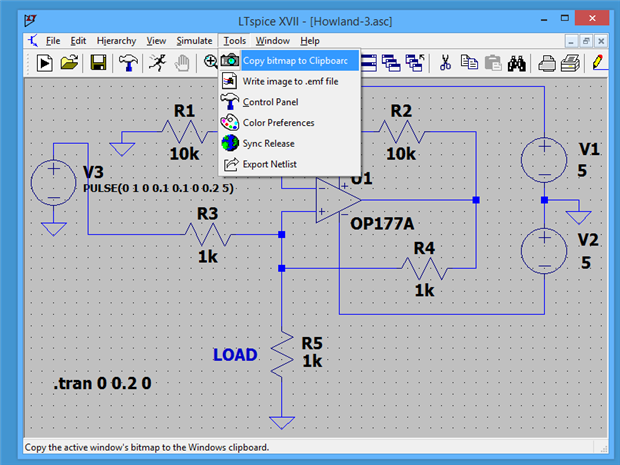
    In case you don't know, you can save a schematic via the clipboard like this. It isn't very obvious the first time you use LTSpice. I then read it into GIMP and export it as a .png file, though you'll probably have your own favourite way of doing that bit. You'll probably get more of a conversation going if there are embedded pictures to look at in your discussion posts rather than links to files on other websites.


    image


    With regard to the design files, people seem to be able to attach .zip files to blog posts, so maybe try that.

    • Cancel
    • Vote Up +3 Vote Down
    • Sign in to reply
    • Verify Answer
    • Reject Answer
    • Cancel
  • Andrew J
    0 Andrew J over 6 years ago in reply to michaelkellett

    I hear you - I really didn't want to drag anyone into spending ages debugging this which is why I didn't post it first and was asking about the data sheet principally.  It's something I'm working on as part of my own education so I try not to get people to do my work for me, if that makes sense.  Sometimes, however, I just run into things I can't get my head around or find information on.


    With the schematic built in LT Spice it works: I can adjust the load (RLOAD), VCTRL and ICTRL and vary the output in line with expectations at least as far as my limited experience tells me.  What I was getting into was some detail of the circuit as part of understanding it further and ensuring that the simulation wasn't hiding anything - for example, as I understand it, LT Spice doesn't flag up things such as over-powering devices.  When I was looking at the voltage and current loads against the data sheet of the LTC1624 I was concerned this was one of those 'hidden' things.


    Essentially, this is a bench power supply based on a design from Linear Technologies: https://www.analog.com/en/design-center/evaluation-hardware-and-software/evaluation-boards-kits/dc2132a.html#


    That uses a bunch of ICs in a QFN package which I didn't want to get into soldering, frankly, if I moved this forward.  There is an alternative build here which uses 'easier' components but based on the same design (not exactly but...) 


    https://www.instructables.com/id/High-Performance-Adjustable-Power-Supply-50-With-O/


    What I was aiming for was ensuring that it worked and understanding how: the schematic's BOM is different to the provided LT Spice model that shows 'it works'.  I re-created the model (which you have seen) and using the BOM shows me it doesn't, so I've made some slight adjustments, e.g. changing the Mosfet (and now it does simulate correctly at least).  Once I got it to a certain point I was then going to look at individual pieces of it and consider alternatives.  For example, the 7805, LTC1983 and 2N3904 are just doing what you say and it allows the LT3081s to go to 0v.  However, the power drop on the 7805 is a possible concern and I don't need a regulator that is capable of providing 1A there, so I was going to investigate alternatives, perhaps even an alternate power source for that part.


    As an aside, even if I went further with the LT DC2132a design linked above, I would still have re-created a LT Spice model to get an understanding of how it was working.


    If you do want to look at it further, I have put the 7805 library and schematic here.  Sorry, I forgot those were models I'd downloaded (they came from the LT Spice Yahoo group):

    https://1drv.ms/u/s!AkgMkSdwBcLBhURMa2Z_QgDaAvPS

    https://1drv.ms/u/s!AkgMkSdwBcLBhUVL0et2Qom29n82


    In terms of, say, your point in respect to the LTC1624 doing something odd in simulation, that was my first thought.  So I built up a separate, simple model in LT Spice, based on the example application in the data sheet, but that also looked 'odd' to me as well!  I assumed it related to my understanding of/confusion with what the data sheet was telling me: I wasn't inclined to believe that Linear Technologies would put an example into the data sheet that was wrong but I couldn't figure out why, if the data sheet says min/max is X/Y, that the simulation of LT's application was  not in that range.  At the time, if I saw the results you posted above showing the  current swinging from -50nA to 190nA I would also think that might be a concern given the min/max in the data sheet of 10nA/50nA!  If I'm honest with myself, I'm still not sure how the data sheet says it isn't a problem!  I guess that will come with experience.


    Hopefully that all makes sense!  I really appreciate the input and time, thanks.

    • Cancel
    • Vote Up +2 Vote Down
    • Sign in to reply
    • Verify Answer
    • Reject Answer
    • Cancel
>
element14 Community

element14 is the first online community specifically for engineers. Connect with your peers and get expert answers to your questions.

  • Members
  • Learn
  • Technologies
  • Challenges & Projects
  • Products
  • Store
  • About Us
  • Feedback & Support
  • FAQs
  • Terms of Use
  • Privacy Policy
  • Legal and Copyright Notices
  • Sitemap
  • Cookies

An Avnet Company © 2025 Premier Farnell Limited. All Rights Reserved.

Premier Farnell Ltd, registered in England and Wales (no 00876412), registered office: Farnell House, Forge Lane, Leeds LS12 2NE.

ICP 备案号 10220084.

Follow element14

  • X
  • Facebook
  • linkedin
  • YouTube