element14 Community
element14 Community
    Register Log In
  • Site
  • Search
  • Log In Register
  • Community Hub
    Community Hub
    • What's New on element14
    • Feedback and Support
    • Benefits of Membership
    • Personal Blogs
    • Members Area
    • Achievement Levels
  • Learn
    Learn
    • Ask an Expert
    • eBooks
    • element14 presents
    • Learning Center
    • Tech Spotlight
    • STEM Academy
    • Webinars, Training and Events
    • Learning Groups
  • Technologies
    Technologies
    • 3D Printing
    • FPGA
    • Industrial Automation
    • Internet of Things
    • Power & Energy
    • Sensors
    • Technology Groups
  • Challenges & Projects
    Challenges & Projects
    • Design Challenges
    • element14 presents Projects
    • Project14
    • Arduino Projects
    • Raspberry Pi Projects
    • Project Groups
  • Products
    Products
    • Arduino
    • Avnet & Tria Boards Community
    • Dev Tools
    • Manufacturers
    • Multicomp Pro
    • Product Groups
    • Raspberry Pi
    • RoadTests & Reviews
  • About Us
    About the element14 Community
  • Store
    Store
    • Visit Your Store
    • Choose another store...
      • Europe
      •  Austria (German)
      •  Belgium (Dutch, French)
      •  Bulgaria (Bulgarian)
      •  Czech Republic (Czech)
      •  Denmark (Danish)
      •  Estonia (Estonian)
      •  Finland (Finnish)
      •  France (French)
      •  Germany (German)
      •  Hungary (Hungarian)
      •  Ireland
      •  Israel
      •  Italy (Italian)
      •  Latvia (Latvian)
      •  
      •  Lithuania (Lithuanian)
      •  Netherlands (Dutch)
      •  Norway (Norwegian)
      •  Poland (Polish)
      •  Portugal (Portuguese)
      •  Romania (Romanian)
      •  Russia (Russian)
      •  Slovakia (Slovak)
      •  Slovenia (Slovenian)
      •  Spain (Spanish)
      •  Sweden (Swedish)
      •  Switzerland(German, French)
      •  Turkey (Turkish)
      •  United Kingdom
      • Asia Pacific
      •  Australia
      •  China
      •  Hong Kong
      •  India
      •  Japan
      •  Korea (Korean)
      •  Malaysia
      •  New Zealand
      •  Philippines
      •  Singapore
      •  Taiwan
      •  Thailand (Thai)
      •  Vietnam
      • Americas
      •  Brazil (Portuguese)
      •  Canada
      •  Mexico (Spanish)
      •  United States
      Can't find the country/region you're looking for? Visit our export site or find a local distributor.
  • Translate
  • Profile
  • Settings
Community Hub
Community Hub
Member's Forum Project Builder - LED Barometer
  • Blog
  • Forum
  • Documents
  • Quiz
  • Events
  • Leaderboard
  • Polls
  • Files
  • Members
  • Mentions
  • Sub-Groups
  • Tags
  • More
  • Cancel
  • New
Join Community Hub to participate - click to join for free!
Actions
  • Share
  • More
  • Cancel
Forum Thread Details
  • State Suggested Answer
  • Replies 15 replies
  • Answers 2 answers
  • Subscribers 616 subscribers
  • Views 1760 views
  • Users 0 members are here
Related

Project Builder - LED Barometer

Spencer
Spencer over 1 year ago

Hi

I'm looking to find someone in the UK, ideally the London area, to discuss the possibility of building an LED barometer that I have visually designed. I have a clear understanding of what I would like from the design and have an appreciation of electronics and principles, though lack the practical skills/programming knowledge - if anyone would be intersted in discussing/exploring, I would welcome your response. Thanks, Spencer

  • Sign in to reply
  • Cancel
  • Spencer
    0 Spencer over 1 year ago in reply to beacon_dave

    Thank you for this.

    • Cancel
    • Vote Up 0 Vote Down
    • Sign in to reply
    • Verify Answer
    • Cancel
  • beacon_dave
    0 beacon_dave over 1 year ago in reply to Spencer

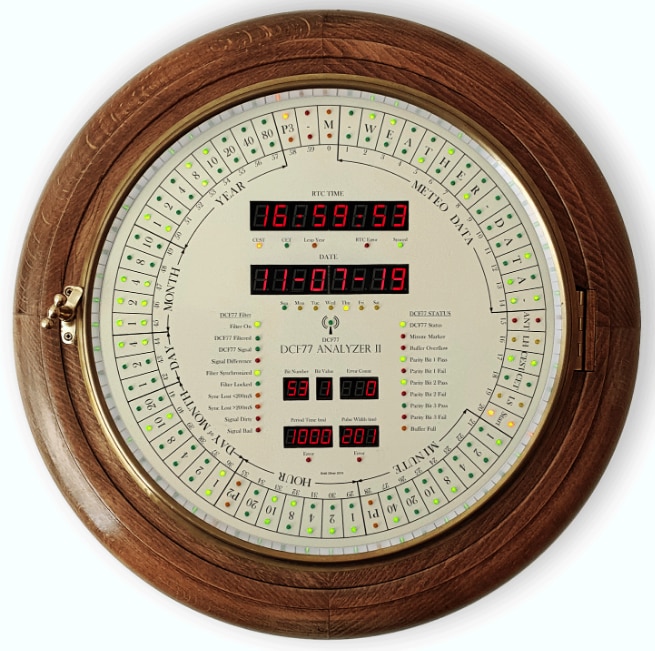
    Brett Oliver's DCF77 Analyzer clock might give you some ideas. He has built one into a traditional round wooden case.

    https://www.brettoliver.org.uk/DCF77_Analyzer_Clock_Mk2/Arduino_DCF77_Analyzer_MK2.htm

    image

    • Cancel
    • Vote Up +1 Vote Down
    • Sign in to reply
    • Verify Answer
    • Cancel
  • beacon_dave
    0 beacon_dave over 1 year ago in reply to Spencer

    If  the case is quite small then another approach might be to use something like a T-Display S3 module

    https://www.youtube.com/watch?v=9vR50HNl3Lo

    https://www.youtube.com/watch?v=AxJ3pf8yh5s

    as this allows you to update the content of the display after construction and give you alternative functionality like displaying a chart of the pressure over time or for adjusting user preferences.

    There are some larger round LCD HDMI displays which could be used with the likes of a Raspberry Pi 
    https://www.youtube.com/watch?v=eJBDXjI5Zu4 

    and this has the potential of making it more of a multipurpose display - barometer, clock, thermometer, picture frame etc.

    You could also use servo motors moving needles to give you a more traditional mechanical dial look but controlled by modern technology.

    • Cancel
    • Vote Up 0 Vote Down
    • Sign in to reply
    • Verify Answer
    • Cancel
  • Spencer
    0 Spencer over 1 year ago in reply to beacon_dave

    Probably a dark wood casing I would think - mahogany of some form, perhaps. I like the hidden/diffused LEDs beneath the veneer in the video! Thanks.

    • Cancel
    • Vote Up 0 Vote Down
    • Sign in to reply
    • Verify Answer
    • Cancel
  • beacon_dave
    0 beacon_dave over 1 year ago in reply to Spencer

    What style of old fashioned case were you thinking of ?

    Traditional 'banjo style' with a round barometer at the bottom and the the vertical thermometer above ? Or perhaps something more minimalist ?

    You can hide LEDs behind thin wood veneer like this:

    /challenges-projects/project14/hacktheholidays/b/blog/posts/led-christmas-tree-advent-calendar

    if you want a plain wood panel that comes to life with modern electronics.

    • Cancel
    • Vote Up 0 Vote Down
    • Sign in to reply
    • Verify Answer
    • Cancel
  • Spencer
    0 Spencer over 1 year ago in reply to electronicbiker

    Thanks. :-)

    • Cancel
    • Vote Up 0 Vote Down
    • Sign in to reply
    • Verify Answer
    • Cancel
  • Spencer
    0 Spencer over 1 year ago in reply to beacon_dave

    Thank you for this information and corresponding links, Dave.

    • Cancel
    • Vote Up 0 Vote Down
    • Sign in to reply
    • Verify Answer
    • Cancel
  • Spencer
    0 Spencer over 1 year ago in reply to michaelkellett

    Thank you, MK.

    • Cancel
    • Vote Up 0 Vote Down
    • Sign in to reply
    • Verify Answer
    • Cancel
  • beacon_dave
    0 beacon_dave over 1 year ago

    Perhaps this Arduino project is something similar to what you are trying to do ?

    https://github.com/willemsphoto/Barometer/blob/main/redled-barometer-box.pdf

    Also perhaps take a look at Natasha's series here on how to animate NeoPixel LEDs with a micro:bit

    /learn/learning-center/stem-academy/microbit/microbit-tutorial-videos/b/blog/posts/animating-leds 

    • Cancel
    • Vote Up +1 Vote Down
    • Sign in to reply
    • Verify Answer
    • Reject Answer
    • Cancel
  • michaelkellett
    0 michaelkellett over 1 year ago in reply to Spencer

    From your detailed description in your reply to  electronicbiker I think your best bet would be to use a string of neopixels controlled by an arduino . You will need a pressure sensor as well.

    The neopixels are cheap and will allow you to have any colour for any LED and pretty much as many as you like.

    Arduinos are good for simple projects with a lot of support on the web. You could make your own control board or use one of dozens of alternatives if you don't fancy the Arduino.

    If you want to go wild you could have a column display of  pressure a bit like a zoomed in mercury barometer. 

    https://thepihut.com/collections/adafruit-neopixels

    You can buy neopixels from Aliexpress very cheaply - either loose (requiring assembly onto a pcb) or on tape (ready to connect to a microcontroller.).

    MK

    • Cancel
    • Vote Up +1 Vote Down
    • Sign in to reply
    • Verify Answer
    • Reject Answer
    • Cancel
>
element14 Community

element14 is the first online community specifically for engineers. Connect with your peers and get expert answers to your questions.

  • Members
  • Learn
  • Technologies
  • Challenges & Projects
  • Products
  • Store
  • About Us
  • Feedback & Support
  • FAQs
  • Terms of Use
  • Privacy Policy
  • Legal and Copyright Notices
  • Sitemap
  • Cookies

An Avnet Company © 2026 Premier Farnell Limited. All Rights Reserved.

Premier Farnell Ltd, registered in England and Wales (no 00876412), registered office: Farnell House, Forge Lane, Leeds LS12 2NE.

ICP 备案号 10220084.

Follow element14

  • X
  • Facebook
  • linkedin
  • YouTube