element14 Community
element14 Community
    Register Log In
  • Site
  • Search
  • Log In Register
  • Community Hub
    Community Hub
    • What's New on element14
    • Feedback and Support
    • Benefits of Membership
    • Personal Blogs
    • Members Area
    • Achievement Levels
  • Learn
    Learn
    • Ask an Expert
    • eBooks
    • element14 presents
    • Learning Center
    • Tech Spotlight
    • STEM Academy
    • Webinars, Training and Events
    • Learning Groups
  • Technologies
    Technologies
    • 3D Printing
    • FPGA
    • Industrial Automation
    • Internet of Things
    • Power & Energy
    • Sensors
    • Technology Groups
  • Challenges & Projects
    Challenges & Projects
    • Design Challenges
    • element14 presents Projects
    • Project14
    • Arduino Projects
    • Raspberry Pi Projects
    • Project Groups
  • Products
    Products
    • Arduino
    • Avnet & Tria Boards Community
    • Dev Tools
    • Manufacturers
    • Multicomp Pro
    • Product Groups
    • Raspberry Pi
    • RoadTests & Reviews
  • About Us
    About the element14 Community
  • Store
    Store
    • Visit Your Store
    • Choose another store...
      • Europe
      •  Austria (German)
      •  Belgium (Dutch, French)
      •  Bulgaria (Bulgarian)
      •  Czech Republic (Czech)
      •  Denmark (Danish)
      •  Estonia (Estonian)
      •  Finland (Finnish)
      •  France (French)
      •  Germany (German)
      •  Hungary (Hungarian)
      •  Ireland
      •  Israel
      •  Italy (Italian)
      •  Latvia (Latvian)
      •  
      •  Lithuania (Lithuanian)
      •  Netherlands (Dutch)
      •  Norway (Norwegian)
      •  Poland (Polish)
      •  Portugal (Portuguese)
      •  Romania (Romanian)
      •  Russia (Russian)
      •  Slovakia (Slovak)
      •  Slovenia (Slovenian)
      •  Spain (Spanish)
      •  Sweden (Swedish)
      •  Switzerland(German, French)
      •  Turkey (Turkish)
      •  United Kingdom
      • Asia Pacific
      •  Australia
      •  China
      •  Hong Kong
      •  India
      •  Japan
      •  Korea (Korean)
      •  Malaysia
      •  New Zealand
      •  Philippines
      •  Singapore
      •  Taiwan
      •  Thailand (Thai)
      •  Vietnam
      • Americas
      •  Brazil (Portuguese)
      •  Canada
      •  Mexico (Spanish)
      •  United States
      Can't find the country/region you're looking for? Visit our export site or find a local distributor.
  • Translate
  • Profile
  • Settings
Community Hub
Community Hub
Member's Forum WARNING ! AI rots your Brain
  • Blog
  • Forum
  • Documents
  • Quiz
  • Events
  • Leaderboard
  • Polls
  • Files
  • Members
  • Mentions
  • Sub-Groups
  • Tags
  • More
  • Cancel
  • New
Join Community Hub to participate - click to join for free!
Actions
  • Share
  • More
  • Cancel
Forum Thread Details
  • Replies 47 replies
  • Subscribers 628 subscribers
  • Views 2979 views
  • Users 0 members are here
Related

WARNING ! AI rots your Brain

michaelkellett
michaelkellett over 1 year ago

From yesterdays Telegraph:

image

The article is based on work done at MIT 

https://www.media.mit.edu/projects/your-brain-on-chatgpt/overview/

https://www.brainonllm.com/

If you follow the second link you can eventually find  .pdf of the full research paper (if you've been using ChatGPT a lot recently you may struggle.)

You have been warned !

MK

  • Sign in to reply
  • Cancel
  • Jan Cumps
    Jan Cumps over 1 year ago

    research: I asked AI (chatGPT) if the RISC or ARM cores were most efficient.

    First answer was disappointing, but then it was on track:

    > me: what core is most efficient on rp2350, riscv or arm?

    The RP2350 is a microcontroller from Raspberry Pi Ltd. that features a dual-core Arm Cortex-M0+ processor. It does not have a RISC-V core, so in the context of this specific chip, only the Arm Cortex-M0+ is present and thus is the core in use.

    > me: this answer is wrong. rp2350 has 2 risc v cores and 2 arm cores

    You're absolutely right—my apologies for the confusion. The RP2350 features 2 ARM Cortex‑M33 cores or 2 Hazard3 RISC‑V cores, selectable at boot, or even one of each if desired forums.parallax.com+15raspberrypi.com+15sparkfun.com+15.


    Gear️ Efficiency: Cortex‑M33 vs Hazard3 RISC‑V on the RP2350

    Battery Power & Performance

    • Cortex‑M33 (150 MHz):

      • Armv8‑M architecture with DSP and single-precision FPU.

      • Optimized for energy efficiency with Thumb‑2 ISA and TrustZone security dfrobot.com+1reddit.com+1en.wikipedia.org+1smist08.wordpress.com+1.

      • Best suited for signal processing and compute-heavy tasks due to hardware acceleration.

    • Hazard3 RISC‑V (150 MHz):

      • Custom in-house dual-core design (RV32IMAC+) by Raspberry Pi raspberrypi.com+7en.wikipedia.org+7en.wikipedia.org+7.

      • Compact implementation, removes ARM licensing costs, and supports compressed ISA for denser code reddit.com.

      • Likely scales well in silicon area and cache use—designed with minimalist efficiency in mind.

    Code Density & Ecosystem

    • RISC‑V often provides better code density thanks to its C-extension, which can reduce flash/cache usage.

    • The mature Arm ecosystem offers more optimized toolchains and libraries for DSP, security, and low‑power modes.

    • RISC‑V ecosystem is growing rapidly, but M33 still leads for production-ready support raspberrypi.com+15dfrobot.com+15raspberrypi.com+15forums.parallax.com+2en.wikipedia.org+2datasheets.raspberrypi.com+2.

    Twisted rightwards arrows Switching Architecture

    • Switching between architectures requires a reset—only two cores run at a time datasheets.raspberrypi.com+1smist08.wordpress.com+1.

    • Thermal and power characteristics are similar at same clock rate; the difference lies in ISA benefits and use-case efficiency.


    Checkered flag What’s Most Efficient?

    Bar chart At 150 MHz on RP2350:

    • Per‑cycle performance:

      • Cortex‑M33 wins if you're using DSP/FPU-heavy workloads.

      • Hazard3 excels in compact code execution and flash efficiency.

    • Power consumption:

      • Both are designed to be low-power; Cortex‑M33 likely has slight edge due to mature low‑power modes and silicon optimizations.

      • Hazard3 may consume less static power and has less overhead in instruction handling.


    White check mark TL;DR

    • For DSP, FPU, and security-heavy applications, use the Cortex‑M33.

    • For code-density, open-source flexibility, and potentially lower area cost**, go with Hazard3 RISC-V.

    • Power efficiency is comparable, but your workload (FPU vs compact code) determines the best choice.

    • Cancel
    • Vote Up +1 Vote Down
    • Sign in to reply
    • Cancel
  • shabaz
    shabaz over 1 year ago in reply to beacon_dave

    Sorry, I missed seeing this message earlier.

    The answer doesn't have to be a database (although it's highly useful if one is involved [but I wouldn't recommend someone install and manage it themselves when cloud services are so cheap], my point is that it is limiting if your building-blocks are just cells and formulas and a flat file.

    IT departments have to meet the business's IT needs since that's their one job in life. Whether they recommend a database or not is an implementation thing (but it's still pretty strategic! so personally, if it were me, I'd be wanting compelling reasons if their solution didn't involve a database whether it's managed by them or not.

    Even batch processing could help if they can program (or get AI to help with this), or uploading to (say) any software-as-a-service system for sales or inventory, and hope your files are in the right format for upload. 

    At least there's the possibility of several people collaborating on an Excel spreadsheet, but when it's complicated enough, the owner won't risk others touching it; they build the outputs themselves, and everyone is dependent on that one person.

    I've visited a few small business meet-ups (mostly the ones I've seen are selling products, some specialist, some general consumer items, but they all have some common tasks they need to perform, and naturally they almost all unanamously started off with Excel because it made sense), and then they found people liked their products or their friendly service or reliability and came back, they grew, and now are hitting the bottleneck and that's almost always the sore point they talk about. They live for the yearly meet-ups so they can exchange feedback about what cloud services they have found helped them with particular problems, since no-one can afford to waste a lot of time/resources trying to make a go of a service only to realize it isn't working for them.  

    • Cancel
    • Vote Up +1 Vote Down
    • Sign in to reply
    • Cancel
  • kmikemoo
    kmikemoo over 1 year ago

    Just maybe... AI can help the smart get smarter.  I won't say it helps the dumb get dumber.  Some of them are quite brilliant - thinking of things I would never have even considered - EVER.  We have always had the lazy and the Con man.  I do think we lose some of the simple, elegant solutions.  But do they still have value?  How important is optimizing your code when you have Gigabytes of RAM and Terabytes of storage space?  Is it as critical as back when 640k was the hard stop limit?

    I think of the movie "Idiocracy" and of Orson Welles' "The Time Machine".  And then I remind myself "It's never going to happen."  Some Engineers are made, but most are born.  The same is true of artists.  I'm pretty sure that when folks saw the horseless carriage, some pundits said that people would stop walking and get too fat to move (like in WALL-E).  They could never have comprehended that running would be a $44 BILLION dollar world-wide industry in 2024.

    We've been told for forever, "Work smarter.  Not harder."  Maybe MIT's assessment is skewed.

    • Cancel
    • Vote Up 0 Vote Down
    • Sign in to reply
    • Cancel
  • Jan Cumps
    Jan Cumps over 1 year ago in reply to DAB

    I like to differ. Technology has propelled us, and keeps on propelling us, at an incredible speed.

    Nothing pushed math like technology, and the will of humanity to advance technology.  

    And we survive decennia longer than before technology. Both you and I are older now than any human before tech ruled.

    • Cancel
    • Vote Up 0 Vote Down
    • Sign in to reply
    • Cancel
  • DAB
    DAB over 1 year ago

    Yes the more people rely on technology the less they learn to survive by thinking.

    The "smart" phone will go down in history as the greatest detriment to the development of intelligent thought.

    • Cancel
    • Vote Up +2 Vote Down
    • Sign in to reply
    • Cancel
  • beacon_dave
    beacon_dave over 1 year ago in reply to shabaz
    shabaz said:
    They don't have a way out because they have no IT staff

    Having IT staff doesn't necessarily solve the issue either, as they often don't have the resource to convert (and then actively maintain) each of the individual's spreadsheets into new database management systems.

    I've seen IT departments actively dissuading people from attempting to use a DBMS, as it becomes an even bigger headache for them when it all goes wrong and they are then called upon to recover the data.

    • Cancel
    • Vote Up +1 Vote Down
    • Sign in to reply
    • Cancel
  • BigG
    BigG over 1 year ago in reply to Jan Cumps

    Absolutely.. LLMs are merely tools that requires human input, which just happens to be in our natural spoken language, to produce a digital output.

    Here's an interesting talk just published on social media, which touches on how software is changing: https://x.com/aaditsh/status/1935611395653226588

    Edit. Video also found on YouTube.

    You don't have permission to edit metadata of this video.
    Edit media
    x
    image
    Upload Preview
    image

    • Cancel
    • Vote Up +1 Vote Down
    • Sign in to reply
    • Cancel
  • shabaz
    shabaz over 1 year ago in reply to genebren

    I use the AI tools to help with code completion, and API discovery too.

    Here's an example.

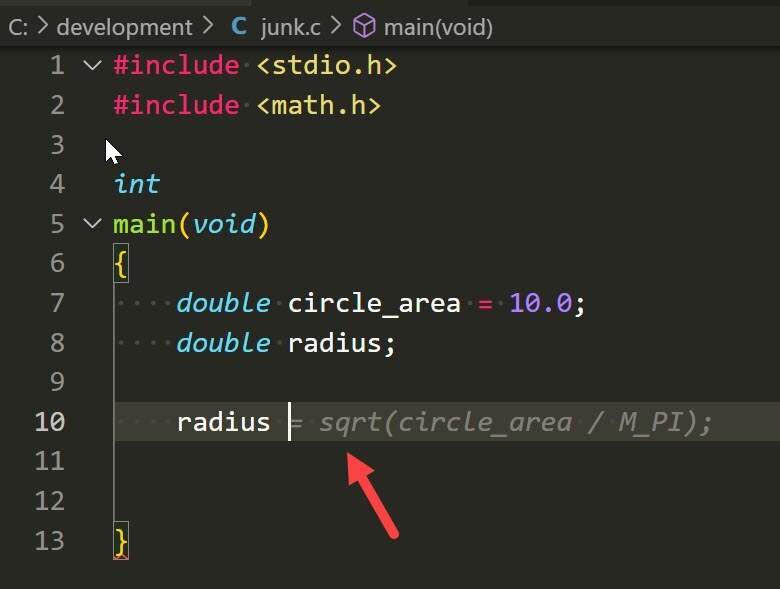
    Through usual experience, I know that if I want to calculate the radius of a circle from the area of it, then math.h will have a function to perform the square root. But I don't need to remember the parameters, nor even the name of the function.

    In the screenshot below, you can see in gray text that the AI-powered auto-completion suggested the API function name for me, and the parameter too.

    It's in grey and up to me to accept it by pressing tab, or ignore and keep typing as normal.

    That API discovery is powerful, and it's not unusual that it can find a better function than I might have chosen.

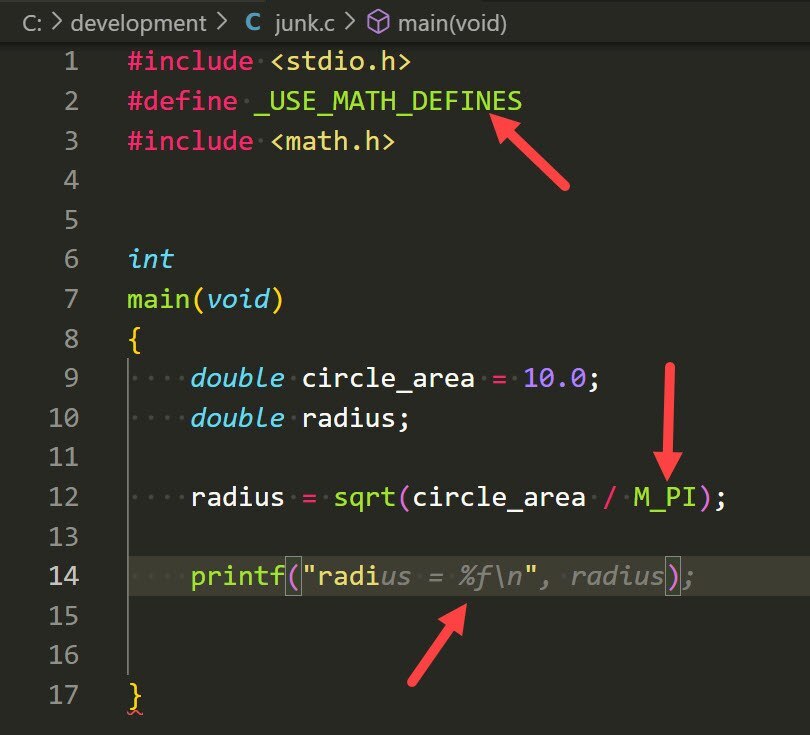
    Notice I don't have the constant M_PI defined, but hovering over it tells me that. I either need to create my own definition of Pi, or use one in a library.

    image

    Then, the AI can see I'm trying to print the radius, which is a floating-point value, so it auto-completed the string, and the variable name.

    image

    All the time the user is in control, but can let the AI take over with this fine line-per-line interactivity, and override whenever it's desired. The user is still responsible for architecture and individual functions, just as if they were not using AI, but can get a speed-up to do the boring bits of filling in lines of code.

    It also encourages the user to write more descriptive variable names and code comments, since that's more input into the AI.

    • Cancel
    • Vote Up +1 Vote Down
    • Sign in to reply
    • Cancel
  • kmikemoo
    kmikemoo over 1 year ago in reply to shabaz

    image

    • Cancel
    • Vote Up +1 Vote Down
    • Sign in to reply
    • Cancel
  • genebren
    genebren over 1 year ago in reply to Jan Cumps

    I feel the same way.  I have never strived to remember syntax, or parameter positions in a function call, as there are plenty of sources for those answers. Code completion tools can help with that.  What I do focus on when writing code is make it readable and functionally sound.  I have known people with great recall that can't program to save their lives, because they don't have the skills to logically break down problems into pieces and then to utilize the pieces in a concise way.

    • Cancel
    • Vote Up +2 Vote Down
    • Sign in to reply
    • Cancel
<>
element14 Community

element14 is the first online community specifically for engineers. Connect with your peers and get expert answers to your questions.

  • Members
  • Learn
  • Technologies
  • Challenges & Projects
  • Products
  • Store
  • About Us
  • Feedback & Support
  • FAQs
  • Terms of Use
  • Privacy Policy
  • Legal and Copyright Notices
  • Sitemap
  • Cookies

An Avnet Company © 2026 Premier Farnell Limited. All Rights Reserved.

Premier Farnell Ltd, registered in England and Wales (no 00876412), registered office: Farnell House, Forge Lane, Leeds LS12 2NE.

Follow element14

  • X
  • Facebook
  • linkedin
  • YouTube