element14 Community
element14 Community
    Register Log In
  • Site
  • Search
  • Log In Register
  • Community Hub
    Community Hub
    • What's New on element14
    • Feedback and Support
    • Benefits of Membership
    • Personal Blogs
    • Members Area
    • Achievement Levels
  • Learn
    Learn
    • Ask an Expert
    • eBooks
    • element14 presents
    • Learning Center
    • Tech Spotlight
    • STEM Academy
    • Webinars, Training and Events
    • Learning Groups
  • Technologies
    Technologies
    • 3D Printing
    • FPGA
    • Industrial Automation
    • Internet of Things
    • Power & Energy
    • Sensors
    • Technology Groups
  • Challenges & Projects
    Challenges & Projects
    • Design Challenges
    • element14 presents Projects
    • Project14
    • Arduino Projects
    • Raspberry Pi Projects
    • Project Groups
  • Products
    Products
    • Arduino
    • Avnet & Tria Boards Community
    • Dev Tools
    • Manufacturers
    • Multicomp Pro
    • Product Groups
    • Raspberry Pi
    • RoadTests & Reviews
  • About Us
    About the element14 Community
  • Store
    Store
    • Visit Your Store
    • Choose another store...
      • Europe
      •  Austria (German)
      •  Belgium (Dutch, French)
      •  Bulgaria (Bulgarian)
      •  Czech Republic (Czech)
      •  Denmark (Danish)
      •  Estonia (Estonian)
      •  Finland (Finnish)
      •  France (French)
      •  Germany (German)
      •  Hungary (Hungarian)
      •  Ireland
      •  Israel
      •  Italy (Italian)
      •  Latvia (Latvian)
      •  
      •  Lithuania (Lithuanian)
      •  Netherlands (Dutch)
      •  Norway (Norwegian)
      •  Poland (Polish)
      •  Portugal (Portuguese)
      •  Romania (Romanian)
      •  Russia (Russian)
      •  Slovakia (Slovak)
      •  Slovenia (Slovenian)
      •  Spain (Spanish)
      •  Sweden (Swedish)
      •  Switzerland(German, French)
      •  Turkey (Turkish)
      •  United Kingdom
      • Asia Pacific
      •  Australia
      •  China
      •  Hong Kong
      •  India
      •  Japan
      •  Korea (Korean)
      •  Malaysia
      •  New Zealand
      •  Philippines
      •  Singapore
      •  Taiwan
      •  Thailand (Thai)
      •  Vietnam
      • Americas
      •  Brazil (Portuguese)
      •  Canada
      •  Mexico (Spanish)
      •  United States
      Can't find the country/region you're looking for? Visit our export site or find a local distributor.
  • Translate
  • Profile
  • Settings
Community Hub
Community Hub
Member's Forum Are there specific mistakes that you now intentionally test for early in new designs?
  • Blog
  • Forum
  • Documents
  • Quiz
  • Events
  • Leaderboard
  • Polls
  • Files
  • Members
  • Mentions
  • Sub-Groups
  • Tags
  • More
  • Cancel
  • New
Join Community Hub to participate - click to join for free!
Actions
  • Share
  • More
  • Cancel
Forum Thread Details
  • Replies 12 replies
  • Subscribers 595 subscribers
  • Views 484 views
  • Users 0 members are here
  • engineer
  • projects
Related

Are there specific mistakes that you now intentionally test for early in new designs?

chloro
chloro 1 month ago

The designs that look good in the early stages often have many failures that tend to repeat themselves. I would like to know the ways in which engineers know which failure modes they can intentionally try to expose as early as possible before the design becomes costly to change.

Are there certain errors that you now intentionally test for early based on past experience (such as power sequencing assumptions, thermal margins, EMI susceptibility, connector orientation, tolerance stacking, or firmware coupling)?

More importantly, how do you set up early tests or reviews to intentionally look for these problems?

  • Sign in to reply
  • Cancel

Top Replies

  • dougw
    dougw 1 month ago +5
    Analog schematics - I check for any paths for power supply noise to reach analog signals such as any resistor or capacitor connecting a signal to a rail. Schematics in general - check for adequate decoupling…
  • wolfgangfriedrich
    wolfgangfriedrich 1 month ago in reply to OwainM +5
    When in doubt, always do this:
  • dang74
    dang74 1 month ago +4
    For PCBs, I always double check pinout and footprint for new components.
  • dang74
    dang74 1 month ago

    For PCBs, I always double check pinout and footprint for new components.

    • Cancel
    • Vote Up +4 Vote Down
    • Sign in to reply
    • Cancel
  • wolfgangfriedrich
    wolfgangfriedrich 1 month ago in reply to dang74

    And that is double true for connector pinout and footprints, so they get triple checked.

    • Cancel
    • Vote Up +1 Vote Down
    • Sign in to reply
    • Cancel
  • dang74
    dang74 1 month ago in reply to wolfgangfriedrich

    Indeed.

    • Cancel
    • Vote Up 0 Vote Down
    • Sign in to reply
    • Cancel
  • Oliver2003
    Oliver2003 1 month ago

    I always prioritize testing for voltage rail sequencing and trace impedance mismatches early so I may avoid costly redesigns and EMI failures later. it helps a lot, my teacher advised me to do so.

    • Cancel
    • Vote Up 0 Vote Down
    • Sign in to reply
    • Cancel
  • Andrew J
    Andrew J 1 month ago in reply to dang74

    I was going to comment exactly the same thing.

    • Cancel
    • Vote Up +1 Vote Down
    • Sign in to reply
    • Cancel
  • dang74
    dang74 1 month ago in reply to Andrew J

    I'm in good company. :)

    • Cancel
    • Vote Up 0 Vote Down
    • Sign in to reply
    • Cancel
  • chloro
    chloro 1 month ago in reply to wolfgangfriedrich

    It's universal ig.

    • Cancel
    • Vote Up 0 Vote Down
    • Sign in to reply
    • Cancel
  • battlecoder
    battlecoder 1 month ago

    Probably the main thing I'm constantly testing for is current consumption. It's very easy to lose track of that while you are designing a circuit. Especially if you are building it by blocks (which is normally how I do it). A project can easily go from being able to run off batteries for a month, to something that would not last a day, if this is not being tested during the design and prototyping stages.

    Now, while this might seem more important for battery-powered stuff, it's also relevant for any project. At one point it's going to require a power supply (either on-board or external) and if it's not providing enough power the circuit will work erratically, or not at all.

    • Cancel
    • Vote Up +1 Vote Down
    • Sign in to reply
    • Cancel
  • dougw
    dougw 1 month ago

    Analog schematics - I check for any paths for power supply noise to reach analog signals such as any resistor or capacitor connecting a signal to a rail.

    Schematics in general - check for adequate decoupling capacitors and ESD protection.

    On relays and inductors - check for snubber diodes

    On PCB layouts - check for appropriate mounting holes and test points and access to every track that may need surgery.

     - check trace width versus current on all power tracks

    - check for ground loops

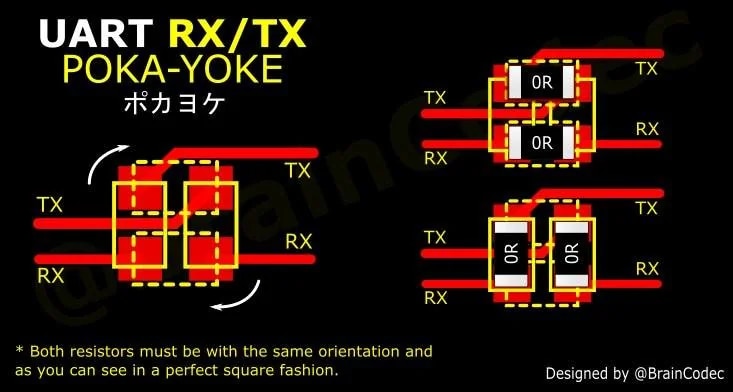
    Double check Tx & Rx pins on connectors

    • Cancel
    • Vote Up +5 Vote Down
    • Sign in to reply
    • Cancel
  • OwainM
    OwainM 1 month ago in reply to dougw

    That last one cost me months! In debugging why a custom shaped ESP32 board I'd designed wouldn't program, it turned out the connection between the USB to UART Bridge and ESP32 was connected Tx to Tx and Rx to Rx.

    • Cancel
    • Vote Up 0 Vote Down
    • Sign in to reply
    • Cancel
>
element14 Community

element14 is the first online community specifically for engineers. Connect with your peers and get expert answers to your questions.

  • Members
  • Learn
  • Technologies
  • Challenges & Projects
  • Products
  • Store
  • About Us
  • Feedback & Support
  • FAQs
  • Terms of Use
  • Privacy Policy
  • Legal and Copyright Notices
  • Sitemap
  • Cookies

An Avnet Company © 2026 Premier Farnell Limited. All Rights Reserved.

Premier Farnell Ltd, registered in England and Wales (no 00876412), registered office: Farnell House, Forge Lane, Leeds LS12 2NE.

ICP 备案号 10220084.

Follow element14

  • X
  • Facebook
  • linkedin
  • YouTube