

Table of contents

Abstract
I needed a way to test my Christmas tree lights, and I needed it NOW!
Project
This is a project I started last year... or maybe the year before, so I thought I'd post about it now that it's Christmas time again!
This is just so I can claim a participation ribbon for Hack the Holidays 2025 
(Maybe next year I'll build something a little more exciting again)
Basically what happened is that I had burnt out lights on my Christmas tree, and it was hard to tell which ones were the culprits as entire sections were dark. So I needed something to test the lights easily, and I didn't have time to wait for any online store to send me a proper tester, and there was no way I was going to venture out into the wilds at THIS time of year! This is the time of year when the Whos are at their most deceptive!
So I put together my own little testing doohickey.
Christmas lights in the strings on trees tend to be either 2.5v or 3v, so using 2 AA batteries in series gives just the right voltage.
I have the old most-likely-to-burn-out incandescent type and mine were 2.5v according to the box.
I used a little 2-AA battery holder I already had, and just popped in some slightly-used AA batteries so that the voltage would be a bit lower, close to the 2.5v mark.
I stuck it onto a small block of wood with some double-sided tape. In my case I used a little piece of 2x4 construction lumber. This just needs to be deep enough to allow a hole to be drilled to fit a little light bulb. The extra thickness of the 2x4 makes it nice and sturdy though.
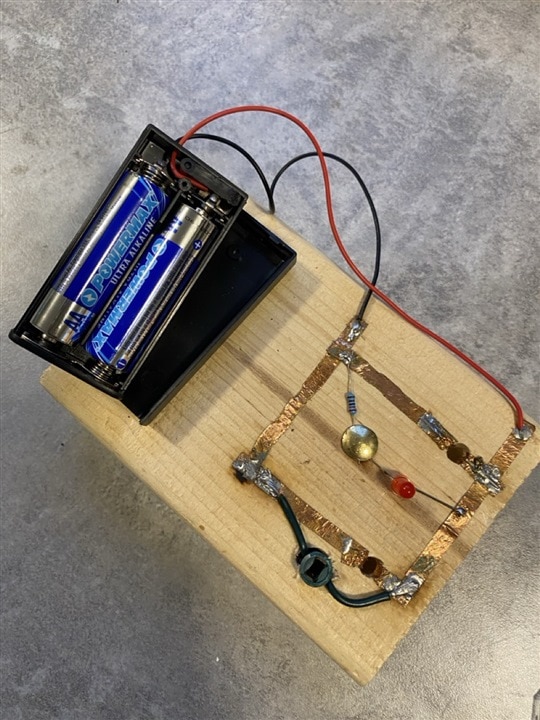
As you can see, I went through a few tries - my initial attempt was just to use copper tape to create a circuit, with holes drilled to fit the light bulb, and the copper tape runs into the edges of the holes so that a light bulb could just be touched to it to see if it was defective. That made it super easy - just run the tape and done! no soldering required... or so I thought.
However, I soon learned that setup did not work very well - it was hard to get good contact on the tape, plus the copper tape is thin and not very durable. And I really did need some soldering to get reliable connections between the pieces of copper tape.
I don't remember why I built it with 2 holes... not like I was able to test 2 at once... maybe I was hoping my wife would help?... maybe in case I broke one I'd have the backup? Or maybe because the first one was unreliable and I was testing another way - for that second hole I used the connecting bits from some broken female headers, hoping it would make a more solid connection... it did, but it was still not great.
I also ran into the issue of wondering whether the batteries were good, or if the battery box switch was turned on, so I added that little LED indicator light, with the required resistor, of course
Fun fact: copper push-pins are great for connecting components I think I did solder the bits together in this case. it's also easy to solder things to the top of the push pin.
And then the final step was to upgrade from the holes-with-copper-tape to an actual light socket. I cut a socket with short wires from an old burnt-out light string, and hooked it up as you see in the picture - I drilled a hole to hold it properly, and I cut the top off the socket so that I could just push the light onto it without the extra effort required of seating it fully.
Finally, that worked great - easy, reliable testing.
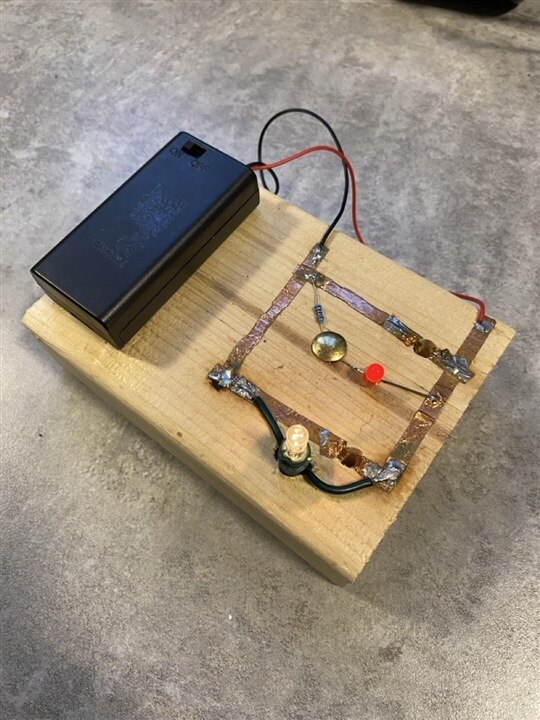
Above it shows a light that works.
Here is a quick video of me using it to test a light bulb.
Now there's a whole other story that goes along with this, involving exactly 400 lights being replaced, one by one, on the existing tree because my wife and I could not agree on a new tree to replace it when nearly ALL the lights on it died! In case you're curious, here's a summary: yes, it's possible; it's best to remove ALL the light bulbs first to make sure you don't miss any; if you want to colour match, you have to replace the bulb in each of the little bases; it's not too bad at first, but it hurts more with every light bulb that gets closer to that 400 mark; and yes, the tree is fully lit again!; and no, I will never try that again haha!
ps, on the old incandescent light strings you can actually use a non-contact circuit tester to find out at which point the string is no longer getting voltage supplied - it will beep up to that point, and hopefully that pin-points the suspect light bulb.
pps, I've also heard that fancy testers can just be plugged into the middle of the string to re-light all except the defective bulbs! whaat!!!??? I might need to buy one to be prepared for when that tree starts going dark again!
Happy Holidays, everyone!
-Nico